
Guiding LLMs to Truth: How CLATTER Elevates Hallucination Detection in High‑Stakes AI

Guiding LLMs to Truth: How CLATTER Elevates Hallucination Detection in High‑Stakes AI

Guiding LLMs to Truth: How CLATTER Elevates Hallucination Detection in High‑Stakes AI | RediMinds-Create The Future

Guiding LLMs to Truth: How CLATTER Elevates Hallucination Detection in High‑Stakes AI

Modern AI systems have a well-known hallucination problem: large language models (LLMs) sometimes generate information that sounds plausible but is completely unsupported by facts. In casual applications, a stray made-up detail might be harmless. But in high‑stakes environments like healthcare, emergency response, or financial operations, even one fabricated “fact” can lead to serious consequences. An LLM confidently asserting a nonexistent lab result to a physician, or inventing a false insurance claim detail, isn’t just an annoyance – it’s a liability. Ensuring AI outputs are grounded in truth has become mission-critical. This is where a new approach called CLATTER (Comprehensive Entailment Reasoning for Hallucination Detection) shines. Introduced in a June 2025 research paper, CLATTER guides LLMs through an explicit reasoning process to verify facts, drastically improving the accuracy of hallucination detection. It’s a breakthrough that holds promise for making AI reliable and transparent in the moments we need it most.

Hallucinations in LLM outputs can slip through without robust checking. In domains like healthcare, a fabricated detail in an AI-generated report or advice can have life-threatening implications, underscoring the need for reliable hallucination detection.

Guiding LLMs to Truth: How CLATTER Elevates Hallucination Detection in High‑Stakes AI | RediMinds-Create The Future

The High-Stakes Problem of AI Hallucinations

Deploying AI in high-stakes settings demands uncompromising factual accuracy. LLMs that hallucinate – i.e. produce factually incorrect or unsupported statements – pose a direct risk to trust and safety. Consider a few scenarios:

  • Healthcare & Emergency Medicine: Clinicians and physicians are increasingly using AI assistants for patient care, from summarizing medical records to suggesting diagnoses. In an emergency department, a hallucinated symptom or misinterpreted lab value in an AI-generated summary could mislead a doctor’s decisions. The result might be a critical treatment delay or an incorrect intervention. For healthcare leaders, patient safety and regulatory compliance hinge on AI systems that don’t fabricate facts. Robust hallucination detection offers a safety net – flagging unsupported content before it can influence clinical decisions.

  • Medical Claims Processing: Insurers and hospital administrators use AI to automate claims review and billing. A hallucination here might mean an AI system invents a procedure that never happened or misreads a policy rule. Such errors could lead to wrongful claim denials, compliance violations, or financial loss. By catching hallucinations in these back-office processes, organizations ensure accuracy in payouts and maintain trust with customers and regulators.

  • Enterprise & Back-Office Automation: Beyond healthcare, many industries employ LLMs to draft documents, analyze reports, or assist with customer support. Business leaders need these AI-generated outputs to be reliable. In domains like law or finance, a stray invented detail could derail a deal or breach legal obligations. Hallucination detection mechanisms give executives confidence that automated documents and analyses can be trusted, enabling broader adoption of AI in core operations.

  • AI/ML Professionals & Developers: For those building AI solutions, hallucinations represent a technical and ethical challenge. AI engineers and data scientists must deliver models that business stakeholders can trust. Techniques like CLATTER provide a blueprint for grounding LLM responses in evidence and making the model’s reasoning transparent. This not only improves performance but also makes it easier to debug and refine AI behavior. Ultimately, incorporating hallucination detection is becoming a best practice for responsible AI development – a practice AI/ML professionals are keenly aware of.

In each of these cases, the ability to automatically detect when an AI’s statement isn’t supported by reality is a game-changer. It means errors can be caught before they cause harm, and users (be they doctors, claims processors, or customers) can trust that the information they’re getting has been vetted for truth. Hallucination detection thus serves as critical assurance in any AI-driven workflow: it’s the layer that says, “we’ve double-checked this.” And as the complexity of AI deployments grows, this assurance is foundational for trustworthy AI.

Beyond Traditional NLI: How CLATTER’s Three-Step Reasoning Works

Until now, a common approach to spotting AI hallucinations has been to treat it as a natural language inference (NLI) problem. In a traditional NLI-based setup, you have the AI’s generated text (the “claim” or hypothesis) and some reference or source text (the “premise”), and an NLI model or an LLM is asked to decide whether the claim is entailed by (supported by) the source, or whether it contradicts the source, or neither. Essentially, it’s a one-shot true/false question: “Does the source back up this statement, yes or no?” This makes hallucination detection a binary classification task – simple in concept, but often tricky in execution. Why? Because a single complex claim can contain multiple facts, some true and some not, and an all-or-nothing judgment might miss subtleties. The reasoning needed to verify a claim can be quite complex (imagine verifying a detailed medical summary against a patient’s chart) – too complex to reliably leave entirely implicit inside the model’s black box of weights.

Guiding LLMs to Truth: How CLATTER Elevates Hallucination Detection in High‑Stakes AI | RediMinds-Create The Future

CLATTER changes the game by making the reasoning explicit. Rather than asking the model to magically intuit the answer in one step, CLATTER guides the model through a structured three-step process. At a high level, the model has to show its work, breaking the task into manageable pieces and finding evidence for each piece before concluding. This structured approach is inspired by “chain-of-thought” techniques that have let models solve complex problems by reasoning in steps, but here it’s applied to factual verification. The acronym CLATTER even hints at what’s happening: it stands for Claim Localization & ATTribution for Entailment Reasoning, emphasizing how the method zeroes in on parts of a claim and ties them to sources. Here’s how the three steps of CLATTER work:

1.Claim Decomposition: The LLM first decomposes the generated claim into smaller, atomic sub-claims (denoted $h_1, h_2, …, h_n$). Each sub-claim should capture a distinct factual element of the overall statement, and ideally, if you put them together, you reconstruct the original claim’s meaning. For example, if the AI said, “The patient’s blood pressure was 120/80 and they had no history of diabetes,” the model might split this into two sub-claims: (a) “The patient’s blood pressure was 120/80.” and (b) “The patient had no history of diabetes.” Each of these is simpler and can be checked individually. Decomposition ensures no detail is glossed over – it forces the AI to consider every part of its statement.

2.Sub-Claim Attribution & Entailment Classification: Next, for each sub-claim, the model searches the source or reference text for evidence that relates to that sub-claim. Essentially, it asks, “Can I find where the source confirms or refutes this piece of information?” If it finds a supporting snippet in the source (e.g., the patient’s record explicitly notes blood pressure 120/80), it marks the sub-claim as Supported. If it finds a direct contradiction (e.g. the record says the patient does have a history of diabetes, contradicting sub-claim b), it marks it as Contradicted. And if it can’t find anything relevant, it treats the sub-claim as Neutral (no evidence). This step is crucial – it’s the evidence-attribution step where the AI must ground each part of its statement in reality. The outcome is a collection of evidence-backed judgments for all the sub-claims, e.g., “(a) supported, (b) contradicted.”

3.Aggregated Classification: Finally, the model aggregates these individual findings to decide the status of the original claim as a whole. The rule CLATTER follows is intuitive: the entire claim is considered supported (true) only if every single sub-claim was found to be supported by the source. If any part lacks support or is contradicted, then the overall claim is not supported. In other words, one false sub-claim is enough to render the whole statement suspect. In our example, since sub-claim (b) was contradicted by the record, the model would conclude the overall statement is not supported – flagging it as a likely hallucination or factual error. This all-or-nothing aggregation aligns with a conservative principle: if an answer contains one fabrication among truths, it should not be trusted as factual. The CLATTER-guided model thus outputs a final verdict (hallucinated or not), and it has a trace of which pieces failed and why.

By forcing a step-by-step breakdown, CLATTER makes the LLM’s thought process more like that of a diligent investigator than a wild storyteller. Each sub-claim is a checkpoint where the model must justify itself with evidence, bringing much-needed granularity and rigor to the inference. This approach contrasts sharply with the traditional single-shot NLI classification. Instead of implicitly figuring everything out in one go, the model explicitly reasons through the claim, looking up proofs or refutations along the way. The benefit is a finer-grained analysis: rather than a blanket “yes, it’s supported” or “no, it’s not,” we get a breakdown of which parts are true and which aren’t, and a final decision based on that breakdown.

How CLATTER Boosts Accuracy and Trust

This structured reasoning isn’t just elegant – it’s effective. In experiments across multiple benchmark datasets (spanning domains like fact-checking, open-ended Q&A verification, and summary evaluation), CLATTER’s guided approach consistently outperformed the usual unguided NLI baseline. By thinking out loud through decomposition and attribution, models were better at spotting hallucinations in generated text. In fact, for advanced reasoning-focused LLMs, CLATTER improved hallucination detection accuracy by an average of 3.76 percentage points over the baseline method. This is a significant gain in the world of AI, where even a 1–2% improvement can be notable. CLATTER didn’t just beat the simplistic approach; it also edged out an alternative strategy that used a Q&A-style reasoning prompt, emerging as the top-performing method tested.

Guiding LLMs to Truth: How CLATTER Elevates Hallucination Detection in High‑Stakes AI | RediMinds-Create The Future

Why does CLATTER achieve better accuracy? The secret lies in grounding and granularity. By breaking claims into atomic facts and tying each fact to source material, the model’s decision becomes anchored in real evidence. As researchers noted, this process “fosters a more reliable assessment” because the model isn’t trying to holistically judge a complex statement all at once. Instead, it tackles one small truth at a time. This means fewer mistakes where the model might overlook a contradiction or get fooled by a partially true statement. The explicit sub-claim checks act like a series of filters catching errors that would slip through a coarse net. In essence, grounding the LLM’s reasoning in verifiable pieces makes its overall judgment far more reliable. The approach enforces a discipline: don’t say it’s true unless you’ve proven every part true.

There’s also a big side-benefit: transparency. With CLATTER, we don’t just get a yes/no answer about hallucination – we get a trace of the reasoning. We can see which sub-claim failed to find support, and even which source evidence was (or wasn’t) found for each point. This is hugely important for trust. In high-stakes settings, a doctor or an auditor might not blindly accept an AI’s verdict; they’ll want to know why the AI thinks something is unsupported. CLATTER provides that rationale by design. In fact, the researchers introduced special metrics to evaluate the quality of each intermediate step (like how sound the decomposition was, or whether the model found the correct evidence for each sub-claim), to ensure that the reasoning process itself was solid. The upshot: not only does CLATTER improve accuracy, it also makes the AI’s decision process more traceable and interpretable. Stakeholders can follow along the chain of reasoning, which is critical for adoption in fields that demand accountability. As one analysis noted, this method offers insight into how the LLM arrives at its conclusions, moving us beyond just a binary output to understanding the reasoning pathway. In other words, CLATTER doesn’t just give a verdict – it shows its work, which builds confidence that the system is doing the right thing for the right reasons.

From an industry perspective, these improvements in factual accuracy and transparency directly translate to greater trust in AI solutions. For example, in one of RediMinds’ own applied AI projects, our team combined LLMs with rule-based models to reduce hallucinations when auto-classifying documents. This hybrid approach significantly improved the trustworthiness and reliability of the system’s outputs. When the AI wasn’t sure, the deterministic logic stepped in, ensuring no unchecked “creative” answers slipped through. The result was an automated workflow that business users could depend on confidently, with near-perfect accuracy. This echoes the philosophy behind CLATTER: by injecting structure and checks into an LLM’s process, we can curb its tendency to improvise facts, thereby strengthening user trust. Our case study on overcoming LLM hallucinations in document processing showed that adding such grounding mechanisms not only slashed error rates but also gave stakeholders visibility into why the AI made each decision. The lesson is clear – whether through CLATTER’s entailment reasoning or other creative safeguards, guiding AI models with explicit reasoning steps yields more dependable results in practice.

Trustworthy AI and the Future of Responsible Automation

The advent of CLATTER is more than a niche research advance – it’s a harbinger of how we’ll build trustworthy AI systems moving forward. As organizations integrate AI into everything from patient care to financial auditing, the tolerance for unexplained errors is nearing zero. We stand at a point where responsible automation is not just a slogan but a strategic imperative. Techniques like CLATTER demonstrate that it’s possible to marry the power of LLMs (which are often black boxes) with the accountability of step-by-step reasoning. This has broader implications for AI governance, compliance, and ethical AI deployment. For instance, regulators in healthcare and finance are beginning to ask not just “what accuracy can your model achieve?” but also “how does it arrive at its answers, and can we audit that process?”. By embedding an explicit reasoning framework, we make auditing feasible – every conclusion can be traced back to evidence. In high-stakes use cases, this level of transparency can make the difference between an AI solution that gets approved for use and one that’s deemed too risky.

Guiding LLMs to Truth: How CLATTER Elevates Hallucination Detection in High‑Stakes AI | RediMinds-Create The Future

Moreover, CLATTER’s success underscores a mindset shift: bigger isn’t always better, but smarter often is. Rather than solely relying on ever-larger models or datasets to reduce errors, we can architect our prompts and workflows for better reasoning. It’s a reminder that how an AI is directed to solve a problem can be as important as the model itself. By strategically guiding the model’s reasoning, we’re effectively teaching it to think before it speaks. This paves the way for more innovations where grounding and reasoning techniques are layered on top of base AI models to ensure they behave responsibly. We expect to see many more such frameworks emerging, tailored to different domains – from legal AI that breaks down case law arguments, to scientific AI that checks each step of its hypotheses against literature. All share the common thread of making AI’s thought process more rigorous and transparent.

For leaders and innovators watching these developments, the message is empowering. We no longer have to accept AI as an inscrutable oracle that sometimes “makes things up.” With approaches like CLATTER, we can demand AI that proves its claims and remains grounded in truth. This builds a foundation for trustworthy AI adoption at scale. Imagine AI assistants that a hospital administrator can trust with summarizing patient histories because each summary is vetted against the source records. Or an automated claims system that an insurance executive knows will flag anything it isn’t fully sure about, preventing costly mistakes. Trustworthy AI turns these scenarios from risky bets to strategic advantages.

RediMinds embraces this future wholeheartedly. We believe that explicit reasoning and grounding must be core principles in AI solutions that operate in any mission-critical capacity. Our team has been actively following breakthroughs like CLATTER and incorporating similar insights into our own AI enablement projects. Whether it’s developing clinical decision support tools or intelligent automation for enterprises, our approach is to combine cutting-edge models with layers of verification, transparency, and control. It’s this blend of innovation and responsibility that defines responsible automation. And it’s how we help our partners deploy AI that is not only intelligent, but also reliable and auditable.

As a result, RediMinds is uniquely positioned as a thought leader and AI enablement partner for organizations navigating this new landscape. We’ve seen first-hand – through our research and case studies – that fostering trust in AI yields tangible benefits: better outcomes, higher user adoption, and reduced regulatory risk. By sharing insights on advances like CLATTER, we aim to lead the conversation on trustworthy AI and guide our clients in harnessing these innovations effectively. (For more on how we tackle real-world AI challenges, explore our ever-growing library of case studies and expert insights on applying AI across industries.)

Guiding LLMs to Truth: How CLATTER Elevates Hallucination Detection in High‑Stakes AI | RediMinds-Create The Future

A Call to Action: Building a Future on Trust and Innovation

Hallucinations in AI don’t have to be the nightmare they once were. Techniques like CLATTER show that with the right strategy, we can demand more from our AI – more accuracy, more honesty, more accountability. It’s an exciting time where problems that seemed inherent to AI are being solved through human creativity and collaboration between researchers and industry. Now is the time for action: for leaders to insist on transparency in the AI they deploy, for clinicians and front-line professionals to advocate for tools that are verified and safe, and for AI builders to embed these principles into the next generation of intelligent systems.

At RediMinds, we are passionate about turning these principles into practice. We invite you to join us on this journey. Imagine an AI-powered future where every recommendation comes with evidence, and every automation is designed for trust – this is the future we’re building towards. Whether you’re a healthcare executive, a physician, or a technology leader, you have a stake in ensuring AI is done right. Let’s start the conversation. Reach out to us, engage with our team on social media, or schedule a discussion about how responsible, grounded AI can unlock new possibilities for your organization. Together, we can create a future where innovation and trust go hand in hand – a future where AI not only sounds intelligent, but truly earns our confidence every day.

Connect with RediMinds to learn how we can help you leverage cutting-edge AI with confidence. Let’s build the next era of intelligent, transparent, and life-changing solutions – safely and responsibly, together.


How Meta-Prompting and Role Engineering Are Unlocking the Next Generation of AI Agents

How Meta-Prompting and Role Engineering Are Unlocking the Next Generation of AI Agents

How Meta-Prompting and Role Engineering Are Unlocking the Next Generation of AI Agents | RediMinds-Create The Future

How Meta-Prompting and Role Engineering Are Unlocking the Next Generation of AI Agents

Introduction

AI has entered a new era of intelligent agents that can carry out complex tasks autonomously. The secret sauce behind these next-gen AI agents isn’t just bigger models or more data – it’s smarter prompts. Recent advances in prompt engineering – from hyper-specific “manager” prompts to meta-prompting where AI optimizes its own instructions – are dramatically boosting what AI agents can do. By carefully crafting the roles, structures, and self-improvement loops in prompts, developers are unlocking more reliable and auditable AI behaviors. This post dives deep into these cutting-edge techniques and explores how they’re applied in the real world, from automating enterprise support to streamlining healthcare operations. We’ll also highlight emerging insights at the intersection of AI governance, interpretability, multi-agent coordination, and workflow design.

The goal is to give you a comprehensive look at how meta-prompting and role engineering are enabling AI systems that act less like disembodied chatbots and more like trustworthy autonomous agents. Let’s explore the techniques driving this transformation.

Cutting-Edge Prompt Engineering Techniques

Modern prompt engineering has become an almost programmatic discipline – today’s production prompts often span multiple pages of structured instructions rather than a single sentence query. Below we break down the most impactful techniques turning plain language models into powerful task-solving agents:

1. Hyper-Specific Prompts (The “Manager” Approach)

One key strategy is to make prompts hyper-specific and detailed, leaving nothing to ambiguity. Think of this as the “manager approach,” where the prompt acts like a project manager giving an employee explicit instructions for every step. Instead of a short request, the AI is given a clear goal, extensive context, and a detailed breakdown of what’s expected. The best AI startups have learned to write prompts that read more like specification documents or code rather than casual prose. For example, a customer support agent prompt might include a full step-by-step plan, decision logic, and even conditional branches for different scenarios. In fact, the AI support platform Parahelp built a prompt so exhaustive that it spans six pages, explicitly instructing the agent how to handle various ticket outcomes and tools to use. This level of detail ensures the model isn’t guessing – it knows exactly the procedures to follow, much like a well-briefed manager guiding their team. As a result, the agent’s outputs become far more consistent and on-policy, which is crucial for enterprise deployments.

To illustrate, Parahelp’s internal “manager prompt” clearly delineates the plan for resolving a support ticket, down to the format and content of each step. It even defines an XML-like structure for actions and includes <if_block> tags for conditional steps. By treating the prompt as a mini program, with explicit sections for goals, constraints, and conditional logic, the AI agent can execute tasks systematically. Studies have found that providing long, structured prompts dramatically improves an AI’s ability to follow complex instructions without deviation. In essence, hyper-specific prompts turn a general LLM into a specialized problem-solver by pre-loading it with domain expertise, stepwise plans, and guardrails before it even begins answering. This manager-style prompting is raw and intensive – often hundreds of lines long – but it unlocks insanely powerful performance gains in real-world agent tasks.

2. Role Prompting (Persona Anchoring)

Another powerful technique is role prompting – assigning the AI a specific persona or role to anchor its tone and behavior. By prefacing a prompt with “You are a customer support agent…” or “Act as a senior software engineer reviewing code…”, we calibrate the model’s responses to the desired style and domain knowledge. This persona anchoring focuses the AI on what matters for the task. For instance, telling the model “You are a compliance officer assisting with a policy review” will encourage it to respond with the thoroughness and formality of an expert in that field, rather than a generic chatbot. Role prompting essentially loads a contextual mindset into the model.

Clear personas lead to better alignment with the task at hand. As one AI practitioner noted, “telling the LLM it’s a customer support manager calibrates its output expectations” – the model will naturally adopt a more empathetic, solution-oriented tone suitable for customer service. Likewise, a model told it is a financial analyst will frame its answers with appropriate caution and use financial terminology. This technique can also narrow the model’s knowledge scope: a medical assistant persona will stick to medical advice and reference clinical guidelines if instructed, reducing off-topic tangents. Role prompts thereby act as anchors, guiding both what the AI says and how it says it. They are especially useful in enterprise settings where responses must align with company voice or regulatory requirements. While recent research debates how much personas improve factual accuracy, in practice many teams find that well-crafted roles yield more trustworthy and context-appropriate outputs. The key is to be specific about the role’s duties and perspective, effectively teaching the AI “here’s your job.” Used wisely, persona anchoring builds consistency and reliability into AI agent interactions.

How Meta-Prompting and Role Engineering Are Unlocking the Next Generation of AI Agents | RediMinds-Create The Future

3. Step-by-Step Task Breakdown

Complex tasks are best handled when broken into simpler subtasks. Step-by-step prompting, often called chain-of-thought, guides the AI to tackle problems through a logical sequence of steps rather than trying to produce an answer in one leap. By instructing the model “Let’s solve this step by step” or by explicitly enumerating steps in the prompt format, we force the AI to externalize its reasoning process. This yields more coherent solutions, especially for multi-faceted problems like troubleshooting technical issues or analyzing business strategies.

In practice, prompt engineers often include an outline of steps or ask the model to generate a plan first. For example, a support agent AI might be prompted: “First, summarize the user’s issue. Next, identify any relevant policies. Then list potential solutions, and finally draft a response.” By receiving this scaffold, the LLM is far less likely to skip important elements. It will produce an answer that visibly follows the requested structure (e.g. a numbered list of steps, followed by a final answer). This not only improves completeness but also makes the agent’s process transparent. In the Parahelp support agent example, their planning prompt literally begins by stating “A plan consists of steps” and then instructs how to create each step (action name, description, goal). The model must first output a <plan> with a series of <step> elements, each detailing an action like searching a knowledge base or replying to the user, possibly nested inside conditionals. Only after the plan is formulated does the agent execute those steps. This method echoes good human problem-solving: outline the approach before diving into action. By walking the AI through the task, we reduce errors and omissions. Step-by-step breakdown is especially critical in domains like engineering and healthcare where reasoning transparency and rigor are necessary – it ensures the AI agent doesn’t take mental shortcuts or make unexplained leaps.

4. Markdown/XML Structuring for Output

Leading teams are also structuring prompts and responses with machine-readable formatting like Markdown or XML to enforce clarity. Instead of asking for a free-form answer, the prompt might say: “Provide the output in the following JSON format with fields X, Y, Z” or embed instructions in XML tags that the model must use. This yields outputs that are easy to parse, validate, or feed into other systems. It’s akin to giving the AI a form to fill out, rather than a blank page. By structuring the expected output, we constrain the model’s freedom in productive ways – it can focus on content, not format, and we get predictable, well-formatted results.

This technique leverages the fact that modern LLMs have been trained on a lot of code and markup, so they’re surprisingly adept at following syntax rules. Y Combinator mentors observed that startups like Parahelp include instructions in XML within their prompts, making them look more like code than plain English. The prompt essentially contains a schema for the answer. For example, an AI agent’s plan might be required to be output as XML <plan> with nested <step> tags, as we saw above, or a documentation summary might be mandated to use specific Markdown headings. By encoding logic in these structures, prompt designers tap into the model’s latent programming capability. One benefit noted by Parahelp’s team was that using XML with <if_block> tags not only made the model follow logical branches more strictly, but also let them easily parse the agent’s output for evaluation. Structured output can thus double as a logging or verification mechanism.

Moreover, structured prompting helps manage complexity. A prompt can include an XML template with placeholders that the model must fill, ensuring no section is skipped. This is particularly useful in compliance reviews or document generation where the output must contain specific sections in order. By having the AI produce a formatted draft (say, an XML that an external program can read), organizations get both consistency and an automated way to check the content. In short, adding a layer of syntax and formatting discipline in prompts significantly boosts reliability. It transforms an AI agent’s output from a loose paragraph into a well-defined artifact that fits into pipelines and can be programmatically validated.

5. Meta-Prompting (LLMs Optimizing Their Own Prompts)

Perhaps one of the most exciting developments is meta-prompting – using an LLM to improve its own instructions. Instead of humans manually fine-tuning prompts through trial and error, we can ask the model itself to critique or refine its prompts. In other words, the AI becomes a co-pilot in prompt engineering. This can take several forms. One approach is to feed the model some examples where its response was flawed, and prompt it with “Based on these failures, how should we change the instructions?”. The model might then suggest a more precise prompt or additional constraints to add. Another approach is iterative: have the model generate a draft prompt for a task, test it on some queries, then ask the model to self-reflect and improve the prompt wording to fix any issues observed.

How Meta-Prompting and Role Engineering Are Unlocking the Next Generation of AI Agents | RediMinds-Create The Future

Y Combinator calls this concept a game-changer: “Metaprompting is the unlock – instead of hand-tuning prompts, use the LLM itself to improve the prompt”. Essentially, the AI agent can enter a loop of self-optimization. For instance, if an agent fails on a certain edge case, a meta-prompt can instruct the agent to analyze why it failed and rewrite its own instructions or plan accordingly. Some cutting-edge systems even chain two instances of the model: one as the “worker” doing the task and another as the “prompt coach” giving feedback and adjusting the worker’s prompt in real-time. This self-referential prompting dramatically accelerates prompt iteration. It’s like having the AI be both the student and the teacher – learning from its mistakes on the fly.

Real-world examples are emerging. The code-analysis agent Jazzberry shared that one of the most effective ways to get better results was to use an LLM to help generate the prompts themselves. In their workflow, they might prompt GPT-4 with something like: “Here’s an example where the bug-finding prompt fell short. How can we refine the instructions to cover this case?” The model, drawing on its vast training data of prompts and patterns, can propose new prompt phrasing or logic. Over time, this yields highly refined prompts that a human alone might not have conceived. Meta-prompting thus allows AI systems to adapt and improve without an army of prompt engineers – the model becomes its own prompt engineer, optimizing the very instructions that govern it.

6. Prompt Folding for Dynamic Sub-Prompts

Related to meta-prompting is the idea of prompt folding, which is about prompts that expand into more prompts. In a multi-step AI agent, a single high-level prompt can trigger the generation of specialized sub-prompts for each step of a task. Think of it as unfolding a plan: the initial prompt asks the model to devise whatever sub-instructions are needed and then execute them. This technique helps manage complex workflows by delegating parts of the problem to dedicated prompts created on the fly.

Prompt folding essentially lets one prompt contain the seeds of many. For example, a top-level prompt might instruct: “Break down the user’s request into a series of actions, and generate a specific prompt for each action.” The model first outputs a structured plan and for each step, it might internally create a new prompt (possibly calling itself recursively with that prompt). This approach was highlighted in discussions of advanced AI agents: “Prompt folding lets one prompt trigger generation of deeper, more specific prompts. [It] helps manage workflows in multi-step AI agents.”. In practice, this could mean an AI agent faced with a broad goal (like “resolve this support ticket”) will internally spawn prompts like “search the knowledge base for X” and “formulate a response about Y” without human intervention in between. Each sub-prompt is tailored to its sub-task, which improves the quality of that step’s output.

Another aspect of prompt folding is using the model’s outputs from one stage as input prompts to itself at the next stage – effectively chaining prompts together dynamically. This has been used to great effect in tool-using agents: the AI plans a series of tool calls by generating the command (as text) it needs, then that text is fed back in as a prompt to execute the tool and gather results, which the agent then uses to decide the next prompt, and so on. In Jazzberry’s bug-finding agent, for instance, the system forms a plan to run certain tests, executes them, then feeds the results back to update its strategy, iteratively zeroing in on bugs. Prompt folding enables this dynamic prompt generation and refinement cycle. It’s a powerful way to handle tasks that aren’t fully known upfront – the AI can “decide what to ask itself next” at runtime. The end result is an agent that behaves more flexibly and autonomously, stitching together multiple context-specific prompts to complete a complex job.

7. Escape Hatches and Uncertainty Admission

A recurring challenge with AI models is their tendency to hallucinate – to confidently make up an answer when they don’t actually know something. Advanced prompt engineers have developed a remedy: escape hatches in the prompt that explicitly permit the AI to admit uncertainty or defer an answer. Essentially, the prompt says “if you’re not sure or lack information, do X instead of guessing.” This could mean instructing the model to say “I don’t have enough information to safely answer that” or to escalate the query to a human. By building such escape clauses into the prompt, we give the model permission to be honest about its limits, which greatly improves trustworthiness.

In top AI agent designs, “escape hatches instruct LLMs to admit uncertainty”, which “prevents hallucination and improves trust”. Rather than forcing an answer at any cost, the prompt might include a rule like: “If the user’s query is unclear or the data is insufficient, respond with a clarifying question or indicate the need for further info.” This approach is crucial in high-stakes domains. For example, a medical AI agent would be prompted with something like: “If you are not confident due to lack of data, do not fabricate an answer. Instead, respond that the information is incomplete or suggest seeking expert advice.” By doing so, the agent avoids potentially harmful conjectures. In enterprise knowledge bases, an escape hatch might trigger the AI to fetch more data (if integrated with a retrieval tool) or simply say it will follow up.

Building uncertainty admission into prompts aligns AI behavior with how a prudent human expert would act – by acknowledging doubt when appropriate. It’s also a form of governance: it ensures the AI stays within its safety bounds. Notably, including these instructions often needs to be very explicit and even repetitive across the prompt. Prompt designers sometimes insert multiple reminders like “Never pretend to know information you don’t explicitly have. It’s okay to say you’re unsure.” The result is an agent that errs on the side of caution. Users have a better experience when an AI says “Let me gather more details” rather than giving a wrong answer confidently. In sum, escape hatches are a simple but effective prompt engineering tool to curb hallucinations and build user trust in AI outputs.

How Meta-Prompting and Role Engineering Are Unlocking the Next Generation of AI Agents | RediMinds-Create The Future

8. Reasoning Traces and Debug Visibility

Transparent reasoning is not just nice-to-have – it’s becoming a requirement for complex AI agents. Reasoning traces (also known as thought traces or model reasoning logs) involve prompting the AI to “show its work” as it arrives at an answer. This can be done by instructing the model to output its intermediate reasoning steps (either in a hidden format or as part of the answer). For instance, a prompt might say: “Provide a step-by-step rationale for your conclusion (this will be used for internal verification before you give the final answer).” The model will then generate a reasoning log which can be reviewed or parsed by another system, before optionally presenting the final answer to the user.

Exposing the model’s internal logic is essential for troubleshooting and iteration. When an AI agent can provide a trace of why it did what it did, developers or even other AI “judge” agents can inspect those traces to catch errors or refine the process. Imagine an AI agent that’s diagnosing a network outage; alongside its recommendation, it outputs a hidden Markdown section listing the clues it considered and the chain of logic leading to the diagnosis. If the conclusion is wrong, an engineer can see where the agent’s reasoning went astray. This visibility greatly speeds up debugging of prompt logic and model behavior – you’re no longer in the dark about how the AI made a decision.

Reasoning traces also feed into better model governance. They provide a level of interpretability that’s crucial in regulated domains. Financial or medical AI systems, for example, could log their reasoning in a structured way so that auditors can later verify that the AI’s decision followed compliant procedures. Some advanced setups use a second AI to read the first AI’s reasoning trace and check for compliance or errors, forming an automated QA layer. A prominent benefit here is catching mistakes early: if an AI agent is about to take a faulty action, a peek into its thought process (by either a human or another AI) can alert the team to intervene. As one summary put it, incorporating “thinking traces and debug info” makes the agent’s decision process transparent and “essential for troubleshooting and iteration”. In practice, enabling reasoning traces might be as straightforward as adding “Show your reasoning step by step” to the prompt. The key is to strike a balance between detail and brevity so that the traces are useful but not overwhelming. When done well, reasoning traces turn AI agents into glass boxes rather than black boxes, which is invaluable for building trust and refining their performance.

9. Evals: Prompt Test Cases and Metrics

The mantra in modern prompt engineering is “If you can’t measure it, you can’t improve it.” This is where evals – systematic prompt evaluations – come into play. Rather than crafting a prompt and hoping for the best, top teams create prompt test suites: diverse sets of input scenarios (including edge cases and tricky queries) against which they continually test the AI’s responses. These evals are essentially unit tests for prompts. By running a prompt through hundreds of test cases, engineers can see where the agent succeeds or fails and iterate accordingly.

In fact, prompt evaluations have become so critical that some say “prompt test cases are more valuable than prompts themselves”. A well-designed eval suite can benchmark an AI agent’s reliability and robustness before it ever faces real users. For example, a customer support AI might be tested on a range of ticket types – straightforward questions, angry customers, ambiguous requests, compliance-related queries, etc. – to ensure the prompt handles each appropriately. If the agent goes off-script or produces a wrong answer in these tests, the prompt is revised and tested again. Over time, the prompt is honed to pass all the test cases, giving high confidence it will perform well in production.

Parahelp’s team described spending hundreds of hours optimizing just a few hundred lines of prompt – and most of that time was spent devising how to evaluate them, finding edge cases, testing in the real world, and iterating on learnings. In other words, writing the prompt was only 10% of the work; the other 90% was running evaluations and refining. By treating prompts like software that needs QA, they could steadily raise their agent’s ticket resolution success rate. Evals also help catch regressions – if a change in the prompt improves one scenario but worsens another, the test suite will reveal it. Moreover, having quantitative metrics (like “% of test cases passed” or specific accuracy scores) turns prompt engineering from art to science. It enables data-driven improvement and comparison of different prompt strategies.

In summary, rigorous evals are now a cornerstone of prompt engineering best practices. They ensure that an AI agent not only works on the examples we thought of, but also stays reliable under the countless variants that real-world users might throw at it. Especially for edge cases or high-risk failure modes, these prompt test cases are the safety net that guides continual refinement. If you’re building an AI agent, investing in evaluations and a feedback loop for prompt updates is essential for achieving enterprise-grade performance.

10. Big-Model Prompt Crafting and Distillation to Smaller Models

There is a practical dilemma in deploying AI agents: the most advanced prompting techniques often rely on very large models (like GPT-4) to get best-in-class results, but those models can be expensive or too slow for production scale. The emerging solution is a two-stage approach: use the “big” model to craft the ideal behavior, then distill that into a smaller model that’s cost-effective for deployment. In other words, leverage the power of a top-tier model during development and testing, and once you’ve perfected the prompts and behavior, transfer that knowledge to a lighter model via fine-tuning or other distillation methods.

A recent insight from Y Combinator circles encapsulated this: “Use big models for prompt crafting, then distill for production on smaller, cheaper models.”. During the R&D phase, prompt engineers will often prototype with something like GPT-4 because it’s more capable of following complex prompts (for instance, handling the multi-step plans and conditional logic we described). They’ll push GPT-4 to its limits with elaborate prompts and get an optimal pattern of responses. Once they have that, they can generate a large dataset of input-output examples using the big model acting under those prompts. This dataset then serves as training material to fine-tune a smaller model (say, a 6B-parameter open-source model or a distilled version of GPT-3.5) to mimic the behavior. Essentially, the smaller model learns from the big model’s demonstrations and reasoning.

The outcome is an AI agent that approximates the intelligence of the huge model but runs at a fraction of the cost. This is how startups are closing seven-figure deals with AI products without bankrupting themselves on API calls – they capture the “prompted IQ” of a big model into a custom model they control. It’s important to note that this distillation isn’t perfect; the smaller model might only achieve, say, 90% of the big model’s performance on evaluations. But if that’s within acceptable range, the cost savings and latency improvements are well worth it. There’s also a middle ground: keep the big model in the loop for the hardest cases and let the small model handle the routine ones, a form of ensemble agent approach.

This big-to-small pipeline also has a governance benefit: by the time you distill, you’ve thoroughly tested the prompts and behaviors with the big model, so you have a clear expectation of what the AI should do. The smaller model can be evaluated on the same prompt test cases to ensure it meets the bar. In effect, the large model serves as an oracle and teacher, and the small model becomes the workhorse embedded in the product. As AI pioneer Garry Tan noted, this strategy of crafting with big models and deploying smaller ones is enabling startups to deliver advanced AI solutions that are both scalable and economically feasible.

These ten techniques – from persona anchoring to prompt folding, from escape hatches to self-evaluating loops – are collectively unlocking a new class of AI agents. They transform how we interact with LLMs: instead of one-shot prompts yielding one-shot answers, we now have persistent, reliable agents that can manage multi-step workflows, handle uncertainty, explain themselves, and continually improve. Next, let’s look at how these innovations are being put to use in real-world scenarios across different sectors.

Real-World Applications Across Sectors

Advanced prompting and role engineering aren’t just academic exercises; they’re driving tangible impact in industry. AI agents built with these techniques are tackling tasks that once required significant human effort and domain expertise. Let’s explore a few key sectors and use cases:

Enterprise Operations (Customer Support, Documentation, Compliance)

In the enterprise, AI agents are becoming valuable “colleagues” handling labor-intensive knowledge tasks. Customer support is a flagship example. Companies are deploying AI support agents that can resolve customer tickets end-to-end, thanks to carefully engineered prompts that guide the agent through troubleshooting steps, tool usage, and policy compliance. The startup Parahelp, for instance, has built an AI support agent that uses a complex prompt (including the planning logic we saw earlier) to autonomously handle support inquiries. They measure success by the percentage of tickets the AI resolves without human intervention. By iterating on prompts and adding domain knowledge, Parahelp’s agent can look up solutions in help center articles, ask clarifying questions, and craft a reply – all in a single workflow. The result is faster response times and support teams freed from repetitive queries.

Enterprise documentation is another area being transformed. AI writing assistants with role prompts (e.g. “You are a technical writer for our company’s knowledge base”) can draft process documentation, user manuals, or internal wikis by intelligently synthesizing information from various sources. They follow structured templates mandated in the prompt – for example, always starting with an executive summary, then a bulleted list of key points, then detailed sections. By including formatting instructions (like Markdown headings for each section) in the prompt, companies ensure the AI’s output slots directly into their documentation systems. This reduces the editing overhead and maintains consistency across hundreds of documents.

Compliance reviews and report generation in regulated industries also benefit. Consider a financial services firm that needs to produce a summary of how a new regulation impacts their operations. An AI agent can be prompted with a role like “You are a compliance analyst,” given the text of the regulation and internal policy documents, and then asked to produce an analysis highlighting key points, required changes, and any uncertainties. Thanks to step-by-step prompting, the agent would methodically go through each clause, compare it with company practices, and even flag areas where legal input might be needed (using escape-hatch instructions to avoid definitive statements if unsure). By structuring the output (perhaps an enumerated list of compliance gaps and recommended actions), the AI’s report is immediately actionable. Enterprises are finding that such agents can handle “first pass” compliance reviews or risk assessments, greatly accelerating what was once a slow manual process. And because these prompts can require the AI to cite sources or provide reasoning traces, the human experts reviewing the AI’s work can quickly verify its conclusions.

In all these enterprise cases, the common thread is intelligent operations: AI agents embedded in workflows to handle knowledge-centric tasks with a high degree of autonomy. They serve as force-multipliers for teams, working 24/7 and scaling up during peak demand. Importantly, the advanced prompt techniques (roles, structured outputs, uncertainty admission) give business leaders confidence that these agents will behave in predictable, auditable ways, which is critical for adoption in corporate environments.

Engineering Workflows (Code Pipelines, Issue Resolution)

Software engineering is another domain seeing the rise of AI agents, often as copilots to developers or maintainers. AI agents managing code pipelines can automate tasks like code review, testing, and bug-finding. For example, imagine an AI agent that watches every new pull request in a codebase. The moment a PR is opened, the agent (with a persona of a “code reviewer and tester”) springs into action: it uses tools to check out the code, run the test suite, maybe generate additional targeted tests, and then outputs a report on potential bugs or stylistic improvements.

How Meta-Prompting and Role Engineering Are Unlocking the Next Generation of AI Agents | RediMinds-Create The Future

This is not science fiction – the YC-backed startup Jazzberry has built exactly such an AI bug-finding agent. When a PR is made, Jazzberry’s agent clones the repository into a sandbox, analyzes the code changes, and even executes commands to run tests or search the codebase. Its prompt is engineered to decide which tests to run or what scenarios to simulate, effectively exploring the code’s behavior. The results of each test (fed back into the agent) inform the next steps – this is prompt folding and meta-prompting in action, creating a loop where the agent refines its own strategy to pin down bugs. Finally, it reports any discovered issues as a neatly formatted markdown table in the PR comments. This greatly accelerates the QA process: developers get immediate feedback on potential bugs before code is merged, catching problems that might have slipped past manual review. By using an AI agent with a well-defined role (an tireless QA engineer) and a robust prompt, teams see fewer production errors and can iterate faster.

AI agents are also aiding in issue resolution and DevOps. Consider an incident response scenario: a monitoring system flags an unusual spike in server errors at 2 AM. Instead of waking an engineer, an AI agent could be triggered. With a prompt that provides it with recent logs and the instruction “You are a site reliability engineer. Diagnose the issue step-by-step and suggest potential fixes,” the agent could parse error messages, correlate with recent deployments (via tool APIs), and even attempt safe remediation steps. It might output something like: “Step 1: Noticed all errors contain Database timeout. Step 2: Queried recent config changes; a new database connection string was deployed. Step 3: Suspect a misconfiguration causing connection pool exhaustion. Recommended fix: roll back the config change or increase the pool size.” Such an agent essentially acts as a first-responder, narrowing down the issue so that the human on-call can quickly execute the fix. The step-by-step reasoning trace in its output would allow the engineer to trust (or verify) the analysis.

Another emerging use is AI agents handling the grunt work of code migration or refactoring. With prompt engineering, you can create an agent persona like “legacy code modernization assistant” that goes through a codebase module by module, explains what it does (reasoning trace), and then suggests updated code or libraries. By giving it access to documentation and specifying an output format (for instance, an annotated diff), developers can accelerate large-scale refactoring with the AI doing the heavy lifting under supervision.

How Meta-Prompting and Role Engineering Are Unlocking the Next Generation of AI Agents | RediMinds-Create The Future

Crucially, healthcare AI agents must be developed with governance and oversight in mind (more on that in the next section). The prompts often contain explicit instructions about adhering to ethical guidelines, patient privacy, and when to defer to a human professional. By weaving these policies into the persona and logic of the agent, organizations can deploy AI in healthcare workflows with greater confidence that it will act as a responsible assistant, not a rogue actor. The payoff is substantial: when done right, these AI agents can drastically cut down administrative burdens (which currently eat up a huge chunk of healthcare costs) and let healthcare workers focus more on patient care.

Finance and Other Regulated Domains

While not explicitly enumerated in the earlier list, it’s worth noting that financial services, legal, and other regulated industries are similarly leveraging meta-prompting and role-engineered agents. In finance, for instance, banks are experimenting with AI agents to automate parts of fraud detection, trading compliance, and client communications. A wealth management firm might have an AI agent generate first-draft portfolio review letters for clients, with a persona of a “financial advisor” and strict markdown templates for sections like performance summary, market outlook, and personalized advice (reviewed by a human advisor before sending). The agent’s prompt will include compliance rules such as “do not promise returns, include the standard risk disclaimer, and if uncertain about a recommendation, escalate for human review.” This is essentially all the techniques combined: role (advisor), structured output (letter template), escape hatch (don’t fabricate or promise), and even self-checking (the agent might append a hidden note if it feels a compliance check is needed).

In legal domains, AI agents can help parse through regulations or case law. A law firm might deploy an AI “research clerk” agent: when given a legal question, it splits the task into steps (find relevant cases, summarize each, then draft an analysis), uses chain-of-thought prompting to do so, and presents an answer with citations. The prompt here would lean heavily on markdown structuring (so the output has sections for Facts, Issues, Conclusion, References) and uncertainty admission (better to say “no precedent found for X” than to misstate the law). These agents must be monitored, but they dramatically speed up the research phase for lawyers.

Across all regulated sectors, a pattern emerges: multi-agent systems are often employed, where one agent generates or analyzes content and another agent (or set of rules) evaluates it for compliance and accuracy. This can even be done in a single prompt – e.g., “First draft an answer, then critique that answer for any policy violations or errors, and output both.” By explicitly prompting the AI to double-check itself, we double the safety net. Some companies use separate models for this: a big model might draft, and a distilled smaller model might judge, following a checklist provided via prompt.

What’s clear is that the thoughtful design of prompts and roles is enabling AI to operate in domains where reliability and accountability are non-negotiable. Businesses are no longer treating prompts as a casual afterthought; they recognize prompt engineering as a core competency for deploying AI agents that can truly augment their operations.

The Next Frontier: Governance, Interpretability, and Multi-Agent Orchestration

As organizations embrace these advanced AI agents, they’re also encountering new strategic questions. Crafting brilliant prompts is one piece of the puzzle – governing and integrating these AI agents into real-world workflows is the next. Here are some forward-looking insights at the intersection of prompt engineering and AI operations design:

  • AI Governance and Policy Embedding: With AI agents taking on more autonomy, companies must establish governance frameworks similar to managing human employees. This means setting boundaries on what an AI agent can and cannot do, and embedding those policies directly into prompts. For example, a bank’s AI advisor agent will have prompt clauses that enforce regulatory compliance (like always generating required disclosures) and ethical limits (like not advising on areas outside its purview). Governance also involves monitoring – using those reasoning traces and evals we discussed as a form of audit trail. There’s a growing practice of having “digital handrails” around agents: if an agent is about to exceed a risk threshold (detected via prompt-based self-checks or external rules), it must trigger an “escape hatch” and involve a human. By designing prompts that include such escalation paths, we ensure AI agents remain under human-in-the-loop control even as they operate independently. The key insight is that effective AI governance starts in the prompt – by aligning the AI’s objectives with organizational values and rules from the get-go.

  • Interpretability and Transparency as First-Class Goals: It’s no longer enough for AI agents to get the right answer; stakeholders need to know why and how. This is driving a focus on interpretable AI agents, where every step and decision can be traced. Techniques like reasoning traces and structured outputs are serving a dual purpose: they make the agent’s inner workings visible not just for debugging, but for explaining outcomes to end-users and regulators. In healthcare, for instance, an AI that assists in diagnosis might produce a reasoning log that can be shown to clinicians to justify its suggestions, increasing their trust in the tool. In finance, an AI audit agent might highlight exactly which transactions triggered a red flag and on what basis. By prioritizing transparency in prompt design (e.g., instructing the model to explain its reasoning or cite sources), we’re creating AI agents whose decisions can be validated and trusted. This interpretability will be crucial if, say, a regulator questions an AI-driven decision – the evidence must be readily available.

  • Multi-Agent Systems and Workflow Design: Many believe the future lies not in one monolithic AI but in swarms of specialized AI agents collaborating. We’re already seeing early signs: an agent for planning, another for execution, another for verification, all coordinating via well-defined prompts. Designing these multi-agent workflows is both an art and a science. Prompts must be crafted not only for each agent’s individual task, but also for the protocol of communication between agents. For example, one agent might output a summary that another agent uses as input – so the format and content need to be agreed upon (much like APIs between software services). Engineers are experimenting with using XML/JSON structures as a lingua franca between agents, as it provides clear slots for information (one agent’s output becomes the next agent’s prompt context in a structured way). A critical insight here is workflow resilience: if one agent hits an escape hatch (uncertainty) or fails a step, how does the system recover? Teams are building fallback prompts and supervisor agents that monitor the overall process. Essentially, we’re applying principles of distributed systems design to AI agents – ensuring redundancy, clarity of interfaces, and fail-safes. The reward is multi-agent systems that can handle very complex jobs (like the entire prior authorization we discussed, or end-to-end customer service across chat, email, and phone) by dividing and conquering tasks. This modularity also makes it easier to upgrade pieces – you could swap in a better “planner” agent later without redoing the whole system.

  • AI in Human Workflows – Augmentation, Not Replacement: Strategically, the organizations succeeding with AI agents treat them as augmentations to existing teams and processes, rather than magical black boxes. That means redesigning workflows to incorporate AI in a sensible way. For instance, in an insurance claims process, the AI agent might do the first review of a claim and fill out a recommended decision, but a human adjuster still signs off. The prompt given to the AI is aware of this dynamic – it might even include a note like “Prepare the decision rationale for the human supervisor to review.” By acknowledging the human step in the prompt, the AI’s output is geared towards making that handoff seamless (e.g., it will be more thorough, knowing someone will read it). Role engineering can extend to the role of the human in the loop as well: some teams explicitly prompt the AI about how to interact with or defer to human collaborators. The unique insight here is that successful deployment isn’t just about the AI agent itself, but about the socio-technical system around it. The prompt becomes a place to encode the workflow rules: when to notify a human, how to log decisions, how to handle exceptions. Forward-thinking leaders are thus encouraging their AI and process teams to co-design; the result is workflows where AI agents take the drudge work and humans handle the complex edge cases, with clear channels between them.

How Meta-Prompting and Role Engineering Are Unlocking the Next Generation of AI Agents | RediMinds-Create The Future

In essence, as AI agents become more capable (thanks to the techniques we covered), the responsibility shifts to us to guide and govern them wisely. Meta-prompting and role engineering give us unprecedented control over AI behavior – and with that comes the duty to integrate these agents in ways that are safe, ethical, and effective. Those who get this right will not only unlock huge productivity gains but do so in a way that stakeholders can feel confident about.

Conclusion: Embracing the Next Generation of AI Agents

We stand at a pivotal moment in the evolution of AI. The advent of meta-prompting and role engineering is turning what were once simple chatbots into sophisticated AI agents that can truly act as extensions of our teams and operations. By mastering hyper-specific prompts, structured outputs, self-optimizing loops, and the other techniques discussed, organizations can design AI that is far more reliable, transparent, and aligned with their goals. This new generation of AI agents is already demonstrating value – handling support tickets, coding tasks, healthcare paperwork, and more – with an efficiency and consistency that augments human expertise in powerful ways.

How Meta-Prompting and Role Engineering Are Unlocking the Next Generation of AI Agents | RediMinds-Create The Future

Yet, as we adopt these AI agents, it’s clear that success requires more than just clever prompts. It calls for an overarching strategy that blends technical innovation with thoughtful governance. This means continuously evaluating AI performance (and failures) through robust test cases, embedding ethical guidelines right into the AI’s “DNA” via prompts, and maintaining a human touch in the loop for oversight. It also means staying ahead of the curve: the field of prompt engineering is rapidly evolving, and what’s cutting-edge today (like prompt folding or meta-prompt feedback loops) will become standard practice tomorrow. Leaders who invest in these capabilities now will set themselves apart by operating with unprecedented intelligence and agility.

At RediMinds, we understand both the excitement and the complexity of this frontier. As a trusted AI enablement partner, we’ve been helping organizations in healthcare, finance, and other regulated domains navigate the journey from traditional processes to intelligent, AI-driven operations. We’ve seen firsthand how the right mix of technical precision and strategic insight can unlock transformative results – whether it’s a healthcare AI system that streamlines prior authorizations, or an enterprise AI assistant that ensures compliance while boosting productivity. Our approach is always emotionally intelligent and ethically grounded: we aim to empower human teams, not replace them, and to build AI solutions that earn trust through transparency and performance.

Now is the time to embrace these next-generation AI agents. The techniques may be sophisticated, but you don’t have to navigate them alone. If you’re looking to build or deploy AI agents that can revolutionize your operations – while keeping safety, accountability, and effectiveness at the forefront – RediMinds is here to help. We invite you to reach out and discover how we can co-create intelligent workflows tailored to your organization’s needs. Together, let’s turn cutting-edge AI innovation into real-world value, and chart a bold path toward the future of intelligent operations.

(Ready to explore what next-gen AI agents can do for your business? Contact RediMinds today to start building the intelligent, reliable solutions that will define your industry’s future.)

Quantum Computing and the Quest for Enterprise AGI: A Hybrid Approach to Responsible AI

Quantum Computing and the Quest for Enterprise AGI: A Hybrid Approach to Responsible AI

Quantum Computing and the Quest for Enterprise AGI: A Hybrid Approach to Responsible AI | RediMinds-Create The Future

Quantum Computing and the Quest for Enterprise AGI: A Hybrid Approach to Responsible AI

Introduction

Today’s large language models (LLMs) are undeniably powerful, but they are not truly “general” intelligences. These models excel at producing human-like text and recognizing patterns, yet they operate as sophisticated next-word predictors, lacking genuine understanding or reasoning. The hype around LLMs has even led some to conflate their capabilities with Artificial General Intelligence (AGI) – an AI with human-level, broad cognitive abilities – but fundamental gaps remain. Current AI systems struggle with complex reasoning: they often stumble on problems requiring multi-step logic, combinatorial search, or deep causal inference beyond surface pattern matching. In essence, today’s AI is narrow, and achieving true AGI will demand breakthroughs that address these reasoning limitations.

One intriguing path forward is emerging at the intersection of cutting-edge fields: quantum computing and AI. Quantum computing isn’t just about speed; it introduces a new computing paradigm that can explore vast solution spaces in parallel, like a massively deep “search layer” beneath classical neural networks. In this blog, we explore how quantum computing could amplify the reasoning abilities of AI, potentially helping overcome the combinatorial and multi-hop reasoning hurdles that stymie current models. We will also discuss why a quantum-classical hybrid architecture – combining quantum’s power for pattern discovery with classical computing’s strengths in control and transparency – is likely the most promising (and responsible) route to AGI in high-stakes enterprise applications.

Quantum Computing and the Quest for Enterprise AGI: A Hybrid Approach to Responsible AI | RediMinds-Create The Future

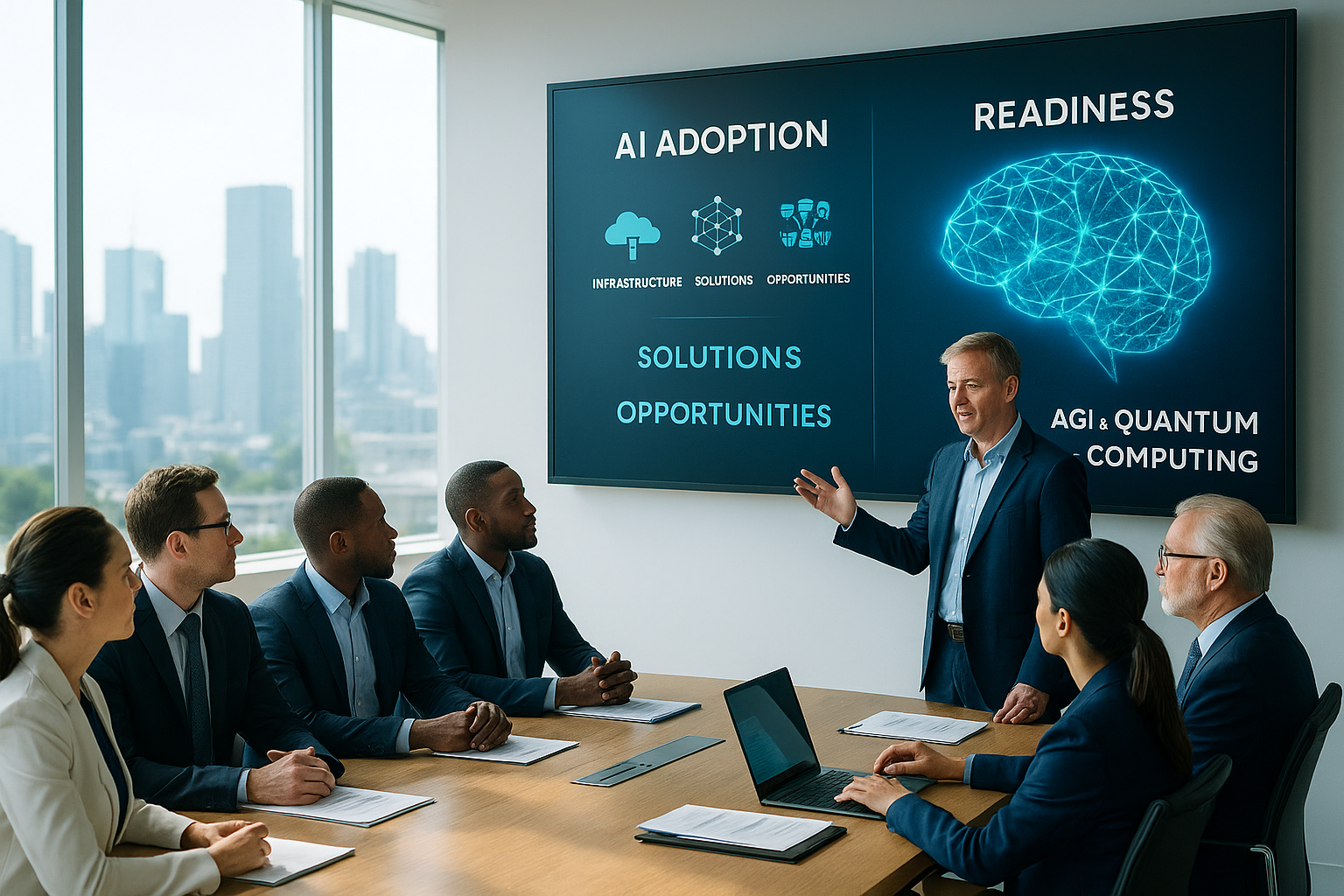
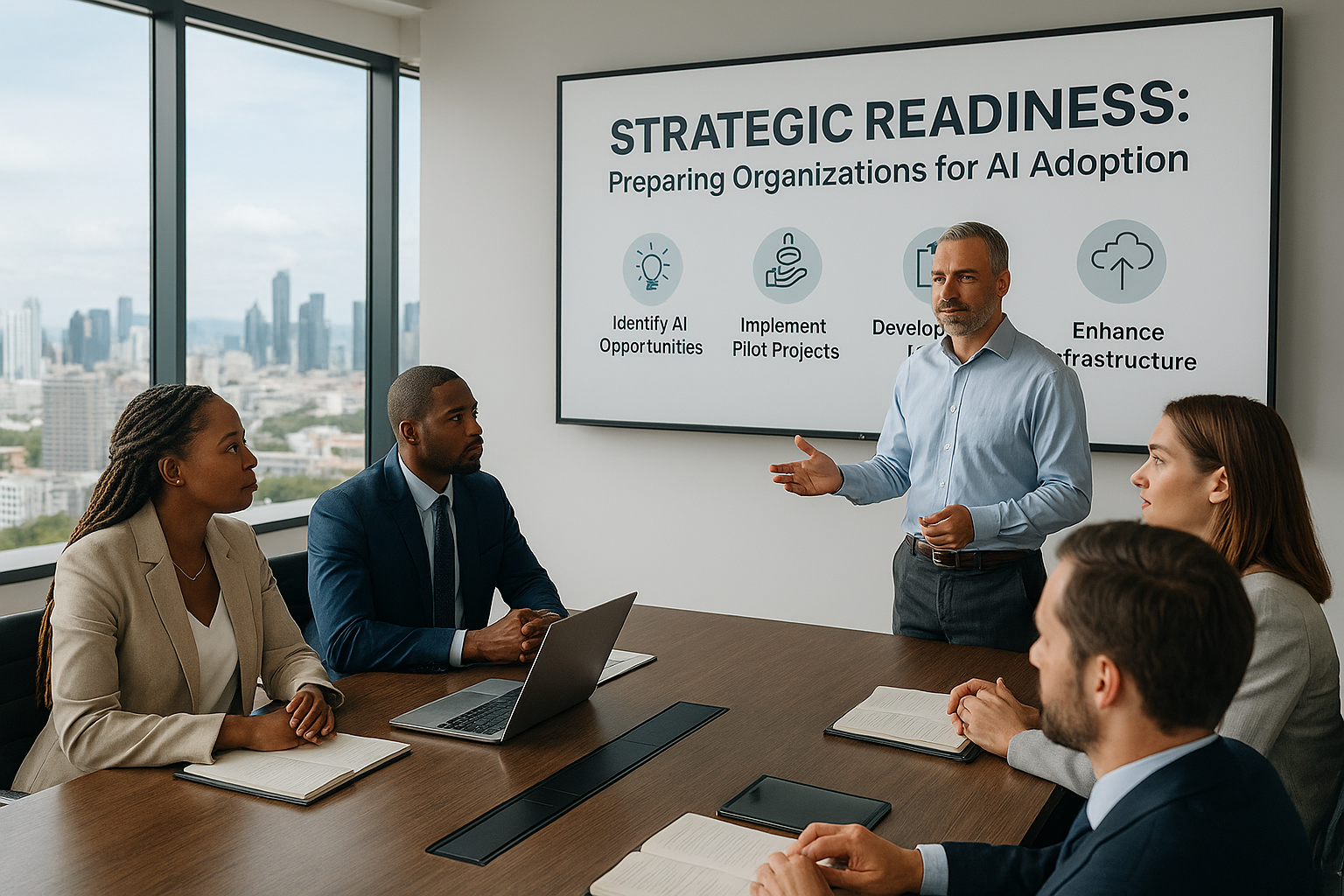
Enterprise leaders are preparing for the next wave of AI adoption. Strategic readiness means identifying high-impact AI opportunities, piloting advanced solutions, and developing the infrastructure to support them. Ensuring AGI readiness in an organization will require embracing new technologies like quantum computing while maintaining strict oversight and compliance.

LLMs vs. AGI – The Limits of Today’s AI

The recent explosion of LLM-driven applications has been impressive, but LLMs are not on their own “general intelligences.” By design, an LLM like GPT-4 or PaLM is trained to statistically predict text, not to truly understand or reason about the world. As a result, even state-of-the-art models exhibit well-documented limitations that prevent them from achieving AGI:

  • Lack of Deep Reasoning: LLMs can imitate reasoning in simple cases, but they falter on tasks requiring multiple hops of logic or combinatorial problem solving. For example, answering a question that needs drawing two or three separate facts together (multi-hop reasoning) often trips up these models. Research has found that while transformers can encode some latent reasoning steps, they “often err” on queries that require composition and multi-step logic. The ability to plan or reason through a complex chain of thought – something a human expert might do systematically – is not a strength of current LLMs.

  • Combinatorial Explosion: Many real-world challenges (from optimizing a supply chain route to proving a mathematical theorem) are combinatorial in nature, meaning the space of possible solutions is astronomically large. Classical algorithms struggle with these problems, and LLMs are not inherently designed to solve combinatorial optimization either. An LLM might help write code or suggest heuristics, but by itself it cannot brute-force search through combinatorial possibilities. This is a key limitation on the path to AGI – true general intelligence needs to handle problems that blow up in complexity, something our current AI finds infeasible.

  • No Grounded Understanding: LLMs lack grounding in real-world experience. They don’t possess true understanding of concepts; they manipulate symbols (words) based on statistical correlation. This leads to behaviors like hallucination (confidently making up facts) and brittleness when faced with inputs outside their training distribution. AGI, by definition, would require robust understanding and the ability to learn new concepts on the fly, not just regurgitate training data patterns.

Given these issues, it’s widely acknowledged that **today’s AI models, on a purely classical computing foundation, may never by themselves achieve **AGI. Simply scaling up parameters or data might yield further improvements, but diminishing returns and fundamental barriers (like lack of true reasoning or real-world grounding) remain. We seem to be approaching the edge of what purely classical, non-specialized approaches can do. As one industry analysis noted, we are “reaching the limits of generative AI in terms of model efficiency and hardware limitations”, suggesting that a significant change in computing approach may be required for the next leap.

Quantum Computing: A New Power for Reasoning and Search

How can we break through these limitations? One compelling answer is quantum computing. Quantum computers operate on completely different principles than classical machines, leveraging phenomena like superposition and entanglement to process information in ways impossible for classical bits. In practical terms, a quantum computer can explore a vast number of states simultaneously, acting as a kind of massively parallel search engine through complex solution spaces. For AI, this raises an exciting possibility: using quantum computing as a “deep search” layer to enhance an AI’s reasoning capabilities.

Richard Feynman famously pointed out that “nature isn’t classical, dammit… if we want to simulate nature, we’d better make it quantum mechanical”. The essence of that insight for AI is that many complex systems (from molecular interactions to human cognition) might be more efficiently modeled with quantum computation. In the context of AGI, quantum algorithms could enable exploration and pattern-recognition at a depth and scale that classical algorithms can’t reach. Rather than brute-forcing every possibility one by one, a quantum algorithm can consider many possibilities in parallel, drastically reducing search times for certain problems.

For example, quantum search algorithms like Grover’s algorithm can find target solutions in an unsorted space quadratically faster than any classical approach – a speedup that could be transformative when searching through combinations of reasoning steps or large knowledge graphs. And beyond speed, certain quantum algorithms natively handle the kind of probabilistic inference and linear algebra that underpin machine learning. A well-known case is quantum annealing: it naturally finds low-energy (optimal or near-optimal) solutions to optimization problems by exploiting quantum tunneling. This could directly tackle combinatorial optimization challenges that are intractable for classical solvers.

Crucially, quantum computing’s advantages align with the very areas where current AI struggles. Need to evaluate an exponentially large number of possibilities? A quantum routine might prune that search space drastically. Need to explore multiple potential reasoning paths in parallel? A quantum system, by its superposition principle, can do exactly that – in Quantum Reinforcement Learning experiments, for instance, quantum agents can explore many possible future states simultaneously, accelerating learning. It’s easy to imagine a future AGI system where a classical neural network proposes a question or partial solution, and a quantum module searches through myriad connections or simulations to advise on the best next step (much like a chess AI evaluating millions of moves in parallel, but at a far larger scale).

Quantum Computing and the Quest for Enterprise AGI: A Hybrid Approach to Responsible AI | RediMinds-Create The Future

To be clear, today’s quantum computers are still in early stages – limited in qubit count and error-prone. But the progress is steady, and quantum capabilities are improving yearly. We’ve already seen demonstrations of “quantum advantage” where quantum hardware solved specific tasks faster than classical supercomputers. As these machines become more powerful, their relevance to AI will grow. The convergence of AI and quantum computing is now a major research frontier, with the promise that quantum-enhanced AI could handle complexity and reasoning in ways that classical AI alone cannot.

Pioneers of Quantum-Classical Hybrid Architecture

This vision of quantum-enhanced AI isn’t just theoretical. Around the world, leading companies and labs are actively developing hybrid quantum-classical architectures to merge the strengths of both paradigms. The idea is not to replace classical neural networks, but to augment them – embedding quantum computations as specialized subroutines within classical AI workflows. Let’s look at some notable players driving this innovation:

  • IBM – As a pioneer in both AI and quantum, IBM is investing heavily in hybrid approaches. IBM Research has demonstrated quantum algorithms that work alongside classical ML to improve performance on certain tasks. For example, IBM’s Quantum Open Science projects have used quantum circuits to classify data and even to enhance feature selection for AI models. IBM’s toolkits like Qiskit Machine Learning allow developers to integrate quantum nodes into classical deep learning pipelines. IBM recently highlighted how quantum-hybrid algorithms could accelerate medical diagnostics, noting that adding quantum routines to an AI workflow improved a cancer diagnostic’s accuracy at identifying cancer sub-types dramatically. IBM’s vision is that quantum and AI will converge in enterprise computing, and it is building the ecosystem (hardware and software) to enable that.

  • Google Quantum AI – Google’s Quantum AI division (in concert with Google Research/DeepMind) is likewise at the forefront. Google has built some of the most advanced superconducting quantum processors (achieving a milestone in quantum supremacy in 2019), and they’ve also released TensorFlow Quantum, an open-source library integrating quantum circuits into the popular TensorFlow AI framework. With TensorFlow Quantum, developers can construct “quantum neural network” models where a quantum circuit is treated as a layer in a neural network, trained with classical backpropagation. Google’s researchers have explored quantum advantages in combinatorial optimization and even quantum-inspired neural nets. The company’s goal is explicitly stated as “building quantum processors and algorithms to dramatically accelerate computational tasks for machine intelligence”.

  • Xanadu – A startup based in Toronto, Xanadu is notable for its focus on photonic quantum computing and its development of PennyLane, a popular open-source framework for quantum machine learning. PennyLane enables quantum differentiable programming, meaning researchers can seamlessly combine quantum circuit simulations with classical deep learning libraries. Xanadu’s team and collaborators have demonstrated hybrid models, like quantum-classical neural networks for image classification and variational quantum algorithms for chemistry. They are even exploring quantum-enhanced generative models. Xanadu’s hardware approach (using light rather than electronic qubits) and its cross-platform software have made it a key player in pushing hybrid quantum-AI research forward.

  • Rigetti Computing – Rigetti is a pioneer of the quantum-classical cloud service model. In 2018, Rigetti launched the first commercial Quantum Cloud Services (QCS) platform, which tightly integrates quantum processors with classical co-processors in one data center. This eliminates latency between the two and allows algorithms to offload parts of the computation to quantum hardware on the fly. Rigetti’s approach was shown to potentially yield 20×–50× speedups on certain algorithms by uniting the systems. The company actively works on quantum algorithms for finance, optimization, and machine learning, and has collaborated with partners like Zapata Computing on compilers for hybrid algorithms. Rigetti’s vision of a tightly coupled quantum-classical infrastructure has influenced larger companies to offer similar integrated cloud access (e.g., Amazon Braket and Azure Quantum now host Rigetti chips for hybrid experimentation).

  • D-Wave Systems – D-Wave took a different route with its quantum technology, specializing in quantum annealing machines that are particularly suited for optimization problems. D-Wave’s systems are already being used in hybrid solutions for real-world use cases. The company offers a Hybrid Solver Service that lets developers formulate problems (like scheduling or routing optimizations) and have it solved by a mix of classical and quantum annealing techniques. For example, D-Wave has worked with automotive and logistics companies on route optimization and traffic flow problems – domains where their quantum solver can evaluate many possible routes to find efficient ones. Enterprise clients have used D-Wave’s hybrid approach to optimize portfolio selections in finance and supply chain logistics, areas where classical algorithms struggle to find near-optimal solutions quickly. D-Wave’s continual hardware improvements (its latest Advantage system has 5000+ qubits, albeit noisy ones) are enabling larger problem instances to be tackled with this quantum-accelerated optimization.

  • Academic Labs (MIT, Caltech, Oxford, and more) – Academia is playing a huge role in inventing the algorithms and theoretical groundwork for quantum-enhanced AI. At MIT, the MIT-IBM Watson AI Lab has a research program on Quantum Computing in machine learning, and MIT’s quantum information researchers have explored everything from quantum boosts to classical neural nets to quantum algorithms for natural language processing. Caltech is home to pioneering quantum theorists and even houses the AWS Quantum Computing Center, where academic and industry researchers jointly explore quantum machine learning algorithms. Caltech’s expertise in both AI (through initiatives like Caltech’s AI4Science program) and quantum (through the IQIM – Institute for Quantum Information and Matter) makes it a hotbed for hybrid ideas. Meanwhile, the University of Oxford has one of the world’s leading quantum computing groups and has produced notable work on quantum algorithms that could impact AI (for instance, algorithms for quantum analogues of neural networks and efforts to use quantum computers for complex graph inference problems). Oxford is also known for quantum natural language processing research, aiming to represent linguistic meaning on quantum computers – a fascinating crossover of AI and quantum theory. These are just a few examples; universities from Stanford to Tsinghua to the University of Toronto are all contributing to the fast-growing body of research on quantum-classical hybrid AI.

Quantum Computing and the Quest for Enterprise AGI: A Hybrid Approach to Responsible AI | RediMinds-Create The Future

What all these efforts share is a recognition that the future of AI may not be purely classical. Instead, a hybrid architecture – where certain heavy-lift reasoning or search tasks are offloaded to quantum subroutines – could dramatically expand AI’s capabilities. Importantly, each of these pioneers also acknowledges that classical computing remains essential: quantum components will augment, not replace, the classical layers of neural networks and logic that we already know work well for perception and pattern recognition.

Quantum Advantage in Action: Enterprise Use Cases

The excitement around hybrid quantum AI isn’t just academic – it stems from very practical needs in industry. Many enterprise use cases push the limits of classical computing, especially in regulated, high-stakes fields where optimal decisions and predictions can save lives or millions of dollars. Here we explore a few domains where quantum-enhanced AI could unlock new levels of performance, and discuss why these gains matter:

Healthcare and Life Sciences

Perhaps nowhere is the impact of advanced AI felt more profoundly than in healthcare. From diagnostics to drug discovery, AI systems are already assisting clinicians and researchers – but they also face extreme requirements for accuracy and accountability. Quantum computing has enormous potential in healthcare AI, where the problems often involve vast combinatorial searches and pattern recognition at the very edge of current capability.

One area gaining attention is diagnostic AI for medical imaging and genomics. Identifying a complex disease from imaging scans, or finding a needle-in-a-haystack mutation in a genome, can be like looking for a very tiny pattern in an ocean of data. Classical AI (like deep convolutional networks) has made great strides in image recognition, but still struggles with subtle, multi-factorial cases – and training such models requires huge computational resources. Quantum-enhanced algorithms could change the game. In fact, IBM researchers reported that by injecting a quantum algorithm into a cancer diagnosis model, the hybrid system could not only detect the presence of cancer but even predict the specific subtype of cancer with 70% accuracy, a significant improvement over previous results. That kind of multi-dimensional pattern recognition hints at why quantum could add value: a quantum model might consider complex interactions in data (like how multiple genes and biomarkers collectively indicate a disease) more naturally than a flattened classical model.

Another healthcare frontier is drug discovery and genomics, which involves navigating astronomically large chemical and genetic search spaces. Pharmaceutical companies have billions of compounds to virtually screen for a potential new drug; combinatorial chemistry and protein folding are famously hard problems. Quantum computers, even today’s prototypes, have shown the ability to simulate small molecular systems more efficiently than classical exact methods. As they scale, we expect quantum subroutines to significantly accelerate drug discovery AI – for example, rapidly suggesting molecular candidates that fit a desired profile or optimizing the design of a compound for efficacy and safety. Companies like Biogen and Roche are already partnering with quantum computing firms to explore these possibilities. In genomics, a quantum-assisted AI might sift through huge genomic databases to find complex patterns (e.g. combinations of genetic variants that together raise disease risk) far faster than classical stats can.

It’s important to note that in healthcare, accuracy isn’t enough – transparency and validation are paramount. So, any quantum-powered diagnosis or discovery would still go through rigorous clinical trials and approvals. But by integrating quantum algorithms into the discovery pipeline, enterprises in biotech and healthcare could gain a competitive edge: faster time-to-insight, the ability to consider more variables and hypotheses, and potentially breakthroughs that a classical-only approach might miss.

Finance and Portfolio Optimization

The finance industry has always been a heavy user of advanced computing, from algorithmic trading to risk modeling. Yet many financial optimization problems remain so complex that even supercomputers struggle – which is why banks and hedge funds are eagerly watching quantum computing’s rise. Quantum AI could fundamentally change how we approach financial optimization and risk analysis.

Consider portfolio optimization: determining the ideal mix of assets (stocks, bonds, etc.) to maximize return for a given risk appetite. This is a classic combinatorial optimization problem that becomes exponentially harder as you increase the number of assets and constraints. Sophisticated investors want to factor in a multitude of data – market scenarios, correlations, macroeconomic indicators – and rebalance in real-time as conditions change. Classical algorithms use heuristics or simplified assumptions because the full problem is intractable beyond a certain size. But a quantum-enhanced optimizer can explore portfolio configurations in a high-dimensional space far more efficiently. Rigetti, for instance, has pointed out that quantum computers can “optimize returns and risks for large financial portfolios”, potentially identifying investment strategies that elude classical methods. Similarly, experiments using D-Wave’s quantum annealer have tackled portfolio selection with promising results, finding optimal or near-optimal portfolios among dozens of assets. The impact for financial firms could be significant – better performing portfolios and faster adaptation to market changes translate directly into competitive advantage and higher profits.

Beyond portfolios, fraud detection and algorithmic trading are also ripe for quantum enhancement. Fraud detection often involves analyzing huge graphs of transactions to spot illicit patterns (a task related to the “subgraph isomorphism” problem which has known quantum speedups). A quantum-infused AI could potentially flag suspicious activity by examining connections and sequences that a classical system might consider impractically complex to evaluate in realtime. For algorithmic trading, which might involve optimizing execution of thousands of trades across global markets, quantum algorithms could help compute optimal strategies under constraints in split seconds, something that could be the difference between a profitable trade and a missed opportunity.

It’s worth noting that finance is a highly regulated domain. Gains from quantum AI will only be realized if they come with robustness and auditability (no black boxes picking trades that can’t be explained to regulators or risk officers). We’ll discuss later how hybrid approaches can ensure this. But it’s clear that the financial services sector stands to benefit enormously from quantum computing – which is why major banks (JPMorgan, Goldman Sachs, etc.) have active quantum research teams and are already testing quantum algorithms on real problems.

Logistics and Supply Chain

Modern global supply chains are incredibly complex, comprising many variables: routing of ships, trucks and planes; inventory levels at warehouses; timing and pricing decisions; and so on. The goal in logistics is usually to optimize efficiency and cost – for example, minimize the total distance traveled or ensure demand is met with minimal delay. This becomes an NP-hard problem (like the infamous traveling salesman problem, but on steroids) and is often too complex to solve optimally. Companies resort to approximate methods and lots of computing power to get “good enough” solutions.

Quantum optimization has a natural fit here. D-Wave’s annealing quantum computers have already been used in pilot projects for things like optimizing delivery routes and traffic light timing in cities. In one example, a partnership with a traffic management system showed that a quantum solver could optimize the routes of municipal buses in near-real-time, reducing congestion and travel time. In supply chain management, quantum algorithms can take into account a vast number of factors (weather, fuel costs, delivery windows, etc.) and churn out routing plans or distribution schedules that are better than those from classical heuristics. D-Wave reports that using their quantum annealer in a hybrid mode has enabled optimizing vehicle routing and reducing fuel costs for transportation companies – a direct boost to the bottom line and sustainability.

Similarly, consider predictive forecasting and inventory management. Retailers must decide how much stock to keep where, and manufacturers must schedule production to meet uncertain future demand. These are probabilistic problems with enormous state spaces (especially in the era of global e-commerce). A quantum-enhanced AI could potentially evaluate many demand scenarios in parallel and find strategies that minimize stockouts and overstocks, something classical Monte Carlo simulations struggle with at scale. By integrating quantum sampling or optimization into forecasting models, enterprises could achieve more resilient, cost-effective supply chains. For instance, a quantum algorithm might quickly solve a complex supply chain routing problem that involves multiple depots and hundreds of stores – a task that classical solvers either simplify (with loss of optimality) or take too long to run.

Quantum Computing and the Quest for Enterprise AGI: A Hybrid Approach to Responsible AI | RediMinds-Create The Future

In logistics, even a small percentage improvement in efficiency can save millions. So the promise of quantum – even a modest quantum speedup or better solution quality – is generating significant interest. Companies like UPS and FedEx, as well as aviation and energy logistics firms, are already engaged in quantum computing trials. As one industry article put it, the real-time optimization of routes and supply flows is poised to be one of the earliest valuable applications of quantum computing, complementing AI-driven predictive analytics in those businesses.

Why AGI Needs Guardrails: Explainability, Compliance, and Trust

We’ve painted an exciting picture of quantum-boosted AI breaking through technical barriers. However, when it comes to deploying any AI – let alone a potential AGI – in high-stakes industries like healthcare, finance, or law, raw capability is not enough. **Enterprise leaders know that AI systems must also be auditable, explainable, and aligned with regulations and ethical norms. In fact, the higher the stakes, the stronger the demand for AI “guardrails” that ensure the technology’s outputs can be trusted and verified.

Classical rule-based systems (and even traditional software algorithms) have historically excelled in these traits. They behave deterministically, their decision logic can often be inspected, and they can be validated against compliance checklists. By contrast, modern AI – especially deep learning – is often a black box. A neural network might provide a diagnosis or approve a loan, but explaining why it did so can be challenging. When we add quantum computing into the mix, the complexity grows further; quantum algorithms are probabilistic and non-intuitive, which could make the overall system even harder to interpret. Therefore, the consensus is that **the future of AGI in enterprise must be a hybrid not just in technology but in governance: pairing quantum-enhanced pattern discovery with classical, rule-based guardrails and oversight.

Consider the earlier healthcare scenario: an AI identifies a cancer in a scan with 99% confidence. That’s great – but a doctor (and patient) will rightly ask, how did it reach that conclusion? Was it a specific shadow on the MRI, a combination of biomarkers? Clinicians are unlikely to accept “the quantum neural network thought so” as an answer. They need interpretable evidence or at least a clear chain of reasoning. This is why researchers are developing explainable AI techniques that can be applied on top of neural networks – and similar work will be needed for quantum algorithms. One promising approach is to have classical logic modules that can audit the suggestions made by an AI (quantum or not). For example, if an AI recommends a treatment plan, a separate classical system might cross-check that recommendation against medical guidelines and the patient’s history, flagging anything that doesn’t align with established knowledge or policy. This kind of “second layer” oversight is something classical computing is well-suited for, ensuring nothing crazy slips through even if the AI’s internal reasoning is opaque.

Quantum Computing and the Quest for Enterprise AGI: A Hybrid Approach to Responsible AI | RediMinds-Create The Future

In high-stakes settings, AI must operate under human oversight. Above, a physician and patient use an AI-driven medical chatbot together. The doctor monitors the chatbot’s suggestions (displayed on the laptop) as the patient asks about her symptoms. This scenario illustrates a key point: AI can assist with preliminary analysis or Q&A, but professionals need to validate its outputs. The doctor’s presence provides assurance, context, and the final judgment – an example of classical “guardrails” in action even as we tap AI for efficiency.

Another example is in the legal domain. Imagine an AI system that helps judges or lawyers by researching case law and even suggesting verdicts or sentences based on precedent – essentially an AGI legal assistant. The risks of bias or error here are profound; a mistake could unjustly alter someone’s life. Legal systems have stringent standards for evidence and explanation. Any AI in this space would need to provide a clear rationale for its suggestion (e.g., citing prior cases and statutes) and operate within the bounds of law and rights. Achieving that requires more than just a powerful AI engine: it needs an architecture designed for accountability. We might see AI that drafts a legal argument (drawing on a quantum-accelerated search through millions of documents), but a suite of classical checks will verify that the citations are valid, the logic follows, and no unethical bias crept in. Essentially, the AI can do the heavy lifting of knowledge retrieval and pattern-finding, while classical systems (and humans) ensure the results are legally sound and fair.

In finance, regulations demand explainability for automated decisions, like credit scoring or trade approvals. An AGI that recommends approving a large loan because “it predicts the business will succeed” would not satisfy an auditor – it would need to show the financial analysis backing that prediction. Here again, classical rule-based frameworks can wrap around the AI’s core, forcing it to justify predictions with reference to understandable factors (cash flow, credit history, etc.) even if a complex model initially made the prediction.

All these considerations point to a clear conclusion: Robust, responsible AGI will blend the best of both worlds. The quantum and AI side will give us unprecedented prediction and optimization capabilities. The classical side will provide stability, interpretability, and adherence to human rules and values. It’s a symbiotic relationship. In fact, we already see the seeds of this today: many “AI in healthcare” products are actually hybrid systems where a machine learning model flags cases and a human doctor or a rule-based expert system double-checks them before action is taken. The future AGI will likely formalize and enhance this pattern at scale.

It’s instructive to note a recent finding in the medical AI field: an AI (GPT-4 based) was able to pass medical licensing exams with high scores, yet still failed at certain real-life clinical decision-making tasks. Researchers from Harvard and Stanford dubbed it a “striking paradox” – the AI could regurgitate medical knowledge for a test, but faltered when dealing with nuanced patient scenarios where questions and answers aren’t straightforward. This underlines our point: test-taking is one thing, but real-world practice needs understanding, context, and judgment. An AGI in medicine (or law, or finance) will face the same challenge. By combining raw AI intelligence (augmented by quantum computing) with classical interpretability and constraints, we give such a system the best chance to perform safely and effectively in the complexities of the real world.

The Hybrid Path to Responsible, Enterprise-Grade AGI

Bringing it all together, a picture emerges of how we can achieve AGI that is both powerful and safe: through a hybrid architecture that leverages quantum-enhanced AI for deep pattern discovery, alongside classical systems for control and transparency. Rather than chasing pure superintelligence in a black box, the most pragmatic and enterprise-friendly vision of AGI is one of balance.

Such a hybrid AGI might work like this in practice: The quantum-enhanced modules (perhaps quantum neural networks or quantum optimizers) tackle the hardest parts of a problem – they churn through the combinatorial possibilities, they generate creative solutions, they see patterns we’d otherwise miss. Surrounding those modules, the classical AI components handle interfacing with humans and existing systems – they apply business rules, legal constraints, ethical guidelines, and they provide explanations in human terms. This way, whenever the “alien intelligence” of a deep quantum algorithm produces an insight, it is immediately contextualized and vetted by more familiar, interpretable processes. The end result is an AI you can trust with critical decisions because it’s both supercharged in capability and inherently audited by design.

For enterprises, this hybrid approach is not just idealistic – it’s likely the only acceptable path. Highly regulated industries (healthcare, finance, defense, etc.) will simply not deploy a monolithic AGI that they cannot explain or control. We’ve already seen regulatory movements (such as the EU’s proposed AI Act) that would require transparency and risk controls for AI systems. A black-box AGI, no matter how intelligent, would face severe adoption hurdles. In contrast, a hybrid AGI can be pitched as “quantum-powered but with classical guardrails.” This is an AI that checks all the boxes: it can solve previously unsolvable problems, drive innovation and efficiency in the enterprise, and at the same time produce audit logs, reason codes, and fail-safes that management and regulators can be comfortable with.

There’s also a practical reason to keep the classical parts around: human talent and institutional knowledge are built on classical computing and decades of business processes. By having the classical layer in our AGI, we ensure that the new system can integrate with existing IT infrastructure and decision-making processes. Think of it as an evolutionary approach to AGI deployment – rather than throwing out all our old systems, we embed a quantum brain within the legacy nervous system of the enterprise. This makes change management feasible. You don’t have to trust a wild new technology blindly; you introduce its benefits gradually, under the watch of tried-and-true systems.

Finally, a hybrid quantum-classical AGI aligns with how humans themselves solve problems. We often have flashes of intuition (which are inscrutable, subconscious, parallel – almost our “quantum” side, if you will) but we validate those intuitions with logic, reason, and social norms (our “classical” reasoning). The best human experts toggle between creative insight and methodical analysis. Our proposed AGI does the same: the quantum part provides the leap, the classical part provides the ladder to climb that leap safely.

Navigating the Quantum AI Frontier with the Right Partner

Achieving this vision of hybrid AGI is no small feat. It requires orchestrating advanced technologies and aligning them with business strategy, regulatory requirements, and industry-specific needs. This is where having a future-ready AI partner becomes invaluable. Organizations will need guidance to navigate the rapidly advancing ecosystem of enterprise-grade AI, quantum computing, and new governance frameworks.

RediMinds positions itself as exactly such a partner. With deep expertise in AI enablement, RediMinds stays at the forefront of emerging trends – from the latest in quantum AI research to best practices in AI ethics and compliance. We understand that enterprise leaders are asking not just “How do we get to AGI?” but “How do we do it responsibly, in a way that’s auditable and aligned with our business goals?” RediMinds helps clients craft a tailored roadmap for AGI readiness, beginning with today’s capabilities and strategically integrating tomorrow’s breakthroughs.

For example, we might start by identifying high-impact AI opportunities in a client’s operations (such as optimizing a supply chain or enhancing diagnostic decision support). From there, our team can pilot hybrid AI architectures that incorporate early quantum computing access (via cloud platforms like AWS Braket or IBM Quantum) alongside classical ML models – essentially implementing pilot projects of quantum-classical solutions on a small scale. As results and insights are gathered, we help develop those into full-fledged systems, enhancing infrastructure as needed to support specialized hardware and ensuring that robust guardrails (explainability modules, audit logs, etc.) are built in from day one. Throughout this journey, RediMinds emphasizes medical AI compliance, data privacy, model validation, and all the other governance aspects required in regulated industry AI deployment. Our goal is that by the time AGI technologies mature, our clients will have the infrastructure and confidence to deploy them responsibly, having already evolved their AI practices in parallel with the tech.

In summary, the path to AGI for the enterprise is not a single giant leap into the unknown; it’s a series of measured steps that combine innovation with prudence. Quantum computing will likely be a catalyst, empowering AI systems to reach new heights of intelligence. But the real winners of the AI revolution will be those who harness this power thoughtfully – blending it with classical strengths to create solutions that are not only super-intelligent, but also trustworthy, transparent, and compliant.

As we stand at this crossroads of technology, enterprise leaders should be planning for a hybrid future. The writing is on the wall: what’s next in AI is not purely generative or purely quantum, but a convergence of both. By embracing a hybrid quantum-classical architecture for AI, and by partnering with experts who understand both cutting-edge tech and industry realities, organizations can ensure they are ready for the era of responsible AGI. That future – where we achieve transformative AI capabilities without sacrificing control and trust – is one we at RediMinds are excited to help build, together with forward-thinking enterprises.

Mastering the Modern AI Ecosystem: A Strategic Guide for Leaders, Innovators, and Institutions

Mastering the Modern AI Ecosystem: A Strategic Guide for Leaders, Innovators, and Institutions

Mastering the Modern AI Ecosystem: A Strategic Guide for Leaders, Innovators, and Institutions | RediMinds-Create The Future

Mastering the Modern AI Ecosystem: A Strategic Guide for Leaders, Innovators, and Institutions

Artificial intelligence has transitioned from a niche tech experiment to a core driver of transformation across industries. Nearly all enterprises are now exploring AI in some form, yet many struggle to translate pilots into tangible value. In fact, one study found that **74% of companies have yet to see **meaningful ROI from their AI investments. Bridging this gap requires more than enthusiasm—it demands a strategic understanding of the complete AI ecosystem. This guide provides high-impact decision-makers with a panoramic view of that ecosystem, from fundamental concepts to real-world applications, ethical responsibilities, and the organizational preparation needed to succeed.

Today’s healthcare executives, finance leaders, legal and regulatory stakeholders, and public sector strategists face a dual imperative. They must grasp what AI can do—the cutting-edge use cases and innovations unlocking new value—and what AI demands in return. Adopting AI at scale isn’t a plug-and-play endeavor; it calls for robust data systems, updated workflows, skilled talent, and unwavering governance. The sections below break down the core elements of AI every leader should know, illustrated with sector-specific examples and actionable insights. By mastering this modern AI ecosystem, leaders can steer their organizations to innovate confidently and responsibly, turning AI from a buzzword into a wellspring of strategic advantage.

Core Fundamentals of AI

Successful AI adoption starts with a solid grasp of core fundamentals. High-level leaders don’t need to become data scientists, but understanding the building blocks of AI is crucial for informed decision-making. At its heart, Artificial Intelligence is a field of computer science aimed at creating systems that exhibit traits of human intelligence. This encompasses several key domains and concepts:

  • Machine Learning (ML): Algorithms that enable machines to learn patterns from data and improve over time. ML powers predictive models in everything from customer behavior forecasts to fraud detection. It often relies on statistical techniques and large datasets rather than explicit programming, allowing systems to learn and adapt.

  • Deep Learning (DL): A subset of ML that uses multi-layered neural networks to achieve powerful pattern recognition. Deep learning has fueled recent breakthroughs in image recognition, speech understanding, and complex decision-making by mimicking the layers of neurons in the human brain.

  • Natural Language Processing (NLP): Techniques for machines to understand and generate human language. NLP underpins chatbots, language translation, and text analysis tools—enabling AI to parse documents, converse with users, and derive insights from unstructured text.

  • Computer Vision: Methods that allow AI to interpret and process visual information like images or video. From medical image analysis to self-driving car navigation, computer vision systems can detect objects, classify images, and even recognize faces or anomalies by “seeing” the world as humans do.

  • Reinforcement Learning: An approach where AI agents learn by trial and error via feedback from their environment. By receiving rewards or penalties for their actions, these agents can autonomously learn optimal strategies—useful in robotics control, game-playing AIs, and any scenario requiring sequential decision-making.

  • Generative AI: Algorithms (often based on deep learning) that can create entirely new content—text, images, audio, even video—from scratch. Recent generative AI models like large language models (LLMs) have demonstrated the ability to draft articles, write code, compose music, or produce realistic art based on user prompts. This subfield burst into the mainstream with applications like ChatGPT and DALL-E, showcasing AI’s creative potential.

Underpinning all these domains is a foundation of mathematics and data science. Linear algebra, calculus, probability, and statistics provide the language in which AI models are formulated. Leaders should appreciate that data is the lifeblood of AI—quality data and sound algorithms go hand in hand. In practice, this means organizations must ensure they have the right data inputs (relevant, accurate, and sufficiently large datasets) and clarity on which AI technique is the best fit for a given problem. By familiarizing themselves with these fundamentals, executives and policymakers can better evaluate proposals, ask the right questions, and set realistic expectations for AI initiatives.

Mastering the Modern AI Ecosystem: A Strategic Guide for Leaders, Innovators, and Institutions | RediMinds-Create The Future

Real-World Applications & Sector-Specific Use Cases

AI in Healthcare

In healthcare, AI is revolutionizing how we diagnose, treat, and manage illness. Advanced machine learning models can analyze medical images (like X-rays, MRIs, CT scans) with expert-level accuracy, aiding radiologists in detecting diseases earlier and more reliably. For example, AI-powered image analysis has shown success in spotting tumors or fractures that might be missed by the human eye. Beyond imaging, AI algorithms comb through electronic health records to identify patterns—flagging at-risk patients for early intervention or optimizing hospital workflows to reduce wait times. Predictive analytics help forecast patient deterioration or hospital readmission risks, enabling preventive care. Meanwhile, natural language processing is automating administrative burdens: transcribing doctors’ notes, processing insurance claims, and triaging patient inquiries via chatbot. Perhaps most exciting is AI’s role in drug discovery and personalized medicine. Generative models (like DeepMind’s AlphaFold) can predict protein structures and suggest new drug molecules, dramatically accelerating research. Healthcare leaders, however, must pair these opportunities with caution—ensuring patient data privacy, validating AI tools for bias and accuracy, and securing regulatory approvals. When applied thoughtfully, AI in healthcare promises improved outcomes, lower costs, and a shift from one-size-fits-all medicine toward truly personalized care.

AI in Finance

Finance was an early adopter of AI and continues to push the frontier in both customer-facing and back-office applications. Banks and fintech firms leverage AI-driven fraud detection systems that scan millions of transactions in real time, spotting anomalies or suspicious patterns far faster than manual review. Investment firms employ algorithmic trading and portfolio optimization models that use machine learning to analyze market data and execute trades at lightning speed, often finding arbitrage opportunities invisible to human traders. Customer service in banking is also augmented by AI: intelligent chatbots and virtual assistants handle routine customer inquiries, assist with account management, and provide 24/7 support, improving client experience. In areas like lending and insurance, AI models assess creditworthiness or risk by analyzing a wide array of data (beyond traditional credit scores), potentially expanding access to services—though this raises fairness questions if not monitored. Robo-advisors are utilizing AI to provide personalized investment advice at scale, adjusting allocations based on individual goals and risk appetite. Additionally, natural language processing systems scour financial news, earnings call transcripts, and social media sentiment to inform trading decisions or risk assessments. Financial leaders must grapple with regulatory compliance and transparency for these AI systems: ensuring algorithms meet regulations, preventing unintended bias (e.g. in loan approvals), and maintaining robust human oversight. When well-managed, AI can boost efficiency, cut fraud losses, enhance decision-making, and create more personalized financial products for consumers.

AI in Government and Public Sector

Public sector organizations and government agencies are increasingly leveraging AI to improve services, optimize operations, and inform policy decisions. One prominent use case is in smart cities: municipalities deploy AI algorithms to analyze traffic patterns and adjust light timings, reducing congestion; computer vision sensors monitor infrastructure for maintenance needs; and predictive models help manage energy consumption across city grids. Governments are also using AI-driven analytics on large datasets (such as census data, economic indicators, or public health data) to identify trends and shape proactive policies. For example, AI can help predict disease outbreaks by analyzing epidemiological data and even social media signals, giving public health officials a head start. In citizen services, AI-powered virtual assistants or chatbots handle common queries about government programs (like permit applications or benefits enrollment), improving responsiveness and freeing up staff for complex cases. Law enforcement and defense have begun experimenting with AI for tasks like analyzing surveillance footage, forecasting crime hotspots (predictive policing), and enhancing cybersecurity—though these applications are rightly subjected to intense ethical scrutiny. Perhaps the most transformative potential is in administrative efficiency: automating paperwork processing, using natural language processing to streamline legal document review or legislative drafting, and applying machine learning to flag waste or fraud in government spending. Public sector leaders must ensure that these AI systems operate transparently and equitably, given the high stakes of public trust. The government AI ecosystem also demands robust data governance (to protect citizen data) and careful alignment with laws and regulations. When done right, AI in government can mean more effective programs, data-driven policymaking, and improved quality of life for citizens.

AI in Legal Services

The legal industry, traditionally known for mountains of documents and intensive research, is ripe for AI-driven disruption. Law firms and in-house legal teams are using natural language processing to rapidly review contracts and legal documents. Instead of paralegals spending dozens of hours on tedious contract analysis or discovery, AI tools can scan and identify relevant clauses, anomalies, or precedents in a fraction of the time. This not only speeds up due diligence in mergers or court discovery in litigation, but it can also reduce human error. Predictive analytics are being used to inform legal strategy—for instance, by analyzing past court decisions and judges’ records to predict the likely outcome of a case or identify which arguments might resonate. Some jurisdictions are even exploring AI to assist with sentencing recommendations or bail decisions, though these applications are controversial due to concerns about bias and transparency. Another emerging use is legal chatbots that help the public navigate legal processes (filing small claims, understanding rights) by providing basic guidance based on vast legal databases. Importantly, AI in legal settings must be handled with care: explainability is critical (lawyers need to justify decisions in court, so they must understand how an AI arrived at a recommendation), and ethical guidelines must ensure AI augments rather than replaces human judgment, particularly where justice and rights are on the line. For legal executives and regulators, embracing AI means balancing efficiency gains with rigorous oversight to maintain fairness and accountability in the justice system.

Beyond these sectors, AI innovations are permeating virtually every field. In marketing and sales, for example, AI is automating customer segmentation, content generation, and campaign optimization to reach the right audience with the right message at the right time. In manufacturing and robotics, AI-driven robots and quality control systems learn to improve production efficiency and reduce defects. Startups across industries are finding niche problems to solve with AI at their core, from agriculture (using AI to monitor crop health) to education (personalizing learning for students). What’s common across all domains is the rapid pace of AI advancement. Techniques like generative AI are creating new possibilities (and challenges) universally—for instance, synthetic data generation to aid training or AI-generated content raising questions of authenticity. Staying updated is therefore a critical part of the AI journey. Leaders should cultivate a habit of following AI research trends, market developments, and success stories. Subscribing to reputable AI newsletters, reading industry-specific AI case studies, and encouraging their teams to share learnings can help decision-makers remain informed. In a landscape where a breakthrough can render old best practices obsolete, an organization’s agility and knowledge are key assets. By understanding the real-world applications of AI in and beyond their sector, leaders can better envision high-impact use cases and anticipate the next waves of innovation.

Mastering the Modern AI Ecosystem: A Strategic Guide for Leaders, Innovators, and Institutions | RediMinds-Create The Future

Ethics, Safety, and Responsible AI

As organizations race to adopt AI, they must give equally urgent attention to AI ethics and safety. For leaders, this isn’t just a matter of compliance or public relations—it’s about trust, risk management, and long-term viability. AI systems, if unchecked, can amplify biases, operate opaquely, or even behave in unintended ways. A strategic AI leader will prioritize responsible AI development and deployment through several lenses:

  • Bias and Fairness: AI models learn from data, and if that data reflects historical biases or inequalities, the AI can inadvertently perpetuate or even magnify those biases. Examples abound: hiring algorithms that discriminate against certain demographics based on past hiring data, or lending models that unfairly score minority borrowers. Leaders should insist on processes to identify and mitigate bias in AI systems. This may include diversifying training data, applying algorithmic fairness techniques, and continuously auditing outcomes for disparate impacts. Establishing an AI ethics committee or equivalent oversight group can help evaluate sensitive use cases and set fairness standards aligned with the organization’s values and legal obligations.

  • Explainability and Transparency: Unlike traditional software with straightforward logic, many AI systems—particularly deep learning models—are “black boxes,” meaning their decision-making processes are not easily interpretable. However, in domains like finance, healthcare, or criminal justice, being able to explain an AI’s recommendation is crucial. Stakeholders (be it a doctor explaining a diagnosis or a bank explaining a loan denial) need clarity into how the AI arrived at its output. Techniques for explainable AI (XAI) are evolving to address this, providing insights into which factors influenced a model’s decision. Leaders should demand a level of transparency from AI vendors and internal projects, ensuring that systems include features or documentation that make their workings understandable to humans. This transparency builds trust and makes it easier to debug and improve AI behavior over time.

  • Regulations and Compliance: The regulatory environment for AI is quickly taking shape. Around the world, governments are introducing rules to govern AI use—such as the EU’s AI Act, which is the first comprehensive legal framework for AI and imposes strict requirements on “high-risk” AI systems. Regulators are concerned with issues like data privacy (e.g. GDPR and similar laws), algorithmic accountability, and consumer protection. In the United States, agencies and bodies have released guidelines (for example, the NIST AI Risk Management Framework in 2023 and the White House’s AI Bill of Rights blueprint) to steer the development of safe AI. Leaders must stay abreast of relevant regulations in their industry and region—whether it’s healthcare AI needing FDA approvals or finance AI complying with audit requirements—and proactively incorporate compliance into AI project plans. Embracing regulatory frameworks not only avoids penalties but can enhance an organization’s reputation as a trustworthy adopter of AI.

  • AI Alignment and Safety: A more recent concern, especially with the advent of very advanced AI like LLMs, is AI alignment—ensuring AI systems act in accordance with human goals, ethical principles, and intended outcomes. An aligned AI is one that reliably does what it is meant to do (and only that). Misaligned AI could range from a customer service chatbot that gives out incorrect or harmful advice to, in far-future scenarios, autonomous systems that could cause harm if their objectives deviate from human intent. While today’s enterprise AI projects aren’t about to turn into science-fiction villains, the principle of alignment underscores the need for rigorous testing and monitoring of AI behavior. Leaders should promote a culture of safety where developers are encouraged to consider worst-case scenarios and implement safeguards (like kill-switches or human-in-the-loop checkpoints for critical decisions). Additionally, scenario planning for AI failures or misbehavior is a wise exercise—much like disaster recovery planning in IT. It prepares the organization to respond quickly and responsibly if an AI system produces an unexpected or dangerous output.

Implementing responsible AI isn’t just an ethical choice; it’s strategically smart. Biased or non-compliant AI can lead to legal repercussions, financial penalties, and irreparable damage to brand reputation. Lack of transparency can erode user and employee trust, making it harder to integrate AI into operations. Conversely, organizations that champion ethics can differentiate themselves. By being candid about how their AI systems work and the steps taken to ensure fairness and privacy, they build confidence among customers, regulators, and partners. Many forward-looking institutions are now creating AI governance frameworks internally—formal policies and committees that review AI initiatives much like financial controls or cybersecurity practices. This ensures a consistent approach to risk across all AI projects. Ultimately, leaders must remember that responsible AI is sustainable AI. The goal is not to fear AI’s risks, but to manage them in a way that unlocks AI’s enormous benefits while upholding the organization’s duty of care to stakeholders and society.

Supporting Technologies and Infrastructure

A common reason AI initiatives falter is not the algorithms themselves, but the lack of supporting technology and infrastructure to deploy and scale those algorithms. To truly master the AI ecosystem, leaders must invest in the complementary tools, platforms, and practices that allow AI to thrive in production environments. These “supporting concepts” ensure that brilliant prototypes in the lab become reliable, high-performing solutions in the real world:

  • Data Science and Big Data: At the core of any AI project is data. Data Science combines statistics, domain expertise, and programming to extract actionable insights from data. It’s the discipline that turns raw data into understanding—using methods from exploratory analysis to predictive modeling. Big Data refers to the massive volume, velocity, and variety of data that modern organizations deal with. AI excels with large, diverse datasets, but handling big data requires robust pipelines and tools (like distributed processing frameworks such as Hadoop or Spark). Leaders should ensure their organizations have strong data engineering capabilities to gather, clean, and organize data for AI use. This might mean breaking down data silos within the company or investing in data integration platforms. The payoff is significant: better data leads to better models and more insightful AI-driven decisions.

  • Cloud Computing for AI: The computational demands of AI, especially deep learning, are immense. Training a single deep learning model can require processing billions of calculations, something not feasible on a typical local server. Cloud computing platforms like Amazon Web Services (AWS), Google Cloud Platform, and Microsoft Azure provide on-demand access to powerful hardware (including GPUs and TPUs specialized for AI workloads) and scalable storage. They also offer managed services for machine learning (for instance, AWS SageMaker or Google’s Vertex AI) that simplify building and deploying models. Cloud infrastructure allows organizations to experiment quickly without massive upfront hardware investment and to scale successful AI solutions to users globally. A strategic leader will weigh the cloud options and possibly adopt a hybrid approach (combining on-premises systems for sensitive data with cloud for heavy computation). Embracing cloud-based AI not only provides agility but can also speed up deployment cycles—from sandbox experimentation to live service—in a secure, cost-efficient manner.

  • MLOps (Machine Learning Operations): Deploying an AI model is not a one-and-done task; models require continuous monitoring, maintenance, and updates to remain effective. MLOps is a set of practices and tools designed to streamline the machine learning lifecycle, analogous to DevOps in software development. It covers version control for datasets and models, automated testing of model performance, CI/CD pipelines for pushing models into production, and monitoring systems to track model predictions and data drift over time. Without MLOps, even a promising AI pilot can stagnate—studies have shown that a large majority of data science projects never make it to production due to deployment and integration challenges. By implementing MLOps, organizations ensure that models can be reliably updated as new data comes in or as conditions change, and that any issues (like a model’s accuracy degrading) are promptly detected and addressed. Leaders should champion the development of an MLOps capability or use of MLOps platforms, as it directly impacts AI ROI: it’s the difference between one-off insights and sustained, scalable AI value.

  • Model Fine-Tuning and Transfer Learning: Not every organization has the resources to train giant AI models from scratch—fortunately, they often don’t need to. Transfer learning is a technique where a model developed for one task (usually trained on a huge dataset by big AI labs) is repurposed for a new, related task by retaining its learned knowledge. For example, a deep learning model trained on millions of general images (such as ImageNet data) can be fine-tuned with a much smaller set of medical images to create a high-accuracy model for detecting a specific condition. Model fine-tuning involves taking a pre-trained model and training it a bit more on your specific data so it learns the nuances of your task. This approach dramatically lowers the data and compute needed for high performance, allowing smaller teams to leverage world-class AI through open source models or API providers. Leaders should make sure their teams are evaluating build vs. buy vs. fine-tune options for AI solutions. Often, the fastest route to value is adapting an existing model (from sources like Hugging Face or model zoos) rather than reinventing the wheel. This approach also encourages the use of AI ecosystems—public pre-trained models, libraries, and frameworks—accelerating development while cutting costs.

  • Integration and Data Infrastructure: In addition to the above concepts, organizations need sound data infrastructure to feed AI and integrate its outputs. This means investing in data warehouses or lakes where data is easily accessible for analysis, implementing APIs or middleware that allow AI services to plug into existing IT systems, and ensuring real-time data pipelines when up-to-the-minute AI decisions are needed (like in fintech or online services). It also includes attention to data security and privacy – using techniques like encryption or federated learning when sensitive data is involved, so that AI can be performed on data without compromising compliance. A well-integrated AI system will seamlessly weave into business workflows: for instance, a sales prediction model should connect to the CRM system so that reps see AI insights in their daily tools, or an AI quality control camera on a factory line should trigger alerts in the operations dashboard when it flags an issue. Leaders should view AI as a component of a larger digital transformation puzzle; it needs the right data plumbing and connections to truly make an impact.

In summary, the hidden heroes of AI success are often these supporting technologies and practices. A brilliant AI algorithm without the right data is impotent; a promising pilot without cloud scalability and MLOps might never reach the customer; a proprietary model built from scratch might lag behind a competitor who smartly fine-tuned an open model with half the effort. By ensuring their organization’s AI infrastructure is as robust as its AI ideas, leaders create an environment where innovation can translate into deployable, dependable solutions. This holistic investment—data, cloud, MLOps, integration—pays off in agility and resilience. It means when a new opportunity arises or a model needs a tweak, the team can respond in weeks, not years, and do so in a governed, secure way. In the fast-moving AI landscape, such preparedness is a strategic advantage.

AI Tools and LLM Skills Mastery

The explosion of user-friendly AI tools and powerful large language models (LLMs) in recent years has put AI capabilities directly into the hands of non-engineers. For leaders, this democratization of AI is a tremendous opportunity: it enables teams across business functions to boost productivity and creativity by leveraging AI in everyday tasks. However, unlocking this potential requires mastery of new skills—particularly knowing how to effectively use AI tools and craft interactions with LLMs. A forward-looking executive will not only invest in enterprise AI platforms, but also foster AI literacy so that employees can make the most of these technologies in a responsible way.

Mastering the Modern AI Ecosystem: A Strategic Guide for Leaders, Innovators, and Institutions | RediMinds-Create The Future

Mastering LLMs (large language models) involves learning how to prompt effectively, understanding the models’ capabilities and limitations, and exploring diverse use cases where these models can augment work or decision-making. Modern LLMs like GPT-4, Google’s PaLM, or open-source alternatives are incredibly versatile—they can draft emails, summarize reports, generate code, brainstorm ideas, and answer domain-specific questions. But their output quality depends heavily on how they are asked. Prompting is the art of crafting the right input or question for an AI model to get a useful result. For example, asking an LLM “Summarize this legal contract in plain English focusing on liabilities and obligations” will yield a more targeted summary than just “Summarize this.” Training staff on prompt engineering techniques can dramatically improve outcomes. Leaders might organize workshops or share best-practice cheat sheets on writing good prompts (clear instructions, providing context or examples, specifying format of answer, etc.). It’s also important to understand capabilities and limits: LLMs can produce fluent, confident answers, but they do not truly reason or guarantee correctness—they sometimes generate incorrect information (so-called “AI hallucinations”). Therefore, teams must learn to use LLMs as assistive tools, double-checking critical outputs and not relying on them for final decisions without verification. By systematically experimenting with use cases of LLMs, organizations can identify where these models add value—be it drafting marketing copy, coding small scripts, answering HR questions, or aiding research—and where human expertise must remain primary. The goal is to integrate LLMs as a kind of cognitive assistant across the workforce: freeing people from drudge work and enabling higher-level focus, all while maintaining appropriate oversight.

Beyond models themselves, a new ecosystem of AI-powered tools is emerging—ranging from productivity and design assistants to code-generation aides and no-code AI app builders. Evaluating and adopting the right tools can significantly accelerate workflows. Today, there are AI tools tailored for almost every professional niche. AI productivity tools (like Notion’s AI assistant or Microsoft 365 Copilot) can help with brainstorming, summarizing lengthy documents, generating first drafts of presentations, or even managing schedules by interpreting natural language requests. These tools act like on-demand research assistants or content creators, allowing employees to accomplish tasks faster. AI design tools have matured to generate graphics, layouts, and even entire website designs based on simple prompts—tools like Canva’s AI features or Adobe’s generative suite can produce banners, social media visuals, or marketing materials in minutes. This lowers the barrier for non-designers to create decent graphics and enables designers to iterate more quickly. In software development, AI coding assistants are game-changers: systems like GitHub Copilot or Amazon CodeWhisperer can auto-complete code, suggest solutions, and help debug, drastically reducing development time for routine programming tasks. These AI pair programmers have been shown to improve productivity and even act as training for junior developers by providing instant suggestions and explanations. Meanwhile, for those who aren’t developers, AI no-code builders allow the creation of simple apps or workflows without writing a single line of code—platforms can translate natural language instructions into working apps or automate data processing tasks visually. And in the creative media space, AI video and audio tools like Descript (for editing podcasts and videos via text transcript) or Rask AI (for automatically translating and dubbing videos into multiple languages) are enabling new levels of content localization and editing efficiency.

For organizational leaders, the challenge is twofold: selection and skills. There’s a flood of AI tools on the market; choosing the right ones means focusing on those that are reputable, secure, and genuinely add value to your workflows (often via trial projects to evaluate them). It’s wise to pilot new tools in a controlled setting—e.g. have a team test an AI sales email generator and measure engagement uplift, or let the design team experiment with an AI image generator for a campaign. Engage your IT and security teams as well, since tools may require data safeguards or compliance checks, especially if they tap into sensitive data or connect to internal systems. On the skills front, simply providing tools isn’t enough; employees need to be trained to use them effectively. This might involve creating internal “AI toolkits” or training sessions so staff can see concrete examples of how to apply these tools in their day-to-day jobs. Encouraging a culture of experimentation is key—employees should feel empowered to try these AI aids, share successes and tips, and also voice concerns or limitations they observe. By building LLM and AI tool mastery across the organization, leaders create a multiplier effect: the collective intelligence and efficiency of the workforce increases. People can focus more on strategy, creativity, and complex problem-solving, while routine or time-consuming parts of their work are handled by AI. In essence, savvy use of AI tools can augment human talent, and companies that embrace this augmentation stand to gain a competitive edge in productivity and innovation.

Strategic Readiness: Preparing Organizations for AI Adoption

No AI initiative will thrive without the organization itself being ready. “Readiness” spans technology, people, processes, and leadership mindsets. As numerous studies have shown, it’s often organizational factors—not the AI tech—that determine success. In fact, companies that successfully generate value from AI tend to rewire their operations and culture in the process. For leaders plotting an AI strategy, the following considerations are crucial to prepare your institution for sustainable AI adoption:

Mastering the Modern AI Ecosystem: A Strategic Guide for Leaders, Innovators, and Institutions | RediMinds-Create The Future

1.Align AI with Business Strategy: AI for AI’s sake can lead to pilot projects that go nowhere. Instead, start by identifying key business challenges or opportunities where AI could move the needle—be it improving customer acquisition, reducing operational downtime, personalizing services, or informing policy decisions. Define clear objectives for AI initiatives that tie into the broader strategic goals of the organization. This ensures executive buy-in and resource commitment. When AI efforts are linked to revenue growth, cost savings, or mission outcomes, they’re more likely to get sustained support. Leaders should ask: “How will this AI project create value or advantage, and how will we measure success?” A well-articulated AI roadmap will prioritize projects by impact and feasibility, often starting with some quick wins to build momentum and organizational confidence.

2.Champion Executive and Stakeholder Engagement: Top-down support is a common thread in AI-leading organizations. Senior leadership (C-suite and board) must be visibly and actively involved in AI governance and advocacy. This might mean appointing a Chief AI Officer or forming a steering committee that includes executives from key departments (IT, data, business units). When CEOs and other top leaders evangelize AI’s importance and participate in oversight, it signals to the entire organization that AI is a strategic priority, not just an IT experiment. Furthermore, engagement shouldn’t stop at the corner office—stakeholders across departments should be involved early. Frontline employees can provide practical insights on workflow integration; legal and compliance teams can flag issues early, ensuring solutions are workable within regulatory constraints; and external partners or customers might even be included in co-creating AI solutions (for example, a healthcare provider collaborating with a tech company to develop an AI diagnostic tool). Building a cross-functional AI task force can break down silos and align efforts, integrating diverse perspectives for a more robust implementation.

3.Invest in Skills and Culture: AI adoption will reshape job roles and required skills. It’s essential to upskill and reskill the workforce so employees feel empowered—rather than threatened—by AI. This can range from basic AI literacy programs (helping non-technical staff understand AI concepts and potential in their field) to advanced training for data scientists, machine learning engineers, and AI product managers. Encourage teams to experiment with AI tools (as discussed in the previous section) and share success stories. Some companies create internal AI communities of practice or “AI champions” programs, where enthusiasts help train and support others. Cultivating a data-driven, innovation-friendly culture is equally important. Leaders should promote a mindset where decisions are informed by data and insights (with AI as a key enabler), and where failing fast with pilots is acceptable in pursuit of learning. Recognize and reward employees who find creative ways to improve processes with AI assistance. The objective is to make AI adoption not a top-down imposition, but a grassroots improvement movement within the organization. When people at all levels understand the why and how of the AI changes, they are more likely to embrace them and ensure success.

4.Strengthen Data and Technology Foundations: As highlighted earlier, data readiness and infrastructure are the bedrock of AI. Organizations should conduct an audit of their data assets and data quality. Are critical datasets complete, accurate, and accessible to the teams that need them? Do you have the means to collect new kinds of data (for example, sensor data from operations or customer interaction data from digital channels) that AI models might require? Data governance policies need to be in place so that data is handled ethically and in compliance with privacy laws. On the technology side, ensure you have the required platforms in place for development and deployment—this could mean investing in cloud accounts, MLOps tools, or upgrading hardware for on-premise needs when necessary. Cybersecurity is another aspect of readiness: AI systems can create new attack surfaces (such as adversarial attacks on ML models, or simply more automated processes that hackers might target), so involving your security team to preempt threats is wise. By solidifying data pipelines, storage, compute, and security, you create a stable launchpad for AI projects. This also involves deciding on build vs. buy for AI components: there are many third-party AI services (for vision, speech, etc.) available—part of readiness is knowing when to leverage external solutions versus developing in-house, based on your team’s strengths and strategic control considerations.

5.Embed AI into Workflows and Change Management: Deploying an AI model is only half the battle; the other half is getting people to use it and adjust their workflows accordingly. Change management practices are crucial. When introducing an AI tool (say, an AI sales lead scoring system or an automated report generator), involve the end-users early to co-design the workflow. Address the “What does this mean for my job?” question head-on—be transparent about whether the AI is meant to assist (augmenting the employee’s capabilities) or automate a task, and how roles might shift as a result. Provide training sessions specifically on the new workflow, and create feedback channels for users to express concerns or suggestions. Perhaps assign a human “owner” or liaison for each AI system in production, someone who monitors performance and user feedback and can make adjustments (or retrain the model) as needed. The goal is to avoid scenarios where an AI system is deployed but largely ignored or worked around by staff because it wasn’t well integrated or introduced. By embedding AI into standard operating procedures and making sure there’s accountability and continuous improvement post-launch, you ensure the technology actually delivers the expected benefits. Often this might mean redesigning business processes: for instance, if AI handles the first draft of a financial report, maybe analysts now spend more time on interpretation and validation, and the process document needs updating to reflect that new allocation of tasks.

6.Ensure Ongoing Governance and Evolution: Adopting AI is not a one-time transformation—it’s an ongoing journey. Establishing governance mechanisms (as noted in the ethics section) will provide continuous oversight. This includes setting up key performance indicators (KPIs) to track AI impact (Are error rates decreasing? Is customer satisfaction improving? What’s the ROI on that AI recommendation engine?) and reviewing them at leadership meetings. It also involves regularly revisiting the AI strategy as technology and business needs evolve. Perhaps two years ago your focus was on predictive analytics, but now generative AI opens new possibilities for content creation or code generation—does your strategy adjust to include that? Forward-looking leaders keep an eye on the AI research and competitive landscape: if rivals are using AI in novel ways, it may be time to accelerate your own adoption in that area. Scenario planning for future developments (like regulations getting stricter, or a breakthrough in AI capabilities) can help the organization stay prepared. Moreover, consider ethical governance as part of this evolution—continuously refine your responsible AI guidelines as you learn from each deployment. On the talent side, maintain a pipeline of AI talent by hiring selectively and rotating internal talent into AI projects to build experience. Some firms partner with universities or join industry consortiums to stay at the cutting edge. In short, treat AI capability as a living strategic asset that must be nurtured, evaluated, and renewed over time.

Finally, leaders should consider partnerships as part of strategic readiness. Few organizations can do everything alone. Partnering with experienced AI vendors, consultants, or research institutions (for example, tapping into an AI startup’s innovation via collaboration, or working with a firm like RediMinds that specializes in AI enablement) can accelerate learning and implementation. These partners bring cross-domain experience, technical expertise, and an external perspective that can help avoid pitfalls. The key is to approach partnerships strategically: identify gaps in your AI roadmap that an external partner could fill more efficiently and ensure knowledge transfer so your internal team grows stronger through the collaboration.

Conclusion: Building the Future with Strategic AI

The modern AI ecosystem is vast and fast-moving—encompassing everything from algorithms and data pipelines to ethics and workforce enablement. For leaders, mastering this ecosystem isn’t a luxury; it’s quickly becoming a prerequisite for driving meaningful innovation and staying ahead of the curve. By understanding core AI principles, keeping a pulse on real-world applications, enforcing ethical guardrails, strengthening your technology foundations, and upskilling your people to wield new AI tools, you prepare your organization not just to adopt AI, but to thrive with AI.

The journey may seem complex, but the reward is transformative. Companies and institutions that integrate AI strategically are already reaping benefits: streamlined operations, more personalized services, smarter decision-making, and new avenues for growth. Meanwhile, those that take a passive or haphazard approach risk falling behind in efficiency, customer experience, and even talent attraction (as next-generation workers gravitate towards AI-forward environments). The guidance laid out in this post is a blueprint to approach AI with confidence—treating it not as a magic solution, but as a multifaceted capability that, when built and guided correctly, can yield extraordinary outcomes.

As you look to the future, remember that successful AI adoption is a team effort that blends business savvy, technical insight, and responsible leadership. It’s about crafting a vision for how AI will create value in your context and then executing that vision with discipline and care. Whether you are in a hospital network, a financial conglomerate, a government agency, or a law firm, the path to “mastering” AI involves continuous learning and adaptation. And you don’t have to navigate it alone.

If you’re ready to turn ambition into reality, consider tapping into specialized expertise to accelerate and de-risk your AI initiatives. RediMinds stands ready as a trusted partner in this journey—bringing deep experience in AI enablement to help leaders like you build the future, strategically, securely, and intelligently. From initial strategy and infrastructure set-up to model development and ethical governance, we help organizations weave AI into the fabric of their business in a sustainable way. Reach out to explore how we can support your vision, and let’s create that future together.

From Chips to Civilizations: How NVIDIA’s AI Factories and Physical Intelligence Will Reshape Industries

From Chips to Civilizations: How NVIDIA’s AI Factories and Physical Intelligence Will Reshape Industries

From Chips to Civilizations: How NVIDIA’s AI Factories and Physical Intelligence Will Reshape Industries | RediMinds-Create The Future

From Chips to Civilizations: How NVIDIA’s AI Factories and Physical Intelligence Will Reshape Industries

From Words to Actions: The Rise of Physical AI

Physical AI shifts artificial intelligence from generating words and images to taking action in the real world. It enables autonomous machines – from humanoid robots to self-driving cars – to perceive, understand, and perform complex tasks in physical environments. NVIDIA’s Jensen Huang calls this the next frontier: “Physical AI and robotics will bring about the next industrial revolution”. Recent NVIDIA announcements back this bold claim, introducing a new class of foundation models for robots alongside simulation tools to train them safely and swiftly.

One highlight is NVIDIA Isaac GR00T N1.5, an open, generalized foundation AI model for humanoid robot reasoning and skills. Described as the “GPT of humanoid robots,” GR00T N1.5 can be customized to imbue robots with general-purpose abilities. Its training leveraged NVIDIA’s simulation platforms: using the new Isaac GR00T-Dreams blueprint, NVIDIA generated vast synthetic “neural trajectory” data in virtual worlds to teach robots new behaviors. In Huang’s COMPUTEX 2025 demo, a single image of a task (like a robot grasping an object) could be turned into a realistic video of the robot performing it in varied scenarios. From those simulations, the system extracts action tokens – bite-sized skills – to load into real robots. The result is dramatic: NVIDIA’s research team updated the GR00T model to version N1.5 in just 36 hours using AI-generated motion data, a process that would have taken nearly three months with manual human demos. The new GR00T N1.5 model is far more adaptable – it generalizes to new environments and understands user instructions for object manipulation, significantly boosting success rates in tasks like sorting and assembly. In short, robots can now learn in simulation at super-human speed and then transfer those skills to the real world.

From Chips to Civilizations: How NVIDIA’s AI Factories and Physical Intelligence Will Reshape Industries | RediMinds-Create The Future

NVIDIA’s Isaac platform uses simulation to generate massive “neural trajectory” datasets for training robots. Foundation models like Isaac GR00T enable humanoid robots to learn tasks (e.g. picking various objects) with unprecedented speed, closing the gap between AI’s understanding and real-world action.

To support this leap from virtual training to physical execution, NVIDIA is also building the ecosystem around physical intelligence. At GTC 2025, NVIDIA, Google DeepMind, and Disney Research announced Newton, a new open-source physics engine optimized for robot learning. Built on NVIDIA’s Warp framework and compatible with DeepMind’s MuJoCo simulator, Newton will let robots practice complex tasks with high-fidelity physics – essentially a sandbox to refine physical skills with precision. It’s slated to launch later this year (with a target around July 2025) and promises a huge speedup (DeepMind reports 70× faster robotics simulations with the upcoming MuJoCo-Warp integration). Even Disney is on board: Disney Imagineering will use Newton to train the next generation of expressive animatronic characters. These tools underscore a key point: to build physical AI, teams need powerful simulation environments to safely train machines on countless scenarios. NVIDIA’s Omniverse and Isaac Sim provide exactly that – a virtual playground where robots can fail, learn, and repeat at scale before touching real-world equipment. Early adopters like Agility Robotics, Boston Dynamics, and others are already embracing NVIDIA’s Isaac platform to accelerate development of humanoid assistants and warehouse robots. By combining foundation models (the “AI brains”), high-fidelity simulators (the training grounds), and powerful robot-compute (the RTX PRO 6000 Blackwell GPU workstations for simulation), NVIDIA is erecting the scaffolding for AI that acts. Physical AI moves beyond content generation; it is about skills generation – teaching machines to manipulate the physical world as reliably as ChatGPT generates text. This transition from words to deeds will redefine work in industries from manufacturing and logistics to healthcare and beyond. “The age of generalist robotics is here,” Huang declared, pointing to a coming era where intelligent machines tackle labor shortages and dangerous tasks by learning from simulation and executing in reality.

AI Factories as the New National Infrastructure

If physical AI is the brains and brawn on the ground, AI factories are the giant “brain farms” powering AI at the national and enterprise level. Jensen Huang often describes AI factories as the next-generation data centers where “data comes in and intelligence comes out” – much like factories turning raw materials into useful goods. These AI factories consist of racks of accelerated computing (usually NVIDIA GPU supercomputers) that train and deploy AI models at scale, from LLMs to genomics and climate models. Critically, they are becoming strategic assets for countries and companies alike – the bedrock of modern economies, as Huang puts it.

In the race for AI leadership, nations are investing heavily in domestic AI factories to secure their digital sovereignty. NVIDIA’s AI Nations initiative has helped over 60 countries craft national AI strategies, often anchored by sovereign AI supercomputers. The logic is simple: AI prowess depends on unique local data (language, culture, industry specifics), and no country wants to export its data only to “buy back” insights from foreign models. “There’s no reason to let somebody else come and scrape your internet, take your history and data… People realize they have to use their own data to create their own AI,” Huang explained. We now see a wave of national AI cloud projects – from Europe’s JLuminor and France’s 1,016-GPU DGX SuperPOD to new initiatives across Asia, the Middle East, and the Americas – all aiming to turn local data into homegrown AI solutions. As VentureBeat noted, Huang views these as “AI generation factories” that transform raw data via supercomputers into “incredibly valuable tokens” – the outputs of generative AI models that drive business and societal applications. In other words, AI factories are becoming as essential as power plants: every nation will build one to fuel its economy in the AI era.

A prime example is Taiwan’s national AI factory, announced at COMPUTEX 2025. NVIDIA and manufacturing giant Foxconn (Hon Hai) are partnering with Taiwan’s government to build a colossal AI supercomputer featuring 10,000 NVIDIA Blackwell GPUs. This “AI cloud for Taiwan” will be run by Foxconn’s Big Innovation subsidiary and provide AI computing as a utility to local researchers, startups, and industries. Backed by Taiwan’s National Science and Technology Council, the AI factory will vastly expand access to AI horsepower for everything from semiconductor R&D at TSMC to smart manufacturing and healthcare across the island. “AI has ignited a new industrial revolution — science and industry will be transformed,” Huang said at the launch, framing the project as critical infrastructure for the country’s future. Foxconn’s chairman described it as “laying the groundwork to connect people… and empower industries” across Taiwan. In essence, Taiwan is ensuring it has its own advanced AI backbone, rather than relying solely on U.S. or Chinese cloud providers. Similar moves are afoot globally. In Canada, telecom leader TELUS is launching a sovereign AI cloud to bolster domestic innovation. In Europe, initiatives like Italy’s Leonardo and France’s Mistral aim to foster AI models attuned to European languages and norms. Even telecom and cloud companies are partnering with NVIDIA to offer regional AI clouds – e.g. Swisscom’s AI factory in Switzerland for privacy-sensitive enterprises.

For enterprises too, AI factories are the new strategic asset. Banks, hospitals, and even automotive firms are deploying on-premises GPU clusters (or renting dedicated DGX Cloud pods) to train models on proprietary data while meeting compliance needs. The appeal is control: a secure AI factory lets an organization refine its own models (say, a finance LLM tuned to internal datasets or a medical imaging model trained on hospital records) without sending data off-site. It’s also about customization – as NVIDIA notes, sovereign AI includes building foundation models with local dialects, domain jargon, and cultural context that big generic models might overlook. We saw this with the rise of large language models for non-English markets and industry-specific models (for example, France’s Bloom or India’s open-source AI models, which aim to reflect local language and values). In short, competitive advantage and national interest now intersect in the data center. Owning an AI factory means faster innovation cycles and protection against being overtaken by those who do. It’s why Huang emphasizes that AI factories will be “the bedrock of modern economies across the world.” Global competitiveness may soon be measured by a nation’s (or company’s) capacity to produce advanced AI in-house – much as industrial might was once measured in steel mills or energy output.

Blackwell and CUDA-X: The New Infrastructure Primitives

Underpinning both physical AI and AI factories is a powerful foundation: accelerated computing platforms like NVIDIA’s Blackwell architecture and the expansive CUDA-X software ecosystem. These are the 21st-century equivalent of electrification or the internet – fundamental infrastructure primitives that enable everything else. NVIDIA’s Blackwell-generation GPUs and Grace CPU superchips are explicitly billed as “the engine of the new industrial revolution”. Why? Because they deliver unprecedented compute horsepower and efficiency, unlocking AI and HPC workloads that were previously impractical. Each Blackwell GPU packs 208 billion transistors, with cutting-edge design features (like twin dies linked at 10 TB/s) to push throughput to new heights. In practical terms, a single Blackwell-based server can train and infer AI models that would have required racks of hardware a few years ago. Blackwell’s Transformer Engine introduces 4-bit floating point (FP4) precision and other optimizations that double the effective performance and model size capacity without sacrificing accuracy. This means next-generation models up to 10 trillion parameters can be trained or served in real-time on Blackwell systems – an astronomical scale edging into what one might call “civilization-scale” AI models.

The impact is evident in benchmarks. At GTC 2025, NVIDIA demonstrated that eight Blackwell GPUs (in a DGX B200 node) can sustain over 30,000 tokens per second throughput on the massive 671B-parameter DeepSeek-R1 model. This is a world record and represents a 36× increase in throughput since January 2025, slashing the cost per inference by 32×. In plain English: Blackwell can serve or “reason” with gigantic models far more efficiently than previous-gen hardware, bringing latency down to practical levels. In fact, using Blackwell with new software optimizations (like NVIDIA’s TensorRT-LLM and 4-bit quantization), NVIDIA achieved 3× higher inference throughput on models like DeepSeek-R1 and Llama-3 than on the prior Hopper-based systems. OpenAI CEO Sam Altman remarked that Blackwell offers massive performance leaps that will accelerate delivery of leading-edge models – a sentiment echoed by industry leaders from Google to Meta. This raw power is what makes national AI factories and enterprise AI clouds feasible; it’s the “workhorse engine” turning all that data into intelligence.

Equally important is CUDA-X, NVIDIA’s collection of GPU-accelerated libraries and frameworks spanning every domain. Over the past decade, NVIDIA didn’t just build chips – they built a full-stack software ecosystem to make those chips useful across disciplines. Jensen Huang highlighted at GTC that CUDA acceleration now powers a multitude of HPC and scientific applications: computer-aided design (CAD), engineering simulations (CAE), physics and chemistry calculations, genomics and drug discovery, weather forecasting, quantum circuit simulation – even basic data analytics. This breadth means Blackwell GPUs are not specialized for AI alone; they have become general-purpose engines for any computation-heavy task. For instance, NVIDIA’s cuQuantum library speeds up quantum computing research by simulating qubit systems on GPUs, aiding the design of future quantum algorithms. In climate science, GPU-accelerated climate models can project weather patterns or climate change scenarios with higher resolution and more speed, improving disaster predictions. In genomics, tools like NVIDIA Clara and Parabricks use GPUs to accelerate genome sequencing and medical imaging for faster diagnoses. These domain-specific accelerations (collectively termed CUDA-X extensions) effectively turn the GPU platform into a utility – much like electricity – that can be applied to countless problems. As Huang put it, CUDA made “the extremely time-consuming or unfeasible possible” by speeding up computation dramatically. It’s now hard to find a cutting-edge industry or scientific field not touched by this accelerated computing revolution. Just as the internet became the underlying network for communication and commerce, GPU-accelerated infrastructure is becoming the underlying engine for intelligence and discovery across domains.

One striking example of how accessible this power is becoming: NVIDIA’s introduction of DGX Spark, dubbed the world’s smallest AI supercomputer. DGX Spark (formerly Project “Digits”) is a Grace-Blackwell desktop system that delivers a petaflop of AI performance on your desk. About the size of a shoebox, this mini supercomputer features the new GB10 Superchip – pairing a Blackwell GPU and 20-core Grace CPU on one chip – and 128 GB of unified memory, enough to train or fine-tune large models up to 200 billion parameters locally. Jensen Huang described it as “placing an AI supercomputer on the desks of every researcher and student”, enabling developers to experiment with advanced models at home and then seamlessly scale up to cloud or data center clusters. With products like this (and its bigger sibling DGX Station, which boasts nearly 800 GB of memory for larger workloads), AI compute is scaling out as well as up. It’s reminiscent of the PC revolution – bringing computing power to every individual – but now it’s AI power. The Grace–Blackwell architecture ensures that whether it’s a national AI facility or a personal workstation, the same stack of technology can run consistently. This ubiquity cements Blackwell and CUDA-X as core infrastructure: much as you assume electricity or broadband in any modern building, tomorrow’s labs and offices will assume the presence of accelerated AI compute.

The net effect is that compute is no longer the bottleneck to grand AI ambitions. With trillion-parameter model capability, secure enclaves for sensitive data (Blackwell introduces confidential computing that protects models and data with near-zero performance penalty), and an ever-expanding suite of optimized libraries, NVIDIA’s platform is akin to a global AI utility provider. It furnishes the raw power and tools needed to transform industries – if leaders know how to harness it. The responsibility now falls on enterprises and policymakers to put this infrastructure to good use in solving real problems.

High-Stakes Domains: Transforming Healthcare, Finance, Law, and Security

The implications of NVIDIA’s AI roadmap for regulated and high-stakes industries are profound. Sectors like healthcare, law, finance, and national security face strict standards for accuracy, fairness, and reliability – yet they stand to gain enormously from AI-accelerated innovation. The challenge and opportunity is to integrate these AI advances in a trustworthy, mission-aligned way.

Take healthcare: Foundation models and generative AI are viewed as a “major revolution in AI’s capabilities, offering tremendous potential to improve care.” Advanced language models could act as medical copilots, aiding clinicians in summarizing patient histories or suggesting diagnoses; computer vision models can analyze radiology scans faster than human eyes; generative models might design new drug molecules or treatment plans. Importantly, these models can be tuned to local medical data and practices – for example, an LLM could be trained on a hospital system’s own electronic health records to answer clinician queries with knowledge of that hospital’s formulary and protocols. Already, NVIDIA’s Clara platform and partnerships with healthcare institutions are enabling AI in medical imaging and genomics. However, the introduction of such powerful AI requires rigorous validation. Medical journals and regulators emphasize thorough testing of AI tools on clinical outcomes, and caution that new risks like hallucinations or biased recommendations must be managed. The encouraging news is that techniques like federated learning (training on sensitive data without that data leaving the hospital) and Blackwell’s confidential computing features can help preserve patient privacy while leveraging collective insights. The expansion of CUDA-X into life sciences – e.g., GPU-accelerated genomic sequencing that can analyze a genome in under an hour – will likely make certain medical processes both faster and safer. In short, healthcare leaders should view AI factories and models as critical tools for tasks like drug discovery, personalized medicine, and operational efficiency, but they must also invest in validation, bias mitigation, and clinician training to safely deploy these tools.

In finance, accelerated AI promises real-time risk modeling, fraud detection, and even natural language interfaces for banking customers. Wall Street has long used GPUs for high-frequency trading simulations; now, with Blackwell and FP4 precision, they can run far more complex stress tests and AI-driven forecasts on economic data. Major banks are exploring large language models fine-tuned on their own research reports and customer data – essentially AI analysts that can parse market trends or regulatory changes instantly. However, issues of model governance and transparency loom large. Financial regulators will demand explainability for AI decisions (e.g. why a loan was denied by an AI model). Fortunately, there is progress here: NVIDIA’s focus on safety (such as the NVIDIA Halos safety platform for autonomous vehicles, built with explainability in mind) is an example that accountability can be designed into AI systems. Finance firms are beginning to adopt similar ideas, like “AI audit trails” and adversarial testing, to ensure compliance. For instance, some compliance teams use red-teaming exercises – borrowed from cybersecurity – to probe their AI for weaknesses. (One law firm, DLA Piper, even enlisted its lawyers to red-team AI systems and check if outputs adhere to legal frameworks, a practice financial institutions could emulate for regulatory compliance.) With the right safeguards, AI factories can empower finance with superior analytic insight while keeping human oversight in the loop.

Law and government sectors likewise must balance innovation and risk. Generative AI can rapidly sift legal documents, draft contracts, or support intelligence analysis – tasks that consume thousands of hours today. Yet, a hallucinated legal citation or a biased algorithm in policing could have serious consequences. This places a premium on domain-specific fine-tuning and evaluation. We’re likely to see “LLMs with law degrees” – models trained on national laws and case precedents – deployed to help judges and lawyers, but always with a human in charge to verify outputs. National security agencies are investing in AI factories to develop secure models for intelligence (ensuring that no sensitive data or methods leak out). At the same time, governments are drafting policies (e.g. the U.S. National Security Memorandum on AI, the EU AI Act) to set boundaries on acceptable AI use. NVIDIA’s platform supports these needs by enabling on-premises, auditable AI deployments – one can fine-tune models behind an organization’s firewall and even lock weights or apply watermarks to model outputs for traceability. Additionally, the immense compute efficiency gains (like Blackwell’s ability to run giant models cheaply) mean that even public sector agencies with limited budgets can contemplate their own AI solutions rather than depending entirely on Big Tech providers.

In all these regulated arenas, one common theme emerges: human oversight and alignment are as important as raw compute power. The technology is reaching a point where it can be applied to critical tasks; the focus now is on aligning it with societal values, ethical norms, and legal requirements. Enterprises and governments will need interdisciplinary teams – AI engineers working with doctors, lawyers, economists, policymakers – to ensure the models and simulations are validated and robust. The good news is that the same technologies powering this revolution can also assist in managing it. For example, AI simulation can generate rare scenarios (edge cases) to test an autonomous vehicle or a medical diagnosis model exhaustively before deployment. And as noted, red-teaming and stress-testing AI is becoming a best practice to uncover vulnerabilities. With proper guardrails, high-stakes industries can reap the rewards of AI (better outcomes, lower costs, enhanced capabilities) while minimizing unintended harm.

Preparing for an AI-Native Future: A Leadership Roadmap

For enterprise CTOs, policymakers, and developers, the writing on the wall is clear: an AI-native paradigm is fast emerging, and preparing for it is now a strategic imperative. NVIDIA’s advances – AI factories, physical AI, Blackwell superchips – provide the tools, but how those tools are used will determine winners and losers in the next decade. Here’s how leaders can get ready:

  • Invest in AI-Fluent Talent: Ensure your workforce includes people who understand both advanced AI technology and your sector’s unique context. This might mean training existing domain experts (e.g. radiologists, lawyers, engineers) in data science and AI, as well as hiring new talent familiar with NVIDIA’s AI stack and modern ML Ops. The goal is to build “translators” – individuals or teams who can bridge cutting-edge compute innovation with industry-specific problems. For example, a robotics developer in manufacturing should grasp NVIDIA Isaac simulation workflows and the nuances of factory operations. Building this talent now will position your organization to fully leverage AI factories and avoid the adoption pitfalls that come from misunderstanding AI outputs.

  • Forge Compute and Data Partnerships: The scale of AI compute and data needed is enormous, and not every organization will own a 10,000-GPU supercomputer. But partnerships can grant access to these resources. Leaders should explore collaborations with cloud providers, national supercomputing centers, or initiatives like NVIDIA’s DGX Cloud and AI Nations program to tap into large-scale compute on demand. Likewise, data partnerships – across agencies in a country or between companies in a supply chain – can create richer datasets to train better models (while respecting privacy via federated learning or secure enclaves). A hospital network, for instance, might partner with a government research cloud to train healthcare models on combined anonymized datasets from multiple hospitals, all using an AI factory as the centralized training ground. Such alliances will be key to keeping up with the rapid progress in model capabilities.

  • Adopt AI-Native Workflows and Governance: Preparing for this shift means embedding AI into the core of your workflows, not as an afterthought. Encourage teams to pilot AI-driven processes – whether it’s a copilot for software developers to write code, an AI assistant triaging customer service tickets, or simulation-generated synthetic data augmenting real data in model training. Equally, update your governance: implement AI oversight committees or review boards (with technical, ethical, and domain experts) to vet new AI deployments. Establish clear policies for issues like model bias, data usage rights, and fail-safes when AI is wrong. Organizations that treat AI governance with the same rigor as financial auditing or cybersecurity will build trust and be able to deploy innovations faster than those who move fast and break things without oversight.

  • Focus on High-Impact, Regulated Use Cases First: Counterintuitive as it sounds, some of the biggest wins (and challenges) will come in regulated sectors that have high stakes. Leaders in healthcare, finance, energy, and government should proactively engage with regulators to shape sensible guidelines for AI. By participating in standards development and sharing best practices (for example, how you validated your AI model for FDA approval or how you ensured an AI trading algorithm complied with market rules), you not only gain credibility but also help set the rules in your favor. Proactive compliance – showing that you can deploy AI responsibly and transparently – will be a competitive advantage. It can open the door for faster approvals (e.g. expedited processes for AI-powered medical devices) and public acceptance. Moreover, solving hard problems in regulated domains often yields innovations that transfer to the broader market (similar to how NASA or defense research spins off commercial tech). Prioritize projects where AI can demonstrably enhance safety, efficiency, or accessibility in your field, and document the outcomes rigorously.

  • Cultivate an Innovation Ecosystem: Finally, no single organization can master all facets of this AI revolution. Smart leaders will cultivate an ecosystem of domain-aligned AI experts and partners. This could mean partnering with AI startups specializing in your industry, joining consortiums (like automotive companies banding together on autonomous driving safety standards), or engaging academia on research (e.g. sponsoring a university lab to work on open problems relevant to your business). An ecosystem approach ensures you stay at the cutting edge: you’ll hear about breakthroughs sooner, and you can pilot new NVIDIA releases (like the latest CUDA-X library for quantum chemistry or a new robotics API) in collaboration with those experts. Crucially, it also helps with the cultural shift – integrating external AI expertise can infuse a more experimental, learning-oriented mindset in traditionally risk-averse sectors.

In summary, the next industrial paradigm will be defined by those who merge computational prowess with domain expertise. NVIDIA’s CEO aptly observed that AI has transformed every layer of computing, prompting the rise of “AI-native” computers and applications. Leaders must therefore cultivate AI-native organizations – ready to leverage chips as intelligent as Blackwell, data as vast as national corpora, and simulations as rich as Omniverse to drive their mission.

Conclusion: Bridging Compute Innovation and Industry Transformation

We stand at an inflection point where the boundaries between silicon, software, and society are blurring. NVIDIA’s vision of AI factories and physical intelligence paints a future in which entire industries are refounded on AI-driven capabilities. National competitiveness will be measured by access to accelerated infrastructure and the savvy to use it. Robots endowed with simulation-trained smarts will tackle labor and knowledge gaps, while AI models will co-author discoveries in labs and decisions in boardrooms. From chips enabling trillion-parameter reasoning to AI factories churning out solutions to grand challenges, this new ecosystem holds the promise of unprecedented productivity and innovation – essentially a new civilizational leap powered by AI.

Yet, realizing that promise requires more than technology; it demands leadership. Enterprise CTOs and policymakers must act now to align this technological tsunami with their strategic goals and ethical compass. The call to action is clear: invest, partner, and pilot aggressively but responsibly. Those who build the right talent and partnerships today will be the ones steering industries tomorrow. The era of AI as a mere tool is ending – we are entering the era of AI as infrastructure, as integral to progress as electricity or the internet.

For decision-makers across sectors, the question is no longer if AI will reshape your industry, but how and with whom. It’s time to explore partnerships with domain-specialized AI providers and experts who can bridge NVIDIA’s cutting-edge compute innovations with the nuances of your field. By collaborating with the right AI ecosystem, organizations can ensure that their adoption of AI is not only technically robust but also aligned with sector-specific regulations, risks, and opportunities. From chips to civilizations, the journey will be transformative – and those who engage early with these AI advancements will help shape industries in their image. Now is the moment to step forward and harness this fusion of computing power and human ingenuity, turning today’s AI factories and physical AI breakthroughs into tomorrow’s sustainable, inclusive growth.

Ready to take the next step? Embrace this AI-driven paradigm by partnering with experts who understand both the technology and your domain. Together, you can leverage AI factories, simulation-trained intelligence, and bespoke accelerated solutions to drive innovation that is secure, ethical, and groundbreaking. The new industrial revolution is here – and with the right alliances, your organization can lead it.