

Beyond the 15-Minute Visit: AI, Empathy, and the Future of the Physician’s Role

Beyond the 15-Minute Visit: AI, Empathy, and the Future of the Physician’s Role

Beyond the 15-Minute Visit: AI, Empathy, and the Future of the Physician’s Role | RediMinds-Create The Future

Beyond the 15-Minute Visit: AI, Empathy, and the Future of the Physician’s Role

The 15-Minute Visit and the Empathy Squeeze

 
Beyond the 15-Minute Visit: AI, Empathy, and the Future of the Physician’s Role | RediMinds-Create The Future

A physician faces a patient with concern, underscoring the challenge of empathy under time pressure (AI icon signifies tech’s growing presence).

Modern primary care runs on an unforgiving clock. Office visits are often limited to about 15–20 minutes, leaving precious little time for personal connection. In practice, one study found the average visit was ~16.6 minutes, but only 9 minutes of that involved face-to-face conversation – and more than 7 minutes went to after-hours electronic paperwork. Physicians today spend as much (or more) time navigating electronic health records (EHRs) and documentation as they do with patients. For example, a recent analysis showed primary care doctors logging 36 minutes on the computer per patient visit, even though appointments were scheduled for 30 minutes. These systemic pressures – rapid-fire appointments, heavy clerical loads, endless checklists – directly limit the space for empathy.

It’s no wonder many patients leave visits feeling unheard. The “assembly line” model of care, focused on throughput, can undermine the doctor-patient relationship. Clinicians, forced to multitask on screens and forms, may appear distracted or rushed. Studies link shorter visits with lower patient satisfaction and even increased malpractice risk, as patients perceive a lack of caring or adequate explanation. Meanwhile, doctors themselves report frustration and burnout when they cannot practice the listening and compassion that brought them into medicine. In short, the 15-minute visit squeezes out the human elements of care. This empathy deficit in healthcare sets the stage for an unlikely figure to step in: AI chatbots.

When Chatbots Seem More Empathetic Than Humans

Imagine a patient posts a worried question online at 2 AM. A doctor, juggling dozens of such messages, replies with a terse answer – technically correct, but blunt. An AI assistant, in contrast, crafts a lengthy reply addressing the patient’s fears with warmth and detailed explanations. Which response feels more caring? According to emerging research, the surprising answer is often the AI’s.

In a 2023 study published in JAMA Internal Medicine, a panel of healthcare professionals compared physicians’ answers with those from an AI chatbot (ChatGPT) to real patient questions. The result made headlines: 79% of the time, evaluators preferred the chatbot’s reply, rating it both higher quality and more empathetic. In fact, only 4.6% of doctors’ answers were marked “empathetic” or “very empathetic,” versus 45% of the AI’s – a nearly tenfold difference. The chatbot, unlimited by time constraints, could offer thoughtful advice with a gentle tone, whereas harried physicians often sounded brusque.

And it’s not just experts who notice. In a recent experiment with cancer patients, people consistently rated AI-generated responses as more empathetic than physicians’ replies to the same queries. The most advanced bot’s answers scored about 4.1 out of 5 for empathy, compared to a mere 2.0 for the human doctors. These findings strike at the heart of medicine: if a machine can outperform doctors in perceived compassion, what does that mean for the physician’s role?

Several factors explain why AI can excel at sounding caring. No time pressure: A chatbot can generate a 200-word comforting explanation in seconds, whereas a doctor racing through a clinic may only have time for a one-liner. Optimized tone: Developers train AI models on gracious, patient-centered communication. The chatbot doesn’t feel annoyed or tired; it’s programmed to respond with patience and courtesy every time. Customized empathy: AI can be instructed to adjust reading level, formality, or amount of emotional validation to suit the situation. In essence, the bot’s “bedside manner” is by design. As one ER doctor observed, ChatGPT is an “excellent chatter” – always ready with a creative, reassuring analogy. It never rolls its eyes or rushes the patient.

None of this is to say a bot actually cares (it doesn’t), but it can mimic the language of care exceedingly well. For overstretched clinicians, this contrast can feel almost unfair. In one notable anecdote, an emergency physician struggled to console a distraught family — until he enlisted ChatGPT to help draft a compassionate explanation. The AI’s suggested phrasing helped him connect with the family in a critical moment. Such cases hint at the potential of AI as a partner to humanize communication. Yet they also raise an urgent question: Are we mistaking simulation of empathy for the real thing?

The Perils of Pseudo-Empathy: Why AI’s “Compassion” Isn’t What It Seems
Beyond the 15-Minute Visit: AI, Empathy, and the Future of the Physician’s Role | RediMinds-Create The Future

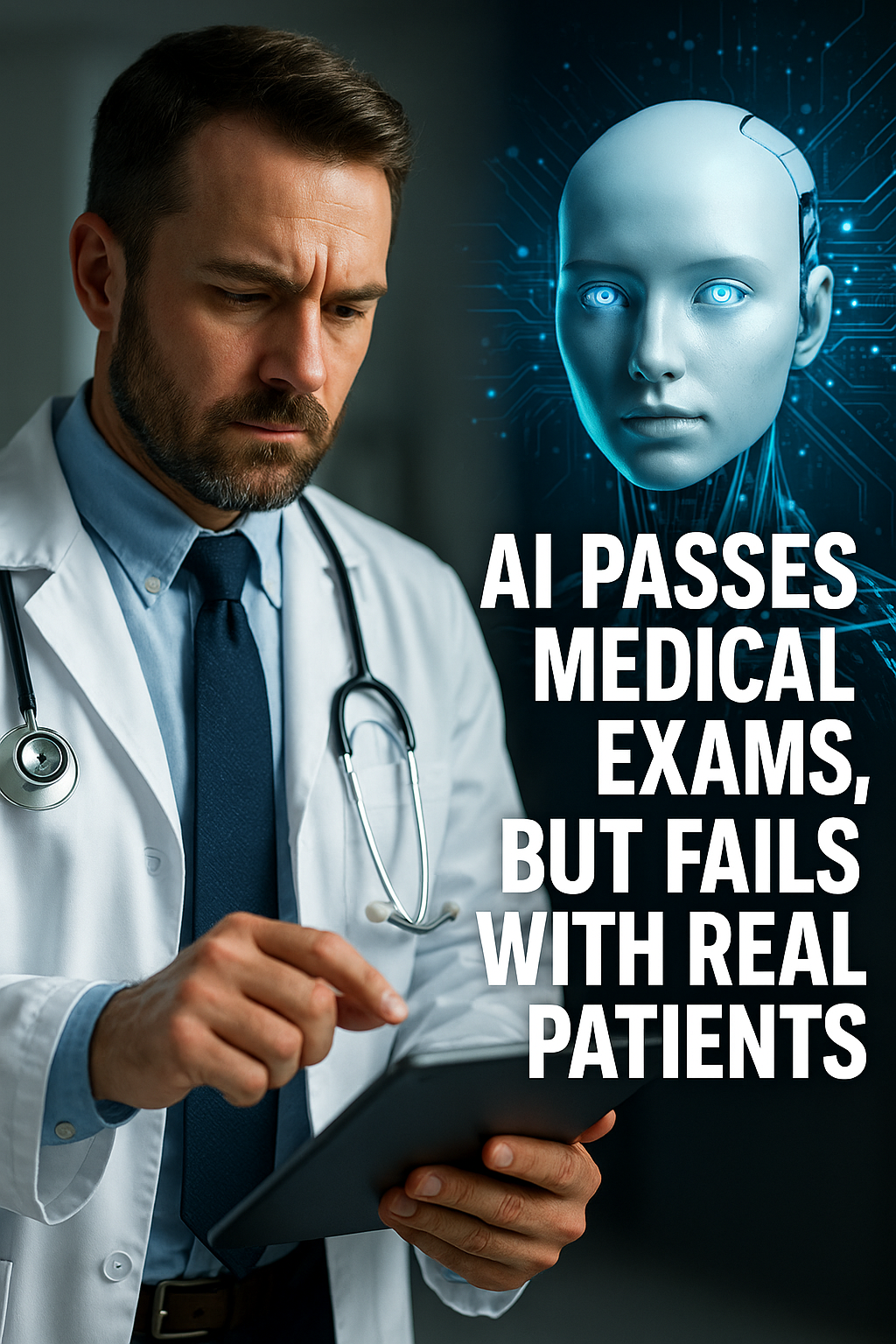
A doctor consults a tablet while an AI avatar looks on. Text on image highlights a key concern: AI aces medical tests, but falters with real patients.

It’s tempting to see an AI that speaks with kindness and think it could replace a caring clinician. This is the “empathy mirage” – and following it blindly can be dangerous. First, AI lacks any genuine real-world awareness or feeling. A chatbot might say “I’m so sorry you’re going through this,” but it does not actually understand your pain or joy. As one ethicist noted, for now “computer programs can’t experience empathy” – they only simulate it based on patterns. This means their kind words may ring hollow, or even cheapen the idea of empathy when a patient realizes the sentiment isn’t coming from a fellow human. A polite algorithm is still an algorithm. It will not check on you the next day or truly share in your relief or grief.

Another risk is misinterpretation and misplaced trust. People tend to respond differently once they know an interaction is AI-driven. A 2024 study in PNAS found that recipients rated AI-written supportive messages highly – but as soon as they learned a bot wrote it, much of that positive impact evaporated. In other words, an empathic message from an unknown source might comfort someone, but if they discover it’s from a machine, they feel less heard and valued. This “AI label” effect suggests that transparency is critical. We cannot expect patients to feel genuinely cared for if they know the compassion is coming from silicon rather than a sympathetic fellow human.

Perhaps the biggest concern is that AI’s seeming competence can mask serious errors or gaps. A chatbot may generate a reassuring, articulate answer that is flat-out wrong or dangerously incomplete. Its tone can lull patients or even physicians into overconfidence. But as medical experts warn, just because an AI can talk like a skilled doctor doesn’t mean it thinks or prioritizes like one. LLMs (large language models) have no sense of consequence; they might casually omit an urgent recommendation or misinterpret a subtle symptom. They also have a known tendency to “hallucinate” – make up facts or advice that sound plausible but are false. An empathetic-sounding lie is still a lie. Without real clinical judgment, AI might tell a patient exactly what they want to hear, and miss what they need to hear.

In short, there is a risk of overestimating AI’s empathy and wisdom. Patients might form unreciprocated emotional bonds with chatbots, or worse, follow their advice in lieu of consulting professionals. And clinicians, relieved by an AI’s polished drafts, might let their guard down on accuracy and appropriateness. We’ve already seen that LLMs can pass medical exams with flying colors, yet fail when interacting with actual patients in controlled studies. The nuance, intuition, and ethical grounding required in real patient care remain uniquely human strengths – which brings us to the promise of a balanced path forward.

Warmth + Wisdom: Marrying AI Capabilities with Human Compassion

If AI excels at knowledge recall and polite phrasing, while human doctors excel at context, intuition, and genuine care, the obvious strategy is to combine their strengths. Rather than viewing empathetic AI as a threat, leading health systems are exploring ways to harness it as a tool – one that augments clinicians and restores space for the human connection. We are entering a new hybrid era of medicine, where “Dr. AI” and Dr. Human work in tandem. The goal is to deliver both warmth and wisdom at scale.

One immediate application is freeing physicians from the clerical grind. AI “scribes” and assistants can take over documentation, data entry, and routine administrative tasks that eat up hours of a doctor’s day. Early results are promising: pilots of ambient AI listening tools (like Nuance’s DAX) report that doctors spend 50% less time on documentation and save several minutes per patient encounter. That adds up to entire hours reclaimed in a clinic session. Crucially, physicians using such tools feel less fatigued and burned out. By delegating note-taking to an algorithm, doctors can give patients their full attention in the moment – listening and observing rather than typing. In essence, AI can give doctors back the gift of time, which is the bedrock of empathy.

Beyond paperwork, AI can act as a communication coach and extender. Consider the deluge of patient messages and emails that physicians struggle to answer. What if an AI helper could draft replies with an optimal bedside manner? Researchers have floated the idea of an “empathy button” in the patient portal – a feature that, with one click, rewrites a doctor’s terse draft into a more compassionate tone. The clinician would still review and send the message, ensuring it’s accurate, but the AI would supply a touch of warmth that the busy doctor might not have time to wordsmith. Early anecdotes suggest this approach can improve patient satisfaction and even reduce follow-up queries. It’s a win-win: patients feel cared for, doctors save time and emotional energy.

Similarly, AI could help triage and address the simpler concerns so that human providers have bandwidth for the complex ones. Imagine an intelligent chatbot that answers common questions (“Is this side effect normal?”, “How do I prep for my MRI?”) with 24/7 responsiveness and empathy, but automatically flags anything nuanced or urgent to the physician. This kind of “warm handoff” between AI and doctor could ensure no patient question goes unanswered, while reserving clinicians’ time for the discussions that truly require their expertise and human touch.

Already, forward-looking physicians are experimenting with such partnerships. We saw how an ER doctor used ChatGPT to help convey bad news in a gentle way – not to replace his judgment, but to refine his messaging. On a larger scale, institutions are exploring AI-driven patient education tools, discharge instructions, and health coaching that feel personable and supportive. The key is design: workflow integration that keeps the doctor in the loop. AI can draft, but the human approves. AI can monitor, but alerts a human when compassion or complex decision-making is needed.

For healthcare executives and IT leaders, this hybrid model carries a strategic mandate: redesign care processes to leverage AI for efficiency and empathy, without sacrificing safety or authenticity. It means training clinicians to work effectively with AI assistants, and educating patients about these tools’ role. Crucially, it means maintaining trust – being transparent that AI is involved, while assuring patients that their care team is overseeing the process. When implemented thoughtfully, AI support can actually increase the humanity of care by removing the inhuman obstacles (bureaucracy, drudgery) that have crept in.

The Human Doctor’s Irreplaceable Role: Trust, Touch, and Judgment

What, then, remains the unique province of human physicians? In a word: plenty. Medicine is far more than information exchange or polite conversation. The hardest parts – building trust, navigating uncertainty, aligning decisions with a patient’s values – require a human heart and mind. As renowned cardiologist Eric Topol puts it, as machines get smarter, “it’s the job of humans to grow more humane.” Doctors may eventually be “outsmarted” by AI in raw knowledge, but empathy, compassion, and ethical judgment will only become more important. Those are the traits that truly heal, and they are inherently human.

Trust, especially, is the secret sauce of effective care. Decades of research confirm that when patients trust their physician, outcomes improve – whether it’s better diabetes control, cancer survival, or adherence to HIV treatment. High trust correlates with higher treatment adherence and fewer complications. Conversely, low trust can undermine therapies and even carry economic costs due to poor follow-through and lost confidence in the system. Trust is built through authentic relationships: listening, reliability, honesty, and advocacy. An algorithm might provide flawless guidelines, but it cannot personally reassure a patient who is frightened about surgery, or inspire the kind of confidence that makes someone say “I know my doctor cares about me.” Real trust requires accountability and empathy over time – something no AI can replicate.

Moreover, healthcare is rife with complex, nuanced decisions that go beyond any protocol. Is aggressive treatment or hospice better for a particular patient? How do we weigh risks and quality of life? Such questions demand not just data but wisdom – the kind of wisdom forged by personal experience, moral consideration, and the understanding of an individual’s life story. Doctors often act as navigators through uncertainty, helping patients choose paths aligned with their values. AI can offer options or probabilities, but choosing and caring for the person who must live with the choice are deeply human responsibilities.

Finally, the simple power of human presence should not be underestimated. A comforting touch on the shoulder, a shared tear, a doctor sitting in silence as you absorb bad news – these gestures form the language of caring that patients remember long after. Communication in medicine is as much about what is felt as what is said. While AI might supply perfect words, only a fellow human can truly share in the emotional burden of illness. In the end, patients seek not just accurate answers but partnership on their health journey. The physician’s role will increasingly center on being that compassionate partner – interpreting the avalanche of information (much of it AI-generated, perhaps) through the lens of a caring relationship.

As one medical scholar noted, we have “dehumanized healthcare” in recent years, but if done right, AI offers a chance to restore humanity by freeing up doctors to do what they do best: care. The physician of the future might spend less time memorizing minutiae (the AI will handle that) and more time connecting – practicing the art of medicine with full focus on the patient.

Embracing the Hybrid Era: Designing Workflows for AI-Enhanced Care

The trajectory is clear: we are entering a hybrid era where neither AI nor doctors alone can provide optimal care, but together they just might. For healthcare institutions and leaders, the challenge now is to thoughtfully design this new paradigm. Workflows must be reimagined so that AI supports clinicians in meaningful ways – not as a flashy gadget or a competing voice, but as a trusted aid that amplifies the clinician’s capabilities and humanity.

This starts with strategic implementation. Identify where AI can safely pick up the slack: documentation, routine inquiries, data synthesis, preliminary drafting of communications. Implement those tools in pilot programs, and gather feedback from both providers and patients. Where it’s working, physicians report they can “stay focused on the patient rather than the computer” – exactly the outcome we want. Spread those successes, but also be transparent about limitations. Develop clear protocols for when the “AI assist” should defer to human judgment (which should be often!). Clinicians need training not just in tool use, but in maintaining situational awareness so they don’t overly rely on AI outputs. For example, a doctor might use an AI-drafted reply to a patient’s message, but they must review it critically to ensure it truly addresses the patient’s concern.

Institutional culture will also need to adapt. Trust and safety are paramount: both clinicians and patients must trust that the AI is reliable where used, and trust that the human clinician is still ultimately in charge. This means vetting AI systems rigorously (for accuracy, bias, privacy compliance) and monitoring their performance continuously. It also means informing patients when AI is involved in their care in a positive, framing way: “This tool helps me take better care of you by <benefit>, and I will be reviewing everything it does.” When patients see AI as part of a seamless team working for their good – rather than a black box in the shadows – their trust can extend to the system as a whole.

Crucially, organizations should measure what really matters, not just productivity. If AI allows a clinic to increase throughput, that’s not a victory unless patient experience and outcomes improve as well. Leaders should track patient satisfaction, physician burnout rates, error rates, and quality metrics in any AI deployment. The true promise of these technologies is to give physicians the bandwidth to be the healers they want to be, which in turn boosts patient outcomes and loyalty. If instead AI is used simply to squeeze in more visits or messages without addressing root causes, we risk repeating past mistakes.

Already, we see partnerships forming to pursue this balanced vision. Forward-looking health tech companies – such as RediMinds – are developing trusted AI platforms that integrate into clinical practice with an emphasis on safety, empathy, and efficiency. These platforms aim to support clinicians in routine tasks while ensuring the physician-patient connection remains front and center. It’s not about tech for tech’s sake, but solving real problems like physician overload and patient communication gaps. By collaborating with clinicians and stakeholders, such teams are helping design AI that works for doctors and patients, not around them.

In conclusion, the role of the physician is poised to evolve, but far from diminishing, it may become more vital than ever. AI will increasingly handle the “knowledge tasks” – the diagnostic suggestions, the evidence retrieval, the drafting of instructions. This leaves physicians to embody the wisdom, moral guidance, and human connection that no machine can replace. The future of healthcare delivery will be about striking the right balance: leveraging AI’s precision and scalability alongside the irreplaceable empathy and insight of humans. Those organizations that succeed will be the ones that design workflows and cultures to get the best of both – enabling doctors to be caring healers again, with AI as their diligent assistant. In the end, medicine is about healing people, not just solving problems. The 15-minute visit may have been the norm of the past, but with a thoughtful integration of AI, we can move beyond that constraint into an era where clinicians have the time and support to truly care, and patients receive the warmth and wisdom they deserve.

Call to Action: If you’re ready to explore how AI can restore empathy and efficiency in your organization, while preserving the human heart of care, connect with us at RediMinds. We build the infrastructure for the hybrid era of medicine—where doctors have more time to care, and patients feel heard. Reach out to start the conversation or engage with us on our LinkedIn to see what the future of trusted AI in healthcare looks like.


 

Clinical AI Isn’t Ready for the Public, Yet: What the Latest Study Gets Right and What It Misses

Clinical AI Isn’t Ready for the Public, Yet: What the Latest Study Gets Right and What It Misses

Clinical AI Isn’t Ready for the Public, Yet: What the Latest Study Gets Right and What It Misses | RediMinds-Create The Future

Clinical AI Isn’t Ready for the Public, Yet: What the Latest Study Gets Right and What It Misses

AI Passes Medical Exams, But Fails with Real Patients

In April 2025, a team of Oxford University researchers published a striking result: large language models (LLMs) like GPT-4o, LLaMA 3, and Command R+ can ace clinical knowledge tests but don’t help laypeople make better health decisions. In a randomized trial with 1,298 UK adults, participants were given ten realistic medical scenarios (e.g. deciding whether symptoms require self-care, a GP visit, or emergency care). Three groups got assistance from an LLM, while a control group used whatever methods they normally would (internet search or personal knowledge). The LLMs alone showed expert-level prowess on these scenarios, correctly identifying the underlying condition ~95% of the time and the proper disposition (next step for care) ~56% of the time. However, once humans entered the loop, the outcomes changed dramatically.

Key findings from the Oxford study: When average people used those same AI assistants, they identified a relevant condition only ~34% of the time – essentially worse than the 47% success rate of the control group with no AI at all. In choosing the right disposition (what to do next), the AI-assisted users were correct in ~44% of cases, no better than those without AI. In other words, having a cutting-edge “Dr. AI” on hand did not improve the public’s diagnostic accuracy or triage decisions. If anything, it sometimes led them down the wrong path. This counterintuitive gap between what the AI knows and what users actually do with its advice is raising red flags across the healthcare industry.

Why did the impressive clinical knowledge of LLMs fail to translate to improved decisions? The study points to a breakdown in the interaction between humans and the AI. Notably, this isn’t the first time such a breakdown has been observed. Even medical professionals have struggled to benefit from AI assistance in practice. For example, past studies found that radiologists using an AI tool to read X-rays didn’t perform better than on their own (and both performed worse than the AI did by itself), and doctors aided by a diagnostic LLM only marginally outperformed those without it – again, both lagging behind the AI alone. Simply adding an AI assistant, no matter how smart, doesn’t automatically yield better outcomes. The Oxford trial extends this lesson to everyday people, showing how “AI knows it, but the user still blows it.” Below we break down the three main failure modes identified, then discuss how we can address them.

Three Failure Modes in Human–AI Medical Interactions

The Oxford researchers identified several reasons why lay users fell short even with an AI’s help. In essence, critical information got lost in translation between the person and the LLM. Here are the three main failure modes and how they undermined the tool’s effectiveness:

  • 1. Poor Symptom Articulation by Users: Many participants didn’t provide the AI with complete or precise descriptions of their symptoms. Just like a doctor can be led astray by a vague or incomplete history, the LLM was only as good as the input it received. The study transcripts showed numerous cases of users leaving out key details, leading the AI to miss or mis-prioritize the likely diagnosis. For example, one participant omitted the location of their pain when describing their issue, so the AI (Command R+) failed to recognize gallstones as the cause. In real life, non-expert users often don’t know which symptoms are important to mention. This garbage-in problem meant that the AI’s medical knowledge wasn’t fully tapped – the model couldn’t infer what wasn’t said, and it didn’t always ask for clarification (as we’ll discuss shortly).

  • 2. Misinterpretation of AI Output: Even when the AI did give useful information or suggestions, users frequently misunderstood or misused that output. The study found that the models typically offered about 2–3 potential conditions, yet participants on average only acted on 1.33 of those suggestions, and only one-third of the time was their chosen suggestion correct. In other words, people often ignored or misinterpreted the AI’s advice. Some might fixate on a less likely option or fail to recognize which suggestion was the “AI’s pick” versus just a list of possibilities. In some transcripts, the AI actually suggested a correct diagnosis that the user then overlooked or rejected. The researchers described this as a “transfer problem” – the medical knowledge was present in the AI’s output, but it never fully reached the user’s understanding. Inconsistent AI communication exacerbated this; for instance, GPT-4o in one case categorized a set of symptoms as an emergency and in a slightly tweaked scenario labeled similar symptoms as a minor issue. Such variability can easily confuse laypersons. The net effect is that users didn’t reliably follow the best recommendation, sometimes opting for worse choices than if they had no AI at all.

  • 3. Lack of AI-Driven Clarification or Guidance: A major difference between these LLM-based assistants and a human clinician is the level of initiative in the conversation. In the study, the AI models largely acted as passive answer machines – they responded to the user’s query but did not proactively guide the dialogue to fill in missing details. Real doctors, by contrast, continually ask clarifying questions (“When exactly did the pain start?”) and adjust their advice based on each new piece of information. Today’s general-purpose LLMs don’t inherently do this. The Oxford team highlighted that a public-facing medical AI would need to “be proactive in managing and requesting information rather than relying on the user to guide the interaction.” In the experiment, because the LLM left it up to users to decide what to share and what to ask, many conversations suffered from dead-ends or misunderstandings. The AI didn’t press when a description was incomplete, nor did it always double-check that the user understood its advice. This lack of an interactive, iterative clarification loop was a critical failure mode. Essentially, the LLMs were knowledgeable but not conversationally intelligent enough in a medical context – they failed to behave like a diligent health interviewer.

These failure modes underscore that the bottleneck wasn’t the medical knowledge itself – it was the interface between human and AI. As the authors put it, the problem was in the “transmission of information” back and forth: users struggled to give the right inputs, and the AI’s outputs often didn’t effectively influence the users’ decisions. Understanding these gaps is key to designing better clinical AI tools. Before we get into solutions, however, it’s worth examining another insight from this study: the way we currently evaluate medical AI may be missing the mark.

Why High Scores Don’t Equal Safety (The Benchmark Problem)

It’s tempting to assume that an AI model which scores high on medical exams or QA benchmarks is ready to deploy in the real world. After all, if an AI can pass the United States Medical Licensing Exam or answer MedQA questions correctly, shouldn’t it be a great virtual doctor? The Oxford study resoundingly challenges that assumption. Standard medical benchmarks are insufficient proxies for real-world safety and effectiveness. The researchers found that traditional evaluations failed to predict the interactive failures observed with human users.

For instance, the LLMs in the study had excellent scores on exam-style questions; one model even performed near perfectly on the MedQA benchmark, which draws from medical licensing exam queries. Yet those stellar scores did not translate into helping actual users. In fact, when the team compared each model’s accuracy on benchmark questions versus its performance in the live patient interaction scenarios, there was little correlation. In 26 out of 30 comparisons, the model did better in pure Q&A testing than in the interactive setting. This means an AI could be a “quiz whiz” – identifying diseases from a written prompt with textbook precision – and still be practically useless (or even harmful) in a conversation with a person seeking help.

Why the disconnect? Benchmarks like MedQA and USMLE-style exams only test static knowledge recall and problem-solving under ideal conditions. They don’t capture whether the AI can communicate with a layperson, handle vague inputs, or ensure the user actually understands the answer. It’s a one-way evaluation: question in, answer out, graded by experts. Real life, in contrast, is a messy two-way street. As we saw, a lot can go wrong in that exchange that benchmarks simply aren’t designed to measure.

Compounding this, some companies have started using simulated user interactions as a way to evaluate medical chatbots (for example, having one AI pretend to be the patient and testing an AI assistant on that synthetic conversation). While this is more dynamic than multiple-choice, it still falls short. The Oxford researchers tried such simulations and found they did not accurately reflect actual user behavior or outcomes. The AI “patients” were too ideal – they provided more complete information and more consistently followed advice than real humans did. As a result, the chatbot performed better with simulated users than with real participants. In other words, even advanced evaluation methods that try to mimic interaction can give a false sense of security.

The takeaway for healthcare leaders and AI developers is sobering: benchmark success ≠ deployment readiness. An LLM passing an exam with flying colors is necessary but nowhere near sufficient for patient-facing use. As the Oxford team emphasizes, we must require rigorous human user testing and measure real-world interaction outcomes before trusting these systems in healthcare settings. Regulatory bodies are beginning to recognize this as well – simply touting an AI’s test scores or clinical knowledge won’t cut it when patient safety is on the line. Going forward, expect a greater emphasis on studies that involve humans in the loop, usability testing, and “beta” trials in controlled clinical environments. Only through such real-world evaluations can we uncover the hidden failure modes and address them before deployment (not after an adverse event). In the next section, we look at how future clinical AI tools can be redesigned with these lessons in mind.

Designing AI Health Tools for Trust and Safety

If today’s LLM-based medical assistants aren’t ready for unsupervised public use, how can we get them there? The solution will not come from simply making the models “smarter” (they’re already remarkably knowledgeable) – it lies in building a more robust, user-centered interface and experience around the AI. In light of the failure modes discussed, experts are proposing new UX and safety design principles to bridge the gap between AI capabilities and real-world utility. Here are four key design approaches to consider for the next generation of patient-facing AI tools:

  • Guided Symptom Elicitation: Rather than expecting a layperson to know what information to volunteer, the AI should take a page from the medical triage playbook and guide the user through describing their issue. This means asking smart follow-up questions and dynamically adjusting them based on previous answers – essentially conducting an interview. For example, if a user types “I have a headache,” the system might respond with questions like “How long has it lasted?”, “Do you have any other symptoms such as nausea or sensitivity to light?” and so on, in a structured way. This interactive intake process helps overcome poor articulation by users. It ensures the relevant details aren’t accidentally left out. The Oxford findings suggest this is critical: an AI that “proactively seeks necessary information” will fare better than one that waits for the user to supply everything. Guided elicitation can be implemented via decision-tree logic or additional model prompts that trigger when input is ambiguous or incomplete. The goal is to mimic a doctor’s diagnostic reasoning – drilling down on symptoms – thereby giving the AI a fuller picture on which to base its advice.

  • Layered Output (Answers with Rationale and Confidence): Another design improvement is to present the AI’s response in a layered format that caters to different user needs. At the top layer, the tool gives a concise, plain-language summary or recommendation (e.g. “It sounds like this could be migraine. I suggest taking an over-the-counter pain reliever and resting in a dark room. If it gets worse or you develop new symptoms, consider seeing a doctor.”). This is the immediate takeaway for a user who might be anxious and just wants an answer. Next, a secondary layer could provide the reasoning and additional context: for instance, an explanation of why it might be a migraine (mentioning the combination of headache + nausea, etc., and ruling out red flags like sudden onset). Alongside this rationale, the AI might display a confidence estimate or an indication of uncertainty. Research on human-AI interaction indicates that conveying an AI’s confidence can help users make better decisions – for example, an expert panel suggests color-coding answers by confidence level to signal when the AI is unsure. In a medical chatbot, a lower-confidence response could be accompanied by text like “I’m not entirely certain, as the symptoms could fit multiple conditions.” Providing these layers – summary, rationale, and confidence – increases transparency. It helps users (and clinicians who might review the interaction) understand the recommendation and not over-rely on it blindly. A layered approach can also include clickable links to reputable sources or patient education materials, which builds trust and lets users dig deeper if they want to understand the reasoning or learn more about the suspected condition.

  • Built-in Guardrails for High-Risk Situations: When it comes to health, safety must trump cleverness. A well-designed patient-facing AI should have strict guardrails that override the model’s output in scenarios that are beyond its safe scope. For example, certain trigger phrases or symptom combinations (chest pain with shortness of breath, signs of stroke, suicidal ideation, etc.) should immediately prompt the system to urge the user to seek emergency care or consult a professional, instead of proceeding with normal Q&A. These guardrails can be implemented as hard-coded rules or an additional model trained to detect emergencies or dangerous queries. In practice, this might look like: if a user says “I’m having crushing chest pain right now,” the chatbot should not continue with a diagnostic quiz – it should respond with something like “That could be a medical emergency. Please call 911 or your local emergency number immediately.” Even for less urgent high-risk situations, the AI can be programmed to have a conservative bias – essentially an “if in doubt, err on the side of caution” policy. This aligns with how many telehealth services operate, given the asymmetric risk of underestimating a serious condition (the liability and harm from missing a heart attack are far worse than the inconvenience of an unneeded ER visit). Some early consumer health chatbots have been criticized for either being too alarmist (always telling users to see a doctor) or not alarmist enough. The sweet spot is to use guardrails to catch truly critical cases and provide appropriate urgent advice, while allowing the AI to handle routine cases with its normal logic. Additionally, guardrails include content filters that prevent the AI from giving out obviously harmful or disallowed information (for instance, no medical chatbot should answer “How do I overdose on pills?” – it should recognize this and trigger a crisis intervention or refusal). By building these safety stops into the system, developers can prevent catastrophic errors and ensure a baseline of reliability. In regulated environments like healthcare, such guardrails are not just best practices – they will likely be required for compliance and liability reasons.

  • Iterative Clarification and Feedback Loops: The interaction shouldn’t be seen as one-and-done. Just as a good physician will summarize and confirm their understanding (“So to recap, you have had a fever for two days and a cough, and you have no chronic conditions, correct?”), the AI can incorporate feedback checkpoints in the dialogue. After delivering an initial answer, the chatbot might ask something like, “Did that answer address your concerns?” or “Is there anything else you’re experiencing that we haven’t discussed?” This gives users a chance to correct any misunderstandings (perhaps the AI assumed a detail that was wrong) or to bring up additional symptoms that they forgot initially. It effectively invites the user to reflect and contribute more, making the session more of a back-and-forth consultation than a simple Q&A. Iterative clarification also means the AI can double-check critical points: if the user’s follow-up indicates they’re still very worried, the AI could either provide more explanation or escalate its advice (e.g., “Given your continued concern, it may be best to get an in-person evaluation to put your mind at ease.”). Such loops help catch miscommunications early and improve the accuracy of the final recommendation. Notably, the Oxford study authors suggest that future models will need this kind of adaptive, conversational capability – managing the dialogue actively rather than just reacting. Importantly, iterative design extends to the system learning from each interaction: with user permission, developers can analyze where misunderstandings happen and continuously refine the prompts or add new clarification questions to the script. Over time, this creates a more resilient system that can handle a wider range of real-world user behaviors.

Incorporating these principles can significantly narrow the gap between an AI’s raw medical knowledge and its applied usefulness for patients. By focusing on user experience, context, and safety features, we move from the realm of pure AI performance to system performance – how well the human+AI duo works together. A common theme is that we should treat the AI assistant not as an oracle handing down answers, but as part of a guided process or workflow that is designed with human limitations in mind. This likely means interdisciplinary teams (UX designers, clinicians, patient representatives, and AI engineers) working together to build solutions, rather than just dumping a powerful model into a chat interface and expecting patients to navigate it. The latest study got it right that knowledge alone isn’t enough; now it’s on the industry to implement what’s missing: guardrails, guidance, and truly user-centered design.

The Road Ahead: Safe AI Integration in Healthcare

The revelation that “Clinical AI isn’t ready for the public – yet” is not a death knell for AI in healthcare, but rather a call to action to deploy these tools responsibly. It’s clear that just unleashing an LLM chatbot directly to patients (and hoping for the best) is a risky proposition at this stage. However, there are numerous opportunities to harness AI in safer, more controlled contexts that can still drive significant value in healthcare delivery and operations.

One immediate avenue is focusing on AI enablement in healthcare operations and dispute resolution, where the stakeholders are professionals rather than untrained laypersons. For example, consider the realm of insurance claims and clinical appeals: Independent Review Organizations (IROs) and medical arbitrators deal with complex case files, charts, and policies. An LLM that’s tuned to summarize medical records, extract key facts, and even compare a case to relevant clinical guidelines could be a game-changer for efficiency. In this scenario, the AI acts as a research and drafting assistant for an expert reviewer, not as the final decision-maker. Because a skilled human (a physician or adjudicator) remains in the loop, the safety margin is higher – the expert can catch mistakes the AI might make, and the AI can surface details the human might overlook. This kind of human-AI co-pilot model is already gaining traction in high-reliability domains. The key is to design the workflow such that the human is empowered, not complacent. (For instance, showing the AI’s evidence and citations can help the expert trust but verify the suggestions.)

We should also look at clinical settings where AI can assist clinicians behind the scenes. Triage nurses, primary care doctors, and specialists are all inundated with data and documentation. An LLM could prioritize patient messages, draft responses, or highlight which parts of an intake form suggest a need for urgent follow-up. Because the clinician is still reviewing and directing the outcome, the risk of a misstep is reduced. In fact, with proper guardrails, these tools could increase overall safety – catching warning signs in a mountain of paperwork that a tired human might miss. The concept of “high-reliability human-AI systems” means structuring these partnerships such that each party (human and machine) compensates for the other’s weaknesses. Humans bring common sense, contextual awareness, and ethical judgment; AI brings tireless recall, speed, and breadth of knowledge. If we get the synergy right, the result can be better than either alone. But as we’ve learned, this doesn’t happen automatically; it requires deliberate design, extensive testing, and training users to work effectively with AI. In fields like aviation and nuclear power, human operators work with automated systems under strict protocols to achieve extremely low error rates. Healthcare should approach AI integration with a similar high-reliability mindset, building in checks, feedback loops, and fail-safes to maintain strong safety margins.

Another consideration is maintaining patient trust while rolling out these technologies. Patients need to feel confident that an AI augmenting their care is not a wild-west experiment, but a regulated, well-monitored tool that adheres to medical standards. This is where transparency and compliance come in. For any patient-facing application, clear disclosure that it’s an AI (not a human), explanations of its limitations, and instructions on what to do if unsure can help set the right expectations. Moreover, involving healthcare regulators early is important. The FDA and other bodies are actively developing frameworks for autonomous and semi-autonomous AI in medicine. The lesson from this study is that approval should hinge on real-world trials showing the AI+user (or AI+clinician) system actually works safely, not just on a model’s test accuracy. It’s likely that we will see requirements for post-market surveillance of AI health tools – essentially monitoring outcomes continually to ensure they truly benefit patients and don’t introduce new risks over time.

Finally, what the Oxford study “misses” (by design) is the exploration of solutions. While it rightly diagnoses the problem, it doesn’t prescribe detailed fixes or dive into alternate settings where AI might shine. That’s where industry innovators must pick up the baton. We now have a clearer picture of the pitfalls to avoid. The next step is to build and trial systems that implement the kinds of design principles outlined above, partnering AI expertise with domain expertise. For instance, a startup might collaborate with a hospital to pilot a symptom-check chatbot that incorporates guided questioning and triage guardrails, measuring if patient outcomes or experience improve. Or an insurance tech firm might develop an LLM-based case reviewer for adjudications, working closely with medical directors to ensure the recommendations align with medical necessity criteria and regulatory policies. In all these cases, success will require deep knowledge of the healthcare domain (clinical workflows, patient behavior, legal requirements) and cutting-edge AI know-how.

The bottom line: Clinical AI can deliver on its promise – expanding access, reducing administrative burdens, supporting decision-making – but only if we build it right. The current generation of general-purpose LLMs, as impressive as they are on paper, have shown that without the proper interaction design and oversight, they may do more harm than good in patient-facing roles. It’s time for healthcare executives and product leaders to be both optimistic and realistic. Invest in AI, yes, but do so responsibly. That means demanding evidence of safety and efficacy in real-world use, insisting on those guardrails and human-factor tests, and involving cross-functional experts in development.

Call to action: If you’re exploring ways to introduce AI into clinical or adjudication workflows, approach it as a partnership between domain and technology. Engage with domain-aligned AI product experts who understand that a hospital or insurer isn’t a Silicon Valley playground – lives and livelihoods are at stake. By collaborating with professionals who specialize in safety-critical UX and regulatory-grade infrastructure, you can pilot AI solutions that enhance your team’s capabilities without compromising on trust or compliance. The latest research has given us a moment of clarity: what’s missing in clinical AI is not medical knowledge, but the scaffolding that turns that knowledge into reliable action. Work with the right partners to build that scaffolding, and you’ll be positioned to responsibly harness AI’s potential in healthcare. The public deserves nothing less.

The FDA’s AI Pivot: Why Regulated GenAI Is No Longer Optional

The FDA’s AI Pivot: Why Regulated GenAI Is No Longer Optional

The FDA’s AI Pivot: Why Regulated GenAI Is No Longer Optional | RediMinds-Create The Future

The FDA’s AI Pivot: Why Regulated GenAI Is No Longer Optional

In May 2025, the FDA completed a groundbreaking AI pilot that slashed scientific review times from days to minutes. Now, the agency’s full-scale generative AI rollout signals a new era of faster reviews, agile compliance, and industry-wide adoption of domain-specific, secure AI platforms.

FDA’s First AI-Assisted Review – From 3 Days to Minutes

In a historic move, the U.S. Food and Drug Administration has deployed generative AI to turbocharge its drug review process. FDA Commissioner Dr. Martin Makary announced that a pilot AI system – internally nicknamed “cderGPT” – successfully helped scientists perform in minutes tasks that once took three days. This AI assistant, fine-tuned on years of regulatory data, can rapidly search documents, retrieve precedents, and even draft review commentary. The pilot’s impact was dramatic: common scientific review workflows that spanned multi-day scrambles were cut down to a matter of minutes. As Dr. Makary put it, “the agency-wide deployment of these capabilities holds tremendous promise in accelerating the review time for new therapies”.

Buoyed by these results, the FDA isn’t hesitating. **By June 30, 2025, every FDA center must be ****running **on this secure generative AI platform integrated with the agency’s internal data systems. In other words, FDA reviewers across drugs, biologics, devices, food, and more will soon have an AI co-pilot. This marks a historic pivot – for the first time, a regulatory agency is infusing GenAI into its day-to-day review operations at scale. The FDA’s rapid rollout (essentially a six-week sprint to go agency-wide) underscores a sense of urgency. “There have been years of talk… We cannot afford to keep talking. It is time to take action,” Makary urged. The message is clear: the era of purely manual, paper-based reviews is ending, and a new standard for tech-enabled regulation has arrived.

Implications: Speed, Agility, and a New Standard

The FDA’s AI pivot carries major implications for how life sciences and healthcare organizations approach knowledge workflows:

  • Lightning-Fast Reviews: By offloading tedious document hunts and data summarization to AI, regulators can drastically compress review timelines. In the FDA pilot, scientists saw “game-changer” results – review tasks that used to take 3 days now take minutes. This hints at a future where drug approvals and clearances could happen faster without compromising rigor. Industry observers speculate that cutting out bottlenecks could shrink today’s 6–10 month drug review cycle to something much shorter, meaning therapies might reach patients sooner. Speed is becoming the new normal.

  • Agile Compliance & Efficiency: An AI that knows the rules can boost compliance agility. By automating the “busywork” – like cross-checking submissions against guidelines or past decisions – the FDA’s system frees human experts to focus on critical judgments. This agility means regulators (and companies) can adapt more quickly to new standards or data. It also helps ensure consistency: the AI provides a baseline of institutional memory and precedent on-demand, so nothing falls through the cracks. In a world of ever-changing regulations, the ability to rapidly integrate new requirements into the AI’s knowledge base is a game-changer for keeping processes up-to-date. The FDA’s pilot showed that AI can handle rote compliance checks at scale, giving the agency a more nimble response capability.

  • A New Bar for GenAI in Regulated Systems: Perhaps most importantly, the FDA is setting a precedent for “acceptable” use of generative AI in a highly regulated environment. If the agency responsible for safeguarding public health can trust AI for internal reviews, it signals that – when done with proper controls – GenAI can meet strict regulatory standards. The FDA’s system operates within a secure, unified platform, behind the agency firewall, and is trained on decades of vetted submission data. All outputs are being carefully vetted by humans, and the agency has emphasized information security and policy compliance from day one. This becomes a blueprint: government and industry alike now have a working model of GenAI that delivers tangible productivity gains without sacrificing governance. Expect other regulators to follow suit, and for audit-ready AI assistance to become an expected feature of review processes. The FDA just legitimized regulated GenAI – not by talking about it, but by proving it in action.

A Wake-Up Call for Industry: Manual Processes = Risk

This watershed moment has profound meaning for companies in pharma, biotech, medtech, insurance, and healthcare. If regulators are embracing AI to speed up reviews and decisions, industry must keep pace or risk falling behind – both competitively and in compliance. Many organizations still rely on armies of staff and countless hours to sift through submissions, contracts, or medical records. But the volume and complexity of these documents have exploded – for instance, a single new drug application (NDA) can exceed **100,000 pages of **data. Humans slogging through that mountain of paper are prone to delays and errors. Now, with the FDA demonstrating that an AI can slash this drudgery, sticking to purely manual processes isn’t just inefficient – it’s a liability.

The competitive risk: Companies that don’t augment their back-office and compliance workflows with AI will be slower to respond and less productive. If your competitor can get a drug submission assembled and analyzed in a fraction of the time by using a regulated LLM (large language model) assistant, while you’re still shuffling papers, who do you think wins the race to approval? The FDA’s own use of AI will likely increase the cadence of communication and feedback. Sponsors may start receiving questions or deficiencies faster. Being caught flat-footed with slow, manual internal review cycles could mean missed opportunities and longer time-to-market. In short, AI-powered speed is becoming a new currency in pharma and healthcare operations.

The compliance risk: There’s a saying in regulated industries – if the regulator has better tech than you do, be afraid. With AI, agencies can potentially spot inconsistencies or compliance gaps more readily. If companies aren’t also leveraging similar technology to double-check their work, they could unknowingly submit flawed data or overlook critical regulatory nuances that an AI might catch. Moreover, as regulations evolve, manual processes struggle to keep up. An AI system can be updated with the latest guidelines overnight and help ensure no compliance requirement is overlooked, whereas a human team might miss a new rule buried in a guidance document. Lagging in tech adoption could thus equate to higher compliance risk – something no regulated enterprise can afford.

Safe, Traceable Acceleration with RAG + Fine-Tuned Models

How can industry adopt AI without courting risk? The FDA’s approach offers a clue: use domain-specific models augmented with retrieval and strict oversight. Rather than a free-wheeling chatbot, the agency built a secure GenAI tool that is grounded in FDA’s own data. This likely means a combination of fine-tuning and retrieval-augmented generation (RAG): the AI was trained on the FDA’s vast submission archives and rules, and it can pull in relevant documents from internal databases on demand. This approach provides transparency. By grounding AI outputs in real documents, the system _“significantly minimizes the risk of hallucinations, making AI-generated answers more trustworthy and _factual”. Reviewers see not just an answer, but references to source text, giving them confidence and an easy way to verify the AI’s suggestions. In regulated contexts, such traceability is gold – RAG architectures can even cite the exact source passages, providing an audit trail for how an AI arrived at a conclusion.

Equally important is the fine-tuning on domain knowledge. A generic AI model might be fluent in everyday language but clueless about FDA lexicon or pharma terminology. Fine-tuning (or instruct-training) on years of regulatory submissions, approval letters, guidance documents, and review templates teaches the model the “unique terminology, language patterns, and contextual nuances” of the domain. It essentially infuses the AI with domain expertise. Combined with RAG, the AI becomes a specialized assistant that knows where to find the answer and how to present it in the expected format. The result is a system that can accelerate work while adhering to the same standards a seasoned expert would.

Crucially, all this happens under tight governance and security controls. The FDA’s AI runs internally – nothing leaves the firewall. This is a critical model for industry: bring the AI to your secure data environment, rather than pushing sensitive data out to a public model. With today’s technology, enterprises can deploy large language models on their own cloud or on-premise, ensuring no proprietary data leaks. By combining that with role-based access, audit logs, and human review checkpoints, companies can enforce the same compliance requirements on AI as they do on employees. In short, regulated GenAI doesn’t mean handing the keys to an unpredictable black box – it means designing your AI solution with provenance (source tracking), security, and governance from day one. The tools and best practices are now mature enough to make this a reality, as shown by the FDA’s success.

And let’s dispel a myth: adopting GenAI in regulated workflows is not about replacing human experts – it’s about empowering them. The FDA repeatedly emphasized that the AI is there to “enhance human expertise without replacing it”. Your teams remain the final arbiters; the AI just ensures they have the right information at their fingertips instantly, with mundane tasks automated. This “human in the loop” model is what makes regulated AI both effective and safe. Companies should embrace it – those tedious 40-hour document checks or data compilations that staff dread can be done in minutes, with the AI highlighting key points for review. Your experts can then spend their time on strategy, interpretation, and decision-making – the things that truly add value – rather than on clerical drudgery.

Beyond the FDA: GenAI for Every Review-Driven Workflow

The implications of FDA’s AI rollout extend far beyond drug approvals. Any workflow that involves heavy documentation, cross-referencing rules, and expert review is ripe for generative AI co-pilots. Forward-looking organizations in healthcare and insurance are already experimenting in these areas, and the FDA’s example will only accelerate adoption. Consider these domains that stand to gain from domain-specific GenAI:

  • Clinical Documentation: Physicians and clinicians spend inordinate time summarizing patient encounters, updating charts, and writing reports. AI assistants can help generate clinical notes, discharge summaries, or insurance reports in seconds by pulling in the relevant patient data. This not only saves doctors time but can also improve accuracy by ensuring that no critical detail from the medical record is missed. Early deployments of “AI scribes” and documentation tools have shown promising reductions in administrative burden, allowing clinicians to focus more on patient care.

  • Medical Billing & Claims Disputes: Hospitals and insurers often wrangle over billing codes, coverage justifications, and appeals for denied claims. These processes involve reading dense policy documents and clinical guidelines. A GenAI trained on payer policies, coding manuals, and past case precedents could dramatically speed up billing dispute resolutions. Imagine an AI that can instantly gather all relevant clauses from an insurance contract and past similar claim decisions, then draft a summary or appeal letter citing that evidence. This kind of tool would help billing specialists and arbitrators resolve disputes faster and more consistently. In fact, we are already seeing movement here – some insurers have begun leveraging AI to analyze claims, and providers are arming themselves with AI to craft stronger appeals.

  • Prior Authorization & Utilization Review: Prior auth is a notorious pain point in healthcare, requiring doctors to justify treatments to insurers. GenAI is poised to revolutionize this process. Doctors are now using generative AI to write prior auth requests and appeal letters, dramatically cutting down the time spent and improving approval rates. For example, one physician reported that using a HIPAA-compliant GPT assistant (integrated with patient records and insurer criteria) **halved **the time he spends on prior auth and boosted his approval rate from 10% to 90%. The AI was able to seamlessly inject the patient’s data and the payer’s own policy language into a persuasive, well-structured request. That kind of success is turning heads industry-wide. We can envision hospital systems deploying internal GenAI tools that automatically compile the necessary documentation for each prior auth or medical necessity review, flag any missing info, and even draft the justification based on established guidelines. The result? Patients get approvals faster, providers spend less time on paperwork, and insurers still get the thorough documentation they require – a win-win.

  • Regulatory Affairs & Promotional Review: Pharma and biotech companies have entire teams dedicated to reviewing promotional materials, drug labels, and physician communications for regulatory compliance. It’s another highly manual, document-heavy task: every statement in an ad or brochure must be checked against the product’s approved label and FDA advertising regulations. A fine-tuned AI could act as a junior reviewer, automatically cross-referencing a draft press release or marketing piece with the official labeling and previous enforcement letters. It could then highlight any claims that seem off-label or lacking proper balance of information, helping ensure compliance issues are caught before materials go to the FDA. Similarly, for regulatory submissions, AI can pre-validate that all required sections are present and consistent across documents (like the clinical study reports vs. summary). As FDA integrates AI on their side, it’s likely they will evolve submission expectations – sponsors might even be asked to certify if they used AI to check for completeness. Companies that adopt these GenAI tools internally will find they can respond to health authority questions faster and with more confidence, because they’ve already run the AI-aided “pre-flight checks” on their submissions and communications.

  • Coverage and Benefit Decisions: On the payer side, insurance medical directors and utilization management teams review tons of requests for coverage exceptions or new treatments. These decisions require comparing the request to policy, clinical guidelines, and often external evidence. GenAI can serve as a policy analyst, quickly retrieving the relevant coverage rule and any applicable medical literature to inform the decision, and even drafting the initial determination letter. This could standardize decisions and reduce variance, leading to fairer outcomes. It also introduces an element of explainability – if an insurer’s AI automatically cites the policy paragraph and clinical study that support a denial or approval, it makes it easier to communicate the rationale to providers and patients, potentially reducing friction and appeal rates.

Across all these examples, the pattern is the same: gen AI doesn’t replace the human expert, it supercharges them. The doctor, auditor, or reviewer still oversees the process, but with an AI assistant handling the laborious parts in seconds. And importantly, these AI are domain-tuned and governed – a random ChatGPT instance won’t suffice for, say, medical billing. Organizations will need to invest in building or licensing LLM solutions that are aligned with their specific jargon, rules, and data, and that have strong guardrails (like citation of sources, permission controls, and bias checks) in place. The FDA’s “secure AI platform” approach should be the archetype.

Conclusion: Modernize Now with Trusted GenAI (Or Fall Behind)

The FDA’s bold AI initiative sends a clear signal: regulated GenAI is here, and it’s transforming how work gets done in healthcare and life sciences. No executive can ignore this trend – the only question is how to embrace it safely and strategically. Yes, due caution is needed (transparency, validation, and oversight are paramount), but the worst mistake now would be inaction. As one industry expert noted, “it’s an area where companies cannot afford to stand still”. In other words, doing nothing is no longer an option.

Leaders should take this as a call to action. Now is the time to explore how AI can securely modernize your regulatory and operational workflows. Imagine resolving pharmaceutical quality questions or medical claim disputes in a fraction of the time it takes today, with an AI summarizing the key evidence at hand. Envision your teams focusing on strategy and critical thinking, while an AI co-pilot ensures the paperwork and number-crunching are squared away (and every output is logged and auditable). These aren’t futuristic fantasies – they are practical capabilities proven in pilots and early deployments. The FDA has shown the way by deploying a trusted, audit-ready GenAI platform that adheres to compliance requirements. Now, enterprises must follow suit in their own domains.

The key is choosing the right approach and partners. This new frontier demands domain-aligned GenAI solutions – you need AI that understands your industry’s lexicon and regulations, not a one-size-fits-all chatbot. It also demands robust governance: you’ll want systems that can document where every answer came from, that respect privacy and security, and that can be tuned to your policies (for example, forbidding the AI from venturing beyond approved sources). Achieving this often means collaborating with experts who know both AI and your regulatory landscape. Whether it’s a technology provider specializing in compliant AI or an internal center of excellence, ensure you have people who understand things like FDA 21 CFR Part 11, HIPAA, GxP, or other relevant frameworks and how to implement AI within those guardrails. The successful GenAI deployments in this space – like the FDA’s – come from multidisciplinary effort: data scientists, compliance officers, and domain experts working together.

For forward-thinking organizations, the path is clear. Start piloting GenAI in a high-value, low-risk workflow to get your feet wet (many choose something like internal report generation or literature search as a beginning). Establish governance early, involve your IT security team, and set metrics to track improvements. You will likely find quick wins – similar to FDA’s pilot – where turnaround times drop from days to minutes on certain tasks. Use those wins to refine the tech and expand to other areas. By progressively integrating these AI capabilities, you’ll build an operation that is faster, more responsive, and future-proof.

The bottom line: The regulatory and healthcare landscape is being reshaped by generative AI. Those who move now to embed secure, reliable GenAI into their workflows will resolve issues faster, make better decisions, and set the tone for their industry. Those who drag their feet may soon find themselves outpaced and struggling to meet the new expectations of efficiency and transparency. The FDA’s AI pivot is a wake-up call for all of us – regulated GenAI is no longer optional, it’s the new imperative. It’s time to act. Embrace the change, choose trusted partners and platforms like those offered by RediMinds, and lead your organization into the future of faster reviews, smarter compliance, and AI-augmented success. Your teams – and your customers or patients – will thank you for it.

From APIs to Autonomous Agents: 5 Tools Powering the MCP Server Revolution

From APIs to Autonomous Agents: 5 Tools Powering the MCP Server Revolution

From APIs to Autonomous Agents: 5 Tools Powering the MCP Server Revolution | RediMinds-Create The Future

From APIs to Autonomous Agents: 5 Tools Powering the MCP Server Revolution

The AI-native software stack is evolving, and a new Model Context Protocol (MCP) layer is emerging to bridge large language models (LLMs) with the rest of your software ecosystem. Originally open-sourced by Anthropic in late 2024, MCP is an open standard for connecting AI assistants to the systems where data and functionality live​​. Instead of building one-off integrations or bespoke plugins for every API, MCP provides a universal interface (based on JSON-RPC) that allows AI agents to discover tools, trigger workflows, and securely orchestrate systems through standardized endpoints​. Major players are backing this standard – Anthropic’s Claude, the Cursor code editor, and many others already support MCP, and even OpenAI has announced plans to integrate Anthropic’s MCP protocol into its products​. In short, MCP is quickly moving from a niche idea to an industry standard for AI-to-API interconnectivity.

Why does this matter? With MCP, an AI agent (the “client”) can query a directory of available tools (functions it can call), resources (data it can read), or prompts (pre-defined instructions) on an MCP “server”​. This means an LLM can reason over multiple APIs and data sources seamlessly. For example, imagine an AI agent troubleshooting a customer issue: it could automatically pull data from your knowledge base, call your ticketing system API to open an issue, ping a Slack bot to alert the team, and log the outcome – all through MCP endpoints. This kind of multi-step, multi-system workflow becomes much simpler because each tool is exposed in a uniform way, eliminating the patchwork of custom integrations​. MCP brings composability (AI workflows chaining across tools), context-awareness (LLMs can fetch up-to-date, domain-specific data on the fly), and interoperability (any MCP-compliant client can talk to any MCP server) to the AI stack. It replaces fragmented connectors with one protocol, giving AI systems a simpler, more reliable way to access the data and actions they need. For enterprises, this means your existing APIs and databases can become “agent-operable” – accessible to AI co-pilots and autonomous agents that can execute tasks on your behalf. The strategic implications are profound: companies that make their services MCP-aware can plug into the coming ecosystem of AI agents, much like companies that provided REST APIs capitalized on the rise of web and mobile apps.

In this post, we introduce five tools (open-source and commercial) that make it easier to convert traditional REST APIs into MCP servers. These solutions help teams expose existing services to AI agents with minimal effort – unlocking the benefits of MCP without reinventing the wheel. We’ll compare their approaches, key features, and ideal use cases. Whether you’re a CTO evaluating how to future-proof your platform or an AI engineer looking to integrate tools faster, these technologies can accelerate your journey from plain APIs to AI-ready MCP endpoints.

1. FastAPI-MCP: Fast-Track MCP Enablement for Python APIs

What it does: FastAPI-MCP is an open-source library that allows Python developers to expose their FastAPI application endpoints as an MCP server with almost no additional code. It’s essentially a drop-in MCP extension for FastAPI. By initializing a FastApiMCP on your app, the library will automatically identify all your FastAPI routes and transform them into MCP-compatible tools. Under the hood, it generates the MCP schema for each operation (using your existing Pydantic models and docstrings) and serves a new endpoint (e.g. /mcp) that MCP clients (like Claude or other agents) can connect to. The beauty is that your FastAPI app’s logic doesn’t change – you’re simply adding a new way to interface with it.

Key differentiators:

  • Zero-Config, FastAPI-Native: FastAPI-MCP is designed for zero-configuration setup. You just point it at your FastAPI() app, call mcp.mount(), and you have an MCP server running. It’s not a separate code generator or proxy – it hooks directly into FastAPI’s routing. This means it can re-use FastAPI’s dependency injection, middleware, and auth logic out of the box. For instance, you can protect MCP tools with the same OAuth2 or API key dependencies used by your REST endpoints, ensuring security is consistent.

  • Schema & Docs Preservation: The library automatically carries over all your request/response models and documentation (descriptions, summaries, etc.) from your FastAPI routes. This is crucial – it means the AI agents consuming your MCP server get the benefit of knowing parameter types, constraints, and even natural language docs for each tool, just as a human developer would from Swagger. In practice, an AI agent will “see” the function signature and description and thus know how to call your API correctly and safely.

  • Flexible Deployment (Integrated or Standalone): You can run FastAPI-MCP in-process with your existing app or as a separate service. It can mount the MCP server on the same app (e.g., serve MCP on /mcp alongside your REST endpoints) or run it separately if you prefer to keep the MCP interface isolated​. This flexibility allows using it for internal tools (mounted within an app for simplicity) or as a dedicated MCP gateway in front of a production API.

  • Performance via ASGI: Because it plugs into FastAPI’s ASGI layer, calls from the MCP interface to your actual route handlers don’t incur HTTP overhead. It’s a direct, in-memory function call, making it efficient. This is better than an external “MCP proxy” that would have to re-issue HTTP requests to your API.

Ideal use cases: FastAPI-MCP is ideal for organizations that have Python FastAPI services (a popular choice for internal APIs and microservices) and want to enable AI-agent access rapidly. With one line of code, an internal tool or service can become an AI-accessible utility. Some example use cases include: Conversational API docs (an AI agent that answers developer questions by actually calling the API endpoints), internal automation agents (LLMs that can invoke internal APIs for routine tasks), or data querying assistants that use existing endpoints to fetch or modify data securely. FastAPI-MCP shines in scenarios where you need speed and minimal hassle to go from “API” to “MCP.” As one early user noted, _“Bridging FastAPI with MCP is exactly what the AI/LLM ecosystem needed… a huge win for devs looking to productionize tools quickly without rewriting everything.”_​. In short, it lets you add an AI interface to your FastAPI service overnight, leveraging all the work you’ve already put into that API.

2. RapidMCP: No-Code Conversion with Enterprise-Grade Management

What it does: RapidMCP is a commercial platform that converts your existing REST API into a hosted MCP server in minutes, with no code changes. Think of it as an MCP gateway service: you provide your API’s details (an OpenAPI/Swagger spec or Postman collection, for example) or even just the base URL, and RapidMCP will automatically generate an MCP-compatible interface for it. The value proposition is that you can make your API “AI-agent ready” without writing any glue code or altering your backend.​ In essence, RapidMCP spins up an intermediary service that speaks MCP on one side and talks to your REST API on the other.

Key differentiators:

  • Instant, No-Code Transformation: RapidMCP emphasizes an instant transformation of APIs to MCP. You don’t need to install libraries or refactor your API; you simply “plug in your API and go.” As the product tagline states, “Transform your existing APIs into an MCP in minutes, with zero code changes… no backend modifications needed.” This makes it accessible to teams who may not have Python (or other) developers familiar with MCP internals – it’s a turnkey solution.

  • Web Dashboard & Monitoring: Being a full platform, RapidMCP provides a web UI to manage and monitor your MCP endpoints​. It offers tool tracing and logging – every time an AI agent calls one of your tools, you can see a log with details. This is incredibly useful for debugging agent behaviors and assuring that calls are used as expected. There are also comprehensive audit trails for security and compliance, so you can track which data was accessed and when​. For enterprises, this addresses the governance concern from day one.

  • Multi-Environment and Upcoming Features: RapidMCP is evolving with features like separate dev/prod environments (so you can have agents use a sandbox vs. production API) and support for GraphQL/gRPC APIs on the roadmap​. It also plans to let you configure MCP prompts and resources via the dashboard (e.g., define prompt templates or connect a database as a resource) without code​. A self-hosted option is noted as “coming soon,” which would appeal to enterprises with strict data residency requirements​.

  • Managed Hosting and Scalability: Since it’s a hosted service (with a possible self-hosted future), RapidMCP handles the operational side of running the MCP server – scaling, uptime, updates to new MCP protocol versions, etc. This means you outsource the complexity of maintaining compatibility as MCP evolves (for example, the recent addition of Streamable HTTP in the MCP spec) to the platform.

Ideal use cases: RapidMCP is well-suited for teams that want a fast, zero-friction solution to publish an MCP interface for their API, especially if they value a polished UI and enterprise features around it. For example, a company could use RapidMCP to expose a legacy REST service to an internal AI assistant without allocating developer time to the task. It’s also useful for product/API providers who want to offer an MCP option to their customers quickly – e.g., a SaaS company could feed in their public API and get an MCP server to include in an “AI integration” offering. Thanks to built-in logging and auditing, enterprise IT and security leaders can be comfortable that any AI agent usage is tracked and controlled. In short, RapidMCP provides speed and peace of mind: quick conversion and the management layer needed for production use (monitoring, compliance). As the Product Hunt launch put it, _“RapidMCP converts your REST API into MCP Servers in minutes – no code required.”_​

3. MCPify: AI-Assisted, No-Code MCP Server Builder

What it does: MCPify takes no-code MCP to the next level by introducing an AI-driven development approach. If RapidMCP converts existing APIs, MCPify is about creating new MCP servers from scratch without coding, guided by an AI. It’s been described as _“like Lovable or V0 (no-code platforms), but for building MCP servers”_​linkedin.com. Using MCPify, you can literally describe the tool or integration you want in natural language – essentially chatting with an AI – and the platform will generate and deploy the MCP server for you. This could involve creating new endpoints that perform certain actions (e.g., “an MCP tool that fetches weather data for a city” or “a tool that posts a message to Twitter”). MCPify abstracts away the code completely: you don’t write Python or JavaScript; you just provide instructions. Under the hood, it likely uses GPT-4/Claude to generate the server logic (the LinkedIn post by the creator mentions it was built entirely on Cloudflare Workers and Durable Objects, showing how it scales globally).

Key differentiators:

  • Conversational Development: You “just talk to the AI” to create your MCP server. This lowers the barrier to entry dramatically. A product manager or non-engineer could spin up a new MCP tool by describing what it should do. MCPify’s AI might ask follow-up questions (e.g., “What API do you want to connect to? Provide an API key if needed.”) and iteratively build the connector. This is true no-code: not even a configuration file – the AI handles it.

  • Streamable and Up-to-date Protocol Support: MCPify supports the latest MCP features, such as the Streamable HTTP transport (introduced in the 2025-03-26 MCP spec) which allows tools to stream responses when appropriate. The platform keeps up with protocol changes, so users of MCPify automatically get compatibility with the newest agent capabilities without manual updates.

  • Built-in Sharing and Marketplace: When you build a tool on MCPify, you can share it with others on the platform easily. This creates a community or marketplace effect – popular MCP servers (for common services like Google Calendar integration, CRM queries, etc.) can be published for others to install or clone. In essence, MCPify could evolve into an “App Store” for MCP tools created by users. This is powerful for spreading useful integrations without each team reinventing the wheel.

  • Cloudflare-Powered Deployment: The entire service runs on Cloudflare’s serverless infrastructure, meaning any MCP server you create is globally distributed and fast by default​. You don’t worry about hosting; MCPify takes your specification and instantly makes the endpoint live on their cloud. This also implies reliability and scale are handled (Cloudflare Durable Objects help manage state if needed).

Ideal use cases: MCPify is great for rapid prototyping and for less technical users who still want to integrate tools with LLMs. Suppose a business analyst wants an AI agent to pull data from a CSV or hit a third-party API – using MCPify, they could create that connector by describing it, without waiting on the development backlog. It’s also useful in hackathons or innovation teams: you can quickly test an idea (“Can our AI assistant interact with ServiceNow? Let’s stand up an MCP tool for it via MCPify.”) in minutes. For organizations, MCPify can enable “citizen developer” style innovation – those closest to a problem can create AI-operable tools to solve it, without coding. Technical teams might use it to accelerate development as well, then export or fine-tune the generated code if needed. The ability to share servers is also beneficial: e.g., an IT department could build an MCP integration for an internal system and then share that with all departments as a reusable AI tool. Overall, MCPify’s strength is speed and approachability – it brings MCP server creation to anyone who can describe what they need in plain English.

4. Speakeasy: Auto-Generate MCP Servers from API Specs

What it does: Speakeasy is an API development platform known for generating SDKs from OpenAPI specifications. Recently, Speakeasy added the ability to generate an MCP server directly from an existing OpenAPI doc (currently in Beta). In practical terms, if you already maintain a Swagger/OpenAPI spec for your REST API, Speakeasy can use that to generate a ready-to-run MCP server in TypeScript​. The MCP server exposes all the operations defined in the API spec as MCP tools, preserving their inputs/outputs. This approach leverages the work you’ve already put into documenting your API. With a simple config flag (enableMCPServer: true in Speakeasy’s generation config), you get a new code module in your SDK for the MCP server​. You can then run this server alongside your existing API. Essentially, Speakeasy treats MCP as just another “target” for your API (like generating a Python client, or a Postman collection, etc., here it generates an MCP interface).

Key differentiators:

  • Leverages Existing API Definitions: Speakeasy’s solution is great if you already have a well-defined API. It works from your OpenAPI spec, meaning all your routes, schemas, and documentation there are automatically translated into the MCP world. There’s no need to annotate every endpoint manually for MCP (though you can customize if desired). This is a huge time-saver for enterprise APIs that often have hundreds of endpoints – one toggle and your whole API is accessible to AI agents​.

  • Customizable Tool Metadata: Speakeasy allows adding extensions to the OpenAPI spec to fine-tune the MCP output. For example, you can add an x-speakeasy-mcp extension on operations to specify a more friendly tool name, provide a concise description (which might differ from the user-facing API description), or define scopes (permissions) for that tool​. This means you can tailor how the tool is presented to the AI (e.g., hide some internal endpoints, or combine multiple API calls into one tool via custom code). It also supports scopes and auth configuration, aligning with enterprise security needs (only expose what’s safe)​.

  • Integrates with SDK/Dev Workflow: The MCP server code is generated as part of your TypeScript SDK package​. Developers can treat it like any other piece of the API infrastructure – check it into source control, run it in CI, etc. There’s also the possibility of using Speakeasy’s hosting or deployment solutions to run the MCP server. Because it’s code generation, you have full control to review or tweak the server code if needed, which some regulated industries might prefer over a black-box solution.

  • Augmentation with Custom Tools: While the generated MCP server will mirror your OpenAPI-defined endpoints, you can extend it with additional tools by editing the code. For instance, you might have some non-HTTP functionality (like performing a complex database query or running a local script) that isn’t in your public API – you could add that as an extra MCP tool in the generated server before deploying. Speakeasy’s docs hint at this extensibility (via “overlays” or custom code regions in the generation pipeline).

Ideal use cases: Speakeasy’s approach is tailored for teams that manage large or external APIs with formal specs. If you’re an API product company or an enterprise with comprehensive API documentation, this tool lets you future-proof your API for the AI era without rebuilding it. It’s perfect for platform providers – e.g., a SaaS with a public API can generate an MCP server and distribute it as part of their dev toolkit, so that any client (or AI agent) can easily interact with their platform​. It’s also useful internally: if your enterprise has dozens of internal microservice APIs, you could generate MCP servers for each and register them so that an internal AI agent (maybe integrated into your employee Slack or IDE) can call any internal service it needs. In short, Speakeasy bridges the gap between traditional API ecosystems and the new MCP ecosystem, allowing organizations to reuse their API investments. The result is that offering “MCP endpoints” could become as common as offering REST or GraphQL endpoints, and Speakeasy is helping push that trend​.

5. MCP Marketplace (Higress): Open-Source Conversion and Discovery

What it does: MCP Marketplace refers to a set of open-source initiatives by the Higress team (an open-source API gateway project backed by Alibaba) to simplify MCP server creation and sharing. Higress has developed a utility called openapi-to-mcp that can convert an OpenAPI specification into an MCP server configuration with one command​. This tool essentially automates the translation of existing API docs into an MCP server (similar in goal to Speakeasy’s, but with an open-source spin and integrated with the Higress gateway). The “Marketplace” part is a platform (accessible at MCP Marketplace ) where developers can publish and host their MCP servers for others to use, leveraging Higress’s infrastructure. In effect, Higress is launching a public hub of MCP servers – think of it like an app marketplace, but for AI tool connectors.

Key differentiators:

  • Fully Open-Source Solution: Unlike some other tools, the core conversion utility (openapi-to-mcpserver) is open source​. Developers can use it freely to generate MCP config/code and even run it on their own. Higress, being an API gateway, offers the runtime environment to host these MCP servers robustly. This will appeal to teams that want transparency and control, or that are already using Higress for API management and can now extend it to MCP.

  • Batch Conversion & Bulk Support: The Higress solution emphasizes efficiency at scale – they highlight “batch converting existing OpenAPIs into MCP servers”​. This is attractive to large enterprises or API providers who might have tens or hundreds of APIs to expose. Instead of handling them one by one, you can automate the process and onboard many services into the MCP ecosystem quickly.

  • Enterprise-Grade Gateway Features: Since this comes from an API gateway project, it inherently focuses on challenges like authentication, authorization, service reliability, and observability for MCP servers​. Higress’s MCP server hosting solution likely integrates things like centralized auth (so your MCP server can authenticate clients securely), request routing, load balancing, and monitoring – all the battle-tested features of an API gateway, now applied to MCP. This could make MCP servers more production-ready for enterprise use (where you can’t compromise on stability or security). For example, Higress can handle things like token-based auth or OAuth scopes uniformly across your MCP tools.

  • Marketplace for Discovery: By launching the Higress MCP Marketplace, they are creating a one-stop directory of available MCP servers (many of which they expect to be converted from popular APIs). This helps AI agents discover tools. In the near future, an AI agent or developer could browse the marketplace to find, say, a “Salesforce CRM MCP connector” or a “Google Maps MCP server,” and install it for their AI agent to use. For API providers, publishing on this marketplace could increase adoption – it’s analogous to publishing an app on an app store to reach users. Alibaba’s cloud blog notes that this marketplace will accelerate bringing existing APIs into the MCP era by lowering time and costs for developers.

Ideal use cases: The MCP Marketplace and Higress tools are ideal for enterprise API teams and open-source enthusiasts. If your organization favors open-source solutions and perhaps already uses the Alibaba tech stack or Kubernetes, deploying Higress’s MCP server solution could fit well. It’s also a fit for those who want to share MCP connectors with the world – e.g., a government open data API provider might use openapi-to-mcp and publish their MCP server on MCP Marketplace for anyone to use in their AI applications. For companies with internal APIs, Higress provides a path to quickly enable AI access while keeping everything self-hosted and secure. Moreover, if you have a complex API with custom auth, Higress (as a gateway) can handle the “protocol translation” – exposing an MCP front door while still speaking OAuth2/LDAP etc. on the back end. Using the Higress solution, an enterprise can systematically roll out MCP across many services, confident that logging, security, and performance are handled. And by participating in the MCP marketplace, they also gain a distribution channel for their API capabilities in the AI ecosystem. It aligns well with a future where “API is MCP” – APIs published in a form immediately consumable by AI agents​.

Strategic Implications: Preparing for an MCP-First Future

The rise of MCP signals that APIs are not just for human developers anymore – they’re becoming for AI agents, too. Enterprise leaders should recognize that making APIs MCP-aware will be increasingly vital. Why? Because if your services can’t be accessed by AI assistants, you risk missing out on a new class of “users.” Just as mobile apps and cloud services drove companies to create RESTful APIs in the 2000s, the spread of AI agents will drive companies to create MCP endpoints in the coming years​. We may soon see RFP checklists asking, “Does your platform offer an MCP interface for AI integration?” Forward-thinking organizations (including OpenAI itself) are already aligning behind MCP as a standard​.

Converting your APIs to MCP servers unlocks powerful new workflows. Internally, your enterprise applications can become agent-operable – routine tasks that used to require clicking through UI dashboards or writing glue scripts can be delegated to an AI. For example, an AI service desk agent could handle an employee request by pulling data from an HR system MCP server, then calling a payroll system MCP server, and so on, without human intervention. These multi-system automations were possible before, but MCP makes them far more straightforward and resilient (no brittle screen-scraping or custom adapters). Externally, offering MCP access means third parties (or even end-users with AI assistants) can integrate with your platform more easily. They could “install” your MCP server in their AI agent and start invoking your services with natural language or autonomous routines. This opens up new integration opportunities and potentially new revenue models – e.g., usage-based billing for API calls could now include AI-driven usage, or marketplaces could emerge where companies charge for premium MCP connectors.

Another major implication is standardized governance. With AI agents having broad powers, enterprises worry about control and compliance. MCP offers a single choke point to enforce policies: “a centralized MCP server can handle authentication, log all AI tool usage, and enforce access policies”, rather than a dozen bots each with separate credentials​. This unified logging is invaluable for auditing – you can answer “what did the AI access and do?” in one place​. Scopes and role-based permissions can be built into MCP servers (as we saw with some tools above), ensuring that an AI agent only has the minimum necessary access. For industries like finance or healthcare, this means you can let AI operate on sensitive systems but with guardrails firmly in place – every action is gated and recorded.

Finally, embracing MCP can catalyze an AI-native product strategy. When your app or SaaS has MCP endpoints, you can start building LLM-native features on top. For instance, you might embed an AI assistant in your product that, behind the scenes, uses your MCP APIs to perform actions for the user. Or you might encourage a community of developers to create agent plugins involving your MCP server, increasing your ecosystem reach. In effect, MCP can be seen as a new distribution channel for your services, via the coming wave of AI agent platforms (from ChatGPT to productivity assistants). Just as companies today optimize for search engine discovery or app store presence, tomorrow they may optimize to be easily found and used by AI agents. Offering an MCP server will be key to that discoverability​.

The bottom line: APIs and AI are converging. Organizations that adapt their APIs for the Model Context Protocol position themselves to leverage AI automation, integrate more deeply into client workflows, and govern AI access safely. Those that don’t may find their services bypassed in favor of “AI-ready” alternatives. The tools we discussed – FastAPI-MCP, RapidMCP, MCPify, Speakeasy, and Higress’s MCP Marketplace – each provide a pathway to join this MCP revolution, catering to different needs (from quick no-code solutions to scalable open-source deployments). By using these, enterprises can accelerate their transformation into AI-native businesses.

Conclusion: From Vision to Reality with RediMinds

MCP is quickly moving from concept to reality, enabling a world where LLM-powered agents can interact with software just as humans can – by calling standard APIs, but in a language they understand. Converting your APIs to MCP-compliant endpoints is the next logical step in an AI strategy, unlocking composability, context-rich intelligence, and interoperability at scale. The five tools highlighted are paving the way, but implementing them effectively in an enterprise requires the right expertise and strategy.

RediMinds is here to help you take advantage of this revolution. We invite enterprise teams to partner with us to drive AI-native transformation. With our deep expertise in AI and software engineering, we can:

  • Convert your existing APIs into MCP-compliant endpoints – quickly and securely – so your business capabilities can plug into AI agents and co-pilots seamlessly.

  • Build LLM-native applications and autonomous agents that leverage these MCP interfaces, tailoring intelligent solutions for your specific workflows and domains.

  • Accelerate your AI-native product innovation by combining strategic insight with hands-on development, ensuring you stay ahead of the curve and unlock new value streams powered by AI.

Ready to empower AI agents with your APIs? Contact RediMinds to explore how we can jointly build the next generation of intelligent, MCP-enabled solutions for your enterprise. Together, let’s transform your products and processes into a truly AI-ready, context-aware system – and lead your organization confidently into the era of autonomous agents.

Sources: The insights and tools discussed here draw on recent developments and expert commentary in the AI industry, including Anthropic’s introduction of the Model Context Protocol​ (anthropic.com ; workos.com), OpenAI’s stated support​ (higress.ai), and analyses of platforms like FastAPI-MCP (​infoq.com​; infoq.com), RapidMCP​ (rapid-mcp.com), MCPify (​linkedin.com), Speakeasy​ (workos.com), and Higress MCP Marketplace​ (alibabacloud.com). These sources reinforce the growing consensus that MCP is set to become a foundational layer for AI integration.


Gemini at Work: Why Google’s AI Push Signals a New Era for Enterprise Productivity

Gemini at Work: Why Google’s AI Push Signals a New Era for Enterprise Productivity

Gemini at Work: Why Google’s AI Push Signals a New Era for Enterprise Productivity | RediMinds-Create The Future

Gemini at Work: Why Google’s AI Push Signals a New Era for Enterprise Productivity

As generative AI becomes central to business strategy, Google is making its boldest move yet to infuse AI throughout the workplace. Recent announcements around Google’s Gemini AI in Workspace mark more than just product upgrades – they signal a strategic shift in how organizations will operate. Google is effectively declaring that AI is no longer optional but essential for every business and every employee​. By integrating Gemini AI capabilities across Docs, Sheets, Meet, Chat, and a new automation tool called Workspace Flows, Google is providing a roadmap for the AI-powered enterprise. For CEOs, boards, and C-suite leaders, the message is clear: we are entering an era where AI agents will be autonomously generative and organizationally embedded in daily work, reshaping knowledge work, decision velocity, organizational clarity, and ultimately enterprise value.

AI is becoming an integral part of leadership strategy discussions in modern enterprises.

Google’s Workspace updates aren’t mere incremental improvements; they represent a blueprint for the future of knowledge work. In this future, AI doesn’t just assist humans with isolated tasks – it acts as an autonomous collaborator that can research information, generate content, and execute multi-step processes on its own. By weaving advanced AI into the tools employees already use, Google is betting that businesses will achieve new levels of productivity and agility. Below, we unpack the key components of Google’s Gemini for Workspace push – from automated workflows to AI-augmented documents and meetings – and explore the broader strategic implications for enterprises. Leaders will see why these shifts are not optional for those who aim to thrive in a fast-changing, data-driven world, and how embracing such AI capabilities ties directly into digital transformation and competitive advantage.

Workspace Flows: Automating Work with Agentic AI

One of the most transformative additions is Google Workspace Flows, a new AI-driven workflow automation tool. Unlike traditional automations that rely on simple IF-THEN rules, Workspace Flows introduces agentic AI into process automation​. It leverages Google’s Gemini models to handle complex, multi-step tasks that require context, reasoning, and content generation – essentially acting as a smart operations agent. As Google explains, Workspace Flows is designed to automate those tedious, routine processes that eat up valuable time, “using AI that can actually research, analyze, and generate content for you”​. In practical terms, this means tasks like chasing approvals, updating spreadsheets, or searching documents can be offloaded to an AI agent capable of making decisions in context.

At the heart of Workspace Flows are Gems – custom AI agents built on Gemini that you can tailor to specialized tasks​. With plain-language instructions, a business user can create a Gem for a specific function (for example, a “Contract Reviewer” Gem or a “Marketing Copy Editor” Gem), and then orchestrate a Flow that calls on this AI agent at the right steps. The Flow can pull relevant data from your Google Drive, apply the custom Gem’s expertise, and take action. For instance, Google demonstrated a customer support workflow where Workspace Flows accepts an incoming support form, identifies the core issue, researches solutions, drafts a response, and flags it for the team to send – effectively streamlining the entire multi-step process​. All of this happens with no coding required: you simply describe what you need in natural language, and Flows will build the logic for you​.

Such agentic workflow automation foreshadows a future where many processes in HR, finance, marketing, and operations can be handled by AI-driven “digital teammates.” The strategic upside is significant. Instead of just helping an employee do a task faster, these AI agents can execute tasks autonomously, end-to-end. This boosts throughput and decision velocity – work gets done in minutes that might have taken days of emails and approvals. It also ensures more consistency and rigor, as the AI can reference policies or data every time. Google’s Yulie Kwon Kim, VP of Workspace, emphasizes that it’s about automating entire processes, not just single steps. For leaders, this means teams can redirect their time from low-value busywork to higher-level thinking. Early adopters of AI process automation are already seeing returns: IDC research finds that “leaders” who successfully operationalize AI to accelerate decision processes significantly outperform “followers” – they set clear goals, invest in AI, and actively increase their decision velocity. Workspace Flows embodies that approach by embedding AI into the fabric of workflow execution, ensuring decisions and actions happen faster and with greater intelligence.

Docs Gets Audio and a Writing Coach

While Gemini supercharges automation behind the scenes, it’s also directly elevating everyday content creation in Google Docs. Two notable enhancements were announced: audio features for Docs and a new “Help me refine” writing coach. These tools point to a future where AI isn’t just a text generator, but a creative and analytical partner that improves our communication.

First, Google is adding the ability to generate audio versions of documents or summaries right within Docs. Imagine pressing a button and having a report or proposal read aloud to you, or getting a podcast-style overview of a lengthy document. This “listen to your Docs” feature is inspired by the popularity of audio summaries in Google’s NotebookLM research project​. It will let busy executives consume information during a commute or help writers catch awkward phrasing by hearing their text spoken. In essence, it offers a new modality to engage with knowledge: listening, not just reading. This can improve knowledge absorption and clarity of understanding across an organization.

Secondly, Docs is getting Help me refine, an AI-powered writing refinement tool that acts like a virtual writing coach​. Unlike basic autocomplete or rewrite suggestions, Help me refine goes further. As Google describes, it offers thoughtful suggestions to strengthen your arguments, improve document structure, ensure key points stand out, and even maintain formatting consistency. The aim isn’t to write for you from scratch, but to help you become a better writer. “The goal isn’t just to fix the document, but to help you become a more effective communicator over time,” says Google’s announcement. For enterprises, this means every employee can get coaching to write clearer emails, reports, and proposals – raising the overall quality of communication. Miscommunication and unclear writing are silent killers of organizational clarity; an AI that helps hone messages can lead to crisper decision-making and fewer misunderstandings.

From a strategic lens, these Docs enhancements illustrate AI’s evolving role in knowledge work. It’s not just about producing more content, but about refining human output for greater clarity and impact. A document that’s well-structured and articulate is more likely to drive the desired action – whether persuading a client or aligning a team. Moreover, audio summaries can democratize information by allowing people to “consume” documents on the go, potentially speeding up the time it takes for busy decision-makers to get up to speed on critical information. In a world where decision velocity matters, having AI distill and deliver information in convenient formats can be a competitive advantage. It’s worth noting that millions of users are already tapping AI in Workspace for help – Google reports over 2 billion AI assists to business users each month in Workspace. Features like these will only deepen that engagement, making AI an ever-present partner in daily work.

Natural Language Insights in Sheets

Data-driven decision-making is a hallmark of successful enterprises, but not everyone is a data analyst. That’s why the introduction of natural-language data analysis in Google Sheets is so important. Google is building an on-demand AI analyst into Sheets called “Help me analyze”, which will allow any user to ask questions about their data and uncover insights without wrestling with complex formulas or pivot tables​.

With Help me analyze, you can simply describe what you’re looking for – for example, “Show me the sales trend by region for last quarter” – and Gemini will interpret the data, highlight interesting patterns, and even generate charts or next-step suggestions. It’s like having a junior data analyst available 24/7 for every employee. The AI will point out trends you might have missed (“Notice that growth in the Midwest slowed in March”), suggest ways to drill deeper (“This segment looks promising, perhaps filter by product line”), and produce clear visualizations to make the findings easy to grasp. In short, powerful analysis becomes accessible to everyone, not just the Excel wizards.

For enterprise leaders, the strategic effect is empowering a truly data-driven culture. When any team member – whether in marketing, operations, or HR – can quickly get answers from data, decisions improve. People are less likely to act on hunches or outdated reports; instead they can validate ideas and measure outcomes in real time. This boosts the organization’s decision velocity, a metric that IDC defines as the speed at which decision-making processes can be executed under enterprise governance​. Faster, well-informed decisions are a competitive differentiator​. In fact, companies leading in AI adoption make a point of accelerating data-to-decision workflows​. By embedding natural language analysis in Sheets, Google is effectively turning every employee into a citizen analyst, reducing bottlenecks where teams would normally wait days for a data analyst or BI report.

Moreover, this capability helps break down silos. In many firms, data lives in spreadsheets that only a few can decipher. Now, a product manager could probe financial data without calling Finance, or a regional manager could analyze performance without a data science team. Over time, this not only speeds up specific decisions but also raises the overall data literacy of the workforce. Organizations that embrace such tools will find their workforce making better decisions at every level – a key factor in enterprise intelligence and value creation. Those that don’t may continue to suffer from underused data: recall that an IDC study found a quarter of operational decisions simply aren’t made because of challenges in data and analytics access​. Google’s move with Sheets directly tackles that problem by removing the friction between employees and insights.

Google Vids: AI-Generated Enterprise Video

Another eye-opening addition to Google’s AI arsenal is Google Vids, a new application for enterprise video generation. Video has become a powerful medium for training, marketing, and internal communications, but producing quality video content has traditionally been costly and time-consuming. Google aims to change that by enabling generative AI video creation right from within Workspace.

Google Vids is already in use by some customers to assemble videos (for example, Mercer International uses it for site-specific safety training videos)​. Now, Google is taking it a step further: soon you will be able to generate high-quality, original video clips via AI within the Vids app, using Google’s advanced Veo 2 generative video model​. Need a 10-second clip of a factory floor for a training module, or an animation explaining a concept for a presentation? Instead of searching stock libraries or hiring a videographer, you can have Gemini’s video model create it on the fly. These AI-generated clips will feature realistic motion and diverse visual styles, helping you illustrate ideas without specialized skills or software​. This capability is rolling out to alpha customers and showcases the bleeding edge of multimodal generative AI.

For enterprises, the ability to create video content with minimal effort is a game-changer in how knowledge and ideas are disseminated. Think about training: a company can quickly generate custom training videos tailored to each facility or role, increasing relevance and engagement of the content​. Think about communications: executives could include an AI-generated explainer video in their monthly update to staff, making complex messages more digestible. Marketing teams could rapidly prototype video ads or product demos without a creative agency for early testing. The speed and cost advantages are clear – what used to take weeks and significant budget might be done in hours at virtually no incremental cost.

This move also signals how AI is lowering the barriers between imagination and execution. In the past, only organizations that invested heavily in media production could leverage video extensively. But in the coming era, any company can be a media company, at least internally. This democratization of creation means richer knowledge sharing and potentially a more informed and aligned organization (people are more likely to watch a 2-minute video summary than read a 10-page memo). It also means customer-facing content can be more easily tailored and localized. As generative AI continues to advance, leaders should envision a near future where much of the routine content – documents, analytics, and now multimedia – is produced in partnership with AI. The winners will be those who integrate these capabilities to inform and educate both their workforce and their customers more effectively.

Gemini in Meet and Chat: Real-Time Conversation Intelligence

Meetings and messaging are the lifeblood of daily corporate collaboration – and Google’s Gemini is now poised to elevate these interactions with live, contextual intelligence. In Google Meet, Gemini will act as your personal in-meeting assistant, and in Google Chat, it becomes a real-time discussion synthesizer. These features reinforce how AI can deliver organizational clarity by capturing and surfacing the important information flowing through conversations.

In Google Meet, Gemini can be invoked during a live meeting to help you stay on top of the discussion. If you join late or get distracted, you can simply ask, “What did I miss?” and Gemini will generate a quick summary of what’s been discussed​. Need clarity on a point? You can ask follow-up questions about decisions or topics in the meeting, and the AI will provide details from the meeting context. By the end, you can even request a recap in your preferred format (bullet points, paragraphs, etc.). Essentially, Gemini in Meet serves as an ever-attentive note-taker and analyst, making sure you never leave a meeting uncertain about outcomes. Google positions this as helping you “catch up, clarify topics, and participate confidently” in meetings. These capabilities will be generally available in Meet later this quarter.

Meanwhile, in Google Chat, the chaos of busy group chats can be tamed by tagging @‌gemini. When added to a chat, Gemini will instantly summarize the conversation thread, highlighting open questions, key decisions made, and next steps identified​. This is incredibly useful for teams where not everyone can monitor a chat 24/7 – now you can quickly get the gist and ensure you’re aligned before jumping in. It cuts through noise and ensures important points aren’t lost in a scrollback buffer. Google’s aim is to keep everyone on the same page and the team moving forward efficiently​. This chat AI assistant will be available via Google Labs in the coming weeks.

The broader significance of these features is how they turn AI into an active participant in communication. We often think of AI as a back-end tool, but here it’s literally sitting in our meetings and chatrooms, facilitating understanding and alignment. For leadership, this means fewer misunderstandings and faster follow-through. How many times has a project stumbled because a key decision in a meeting wasn’t communicated to those who weren’t there? Or how often do teams duplicate work because one department’s conversation wasn’t visible to another? Gemini’s real-time summaries tackle these pain points. They enhance what one might call organizational memory – the collective record of decisions and actions – by making it easily queryable and sharable.

From a decision velocity perspective, having immediate clarity on discussions translates to faster execution. Teams spend less time recapping meetings or hunting down information, and more time acting on decisions. This boosts agility. Additionally, it can improve employee engagement: an employee who misses a meeting doesn’t feel left behind, and those present can focus on the conversation rather than frantically taking notes. In the big picture, AI in Meet and Chat exemplifies AI’s role as a sense-making layer in the enterprise, distilling signal from noise. Companies that leverage this will likely see crisper coordination and a more informed workforce, which directly contributes to better performance.

Privacy and Data Residency for Regulated Industries

As AI becomes deeply embedded in workflows and communications, enterprise leaders (especially in regulated industries like finance, healthcare, or government) will rightly ask: Is our data safe and compliant? Google addressed this head-on in its Gemini Workspace announcements, offering strong privacy assurances and data residency controls that underline how critical trust is in widespread AI adoption.

Google explicitly promises that when you use Gemini AI in Workspace, “your data is your data.” The content flowing through these AI features is not used to train Google’s models outside your organization, not reviewed by humans, and not shared with third parties​. In other words, the AI acts within the bounds of your domain’s data privacy. This guarantee is crucial for enterprises worried that confidential information might inadvertently become part of a public AI model’s training set. By design, Google’s approach keeps your business data isolated and protected even as you leverage powerful models – ensuring you don’t have to trade privacy for productivity gains.

Additionally, Google is introducing data residency options for Gemini in Workspace. Companies can now choose where their AI processing happens – for example, keeping it within the US or EU regions – to meet regulatory requirements like GDPR in Europe or ITAR in the United States​. This is a significant development for sectors that have strict controls on data location and handling. For instance, a European bank can use Gemini’s AI features but set them to operate only on EU-based servers, aligning with GDPR’s data locality rules. Or a defense contractor can keep AI data processing within U.S. borders to comply with ITAR. Such controls remove a major barrier for AI adoption in sensitive industries.

The focus on privacy and compliance signals that AI’s new era is enterprise-ready. Google recognizes that without trust, AI integration will stall. By addressing data sovereignty and confidentiality, they are making it easier for risk-averse organizations to embrace AI. For boards and C-suites, this means the question shifts from “Is it safe to use AI in our work?” to “How can we safely maximize AI’s value?” The conversation becomes about policy and configuration (which Google has now provided) rather than outright prohibition. Enterprises that take advantage of these controls can forge ahead with AI projects knowing they have guardrails in place, while those that remain skittish may find themselves lagging in innovation. In regulated environments, being an early mover with compliant AI can even become a competitive advantage – enabling new services or efficiencies that others can’t match until they sort out their compliance strategy. Google’s investment in privacy features is a clear message: AI at work can be both powerful and principled. Don’t let security or regulatory concerns hold back your transformation, because solutions now exist to have it both ways.

The Strategic Imperative: AI-Native Enterprises Will Thrive

Taken together, Google’s Gemini-fueled Workspace updates paint a picture of the AI-powered organization – one where AI is embedded in every facet of work, from routine processes to creative endeavors and collaborative conversations. For enterprise leaders, the overarching insight is that these shifts are not optional if you aim to remain competitive. We are at an inflection point in digital transformation: adopting AI at scale is becoming as fundamental as adopting computers or the internet. As one industry expert put it, _“The move toward a unified AI strategy is not optional — it is essential for maintaining competitive advantage.”_​ Forward-thinking companies are already aligning their digital transformation agendas to make AI a core pillar, not a bolt-on.

Why is this imperative? First, decision velocity has emerged as a critical differentiator in business. Enterprises that can make faster, smarter decisions will outmaneuver those that slog through analysis paralysis. AI dramatically accelerates decision cycles by providing instant insights (Sheets’ analysis), summarizing knowledge (Docs and Chat), and even taking actions (Flows). A recent IDC survey of Fortune 1000 executives found that top “AI leaders” actively invest in technology to accelerate decision-making and execution, and these leaders are pulling ahead of “followers” in performance​. Conversely, companies not leveraging AI are literally leaving decisions on the table – up to 25% of operational decisions were found to go unmade in organizations struggling with data and AI challenges​. In fast-moving markets, such inertia can be fatal. The strategic writing is on the wall: to increase your organization’s clock speed, you need AI woven into your workflows.

Second, organizational clarity and knowledge sharing are becoming make-or-break, especially with distributed teams and information overload. AI helps cut through the noise, surfacing what matters. When every meeting has an automatic summary and every team chat gets distilled, you achieve a new level of transparency. Important knowledge no longer stays siloed or buried in inboxes; it’s synthesized and available on demand. This clarity enables better alignment across departments and faster collective action. Companies that thrive will be those that harness AI to create a continuously informed organization, where everyone has the context they need. Those that stall will drown in their growing data and communication streams, unable to turn information into insight. As IDC notes, the flood of data in modern business requires investing in new intelligence tools, otherwise “organizations are simply wasting the data” they have​.

Third, embracing autonomously generative AI unlocks capacity and innovation. When AI agents handle 70% (or more) of routine work hours – a figure McKinsey analysts project as feasible with generative AI​ – your talent is liberated to focus on strategic, creative, and complex problems. Imagine your teams doubling the time they spend on innovation and customer engagement because AI took over the drudgery. This isn’t a distant fantasy; it’s starting now with tools like Workspace Flows and custom Gems automating multi-step tasks. Enterprises that fully leverage such autonomous agents can reinvent their operating models. They’ll be leaner, more experimental, and more responsive to opportunities. In contrast, companies that hesitate to adopt AI will find themselves with bloated workflows and slower execution, their human capital tied up in tasks that competitors have offloaded to machines.

Finally, there’s an element of cultural change and being truly AI-native. Just as being “digital-first” became a mantra over the past decade, being AI-first (or AI-native) will define the next. This means training your workforce to work alongside AI, restructuring teams to incorporate AI agents, and developing governance to manage AI outputs. The companies that will thrive are already fostering this culture – encouraging employees to experiment with AI, establishing centers of excellence for AI projects, and reimagining processes from the ground up with an AI lens. The laggards will be those who treat AI as a gimmick or simply dabble in pilots without a holistic strategy. As one tech leader advised, “Is your current AI strategy built for long-term growth?… Now is the time to invest in centralized platforms, boost AI literacy, and foster a culture that encourages innovation”. In essence, making your organization comfortable and proficient with AI is itself a competitive advantage.

Google’s aggressive push with Gemini across Workspace is a wakeup call: the tools for an AI-augmented enterprise are here and maturing rapidly. The question for leadership is whether you will seize them to transform how your company thinks and operates, or whether you’ll wait and risk playing catch-up. As Satya Nadella noted about this agentic era of AI, it’s not about replacing humans, but about amplifying human potential with AI agents working alongside us. Those who amplify their people with AI will amplify their results; those who don’t will simply be outpaced.


Conclusion: Embracing an AI-Native Future with RediMinds

Google’s Gemini-at-Work initiative underlines a pivotal truth: AI is no longer a pilot program in the corner – it’s becoming an integral, ubiquitous layer of the modern enterprise. From automating workflows and enriching documents to illuminating data and bridging communication gaps, Google is showing what’s possible when AI is deeply, thoughtfully embedded in how we work. The era of AI-enhanced productivity is here, and it’s reshaping everything from daily tasks to high-level strategy. Leaders must recognize that adopting these technologies is not just about efficiency, but about fundamentally rethinking workflows and business models for a new age. It’s about becoming an AI-native organization, where intelligent systems are woven into every process, decision, and interaction.

Adapting to this new era requires more than just tools – it requires vision and expertise. This is where partnering with seasoned AI experts becomes invaluable. RediMinds specializes in helping enterprises navigate this transformation and integrate organizationally embedded LLMs and intelligent workflows across departments. We’ve helped industry leaders design AI agents that think, adapt, and seamlessly fit into mission-critical processes. Whether it’s customizing Gemini’s capabilities to your unique business needs, ensuring data privacy and compliance, or training your teams to collaborate effectively with AI, our expertise can accelerate your journey to becoming AI-first.

The future belongs to companies that can harness AI proactively and responsibly. Don’t let your organization be left on the wrong side of this evolution. Now is the time to act – to elevate decision velocity, supercharge knowledge work, and drive new enterprise value through AI. Join the ranks of the AI-native enterprises that are poised to thrive. Contact RediMinds to explore how we can help you integrate these advances and build intelligent, autonomous workflows that redefine what productivity means for your business. It’s not just about implementing AI tools, but about igniting a purpose-driven transformation that will sustain your competitive edge in the years to come. The new era of enterprise productivity is dawning – let’s embrace it together and create the future of work, today.