The Last Mile of AI: Specialized Architectures for Real-Time Inference and Global Delivery

The Last Mile of AI: Specialized Architectures for Real-Time Inference and Global Delivery

The Last Mile of AI: Specialized Architectures for Real-Time Inference and Global Delivery | RediMinds-Create The Future

The Last Mile of AI: Specialized Architectures for Real-Time Inference and Global Delivery

I. Introduction: The Pivot from Training to Deployment

In our previous three installments, we architected the AI Factory for velocity: securing the power baseload, managing the thermal cliff with liquid cooling, and eliminating bottlenecks with lossless fabric and CXL memory. Now, we face the final and most pervasive challenge: Inference.

The architectural goals shift entirely:

  • Training optimizes for Time-to-Train and Throughput (total gradients processed).

  • Inference optimizes for Latency (time per query, measured in milliseconds) and Cost-per-Query.

This is the 90/10 Rule: Training is the massive, one-time investment (10% of operational time), but inference is the continuous, real-time workload (90% of the compute and energy consumption) that determines user experience and profitability. The inference data center is not a training cluster; it is a global, low-latency, and highly decentralized web of compute.

II. The Inference Hardware Hierarchy: Efficiency Over Raw Power

The hardware selection for inference is driven by efficiency; maximizing inferences per watt, not just raw performance.

A. Specialized Accelerators for the Forward Pass

The core task of inference is the forward pass (a single, continuous calculation), which is far less demanding than the backpropagation required for training.

  • The GPU Role: High-end GPUs (like the NVIDIA H100) are still used for the largest Generative AI (GenAI) models, particularly when large sequence lengths or high token generation rates are needed. However, their raw power is often overkill for smaller models or specific tasks.

  • The Cost/Power Advantage (The State of the Art): The market is rapidly moving towards silicon optimized solely for serving:

    • Dedicated ASICs: Chips like AWS Inferentia, Google TPU Inference Cores, and Meta MTIA are designed to offer peak performance and dramatically better power efficiency for fixed models, often achieving a much lower Cost-per-Query than general-purpose GPUs.

    • FPGAs (Field-Programmable Gate Arrays): FPGAs offer high performance per watt and are favored where workloads change frequently (reconfigurability) or when extreme low-latency processing is required for specific algorithms (e.g., real-time signal processing, as demonstrated by Microsoft Project Brainwave).

B. Memory and Model Storage Requirements

Inference requires significantly less VRAM than training (only enough to hold the final model weights). This constraint drives major innovations:

  • Quantization and Compression: The state of the art involves aggressive software techniques like AWQ (Activation-aware Weight Quantization) or FP8/FP4 model formats. These methods compress large LLMs down to a fraction of their original size with minimal loss in accuracy, allowing billion-parameter models to fit onto smaller, cheaper edge GPUs or even highly-optimized CPUs.

  • Low-Latency Storage: Inference systems need ultra-fast access to model weights for rapid model loading and swapping (context switching). High-speed NVMe SSDs and local caching are critical to ensuring the accelerator is never waiting for the next model to load.

III. Software Frameworks: Achieving Low Latency

Hardware is only half the battle; software frameworks define the millisecond response time that users demand.

A. The Challenge of GenAI Latency (The KV Cache)

Large Language Model (LLM) inference is fundamentally sequential (token-by-token generation). To generate the tenth token, the system must access the intermediate state from the previous nine tokens, introducing a sequential “wait” time.

  • Key-Value (KV) Caching: The most crucial software optimization is storing the calculated intermediate state for previously generated tokens (the KV Cache). This feature, which consumes significant memory, drastically reduces redundant computation, becoming the primary driver of inference speed and memory consumption.

  • PowerInfer & Model Parallelism: Cutting-edge research, demonstrated in papers like PowerInfer, focuses on splitting model computation between high-performance accelerators and lower-power CPUs, running the less computationally intensive parts of the model on the CPU to maximize efficiency and further reduce latency on consumer-grade chips.

B. Optimized Serving Frameworks (The State of the Art)

To maximize GPU utilization, requests must be served continuously, even if they arrive asynchronously.

  • Continuous Batching (vLLM / Triton): This core technique, popularized by frameworks like vLLM and NVIDIA Triton Inference Server, maximizes throughput by dynamically batching incoming requests that arrive at different times. It keeps the GPU pipeline full, minimizing idle time and maximizing throughput while maintaining the low-latency contract for each user.

  • Decentralized Orchestration: Modern model serving relies on sophisticated orchestration tools (like Kubernetes) to handle automated load balancing, health checks, and autoscaling across heterogeneous hardware deployed across the globe.
I. Introduction: The Pivot from Training to Deployment</p>
<p>In our previous three installments, we architected the AI Factory for velocity: securing the power baseload, managing the thermal cliff with liquid cooling, and eliminating bottlenecks with lossless fabric and CXL memory. Now, we face the final and most pervasive challenge: Inference.</p>
<p>The architectural goals shift entirely:</p>
<p>Training optimizes for Time-to-Train and Throughput (total gradients processed).</p>
<p>Inference optimizes for Latency (time per query, measured in milliseconds) and Cost-per-Query.</p>
<p>This is the 90/10 Rule: Training is the massive, one-time investment (10% of operational time), but inference is the continuous, real-time workload (90% of the compute and energy consumption) that determines user experience and profitability. The inference data center is not a training cluster; it is a global, low-latency, and highly decentralized web of compute.</p>
<p>II. The Inference Hardware Hierarchy: Efficiency Over Raw Power</p>
<p>The hardware selection for inference is driven by efficiency; maximizing inferences per watt, not just raw performance.</p>
<p>A. Specialized Accelerators for the Forward Pass</p>
<p>The core task of inference is the forward pass (a single, continuous calculation), which is far less demanding than the backpropagation required for training.</p>
<p>The GPU Role: High-end GPUs (like the NVIDIA H100) are still used for the largest Generative AI (GenAI) models, particularly when large sequence lengths or high token generation rates are needed. However, their raw power is often overkill for smaller models or specific tasks.</p>
<p>The Cost/Power Advantage (The State of the Art): The market is rapidly moving towards silicon optimized solely for serving:</p>
<p>Dedicated ASICs: Chips like AWS Inferentia, Google TPU Inference Cores, and Meta MTIA are designed to offer peak performance and dramatically better power efficiency for fixed models, often achieving a much lower Cost-per-Query than general-purpose GPUs.</p>
<p>FPGAs (Field-Programmable Gate Arrays): FPGAs offer high performance per watt and are favored where workloads change frequently (reconfigurability) or when extreme low-latency processing is required for specific algorithms (e.g., real-time signal processing, as demonstrated by Microsoft Project Brainwave).</p>
<p>B. Memory and Model Storage Requirements</p>
<p>Inference requires significantly less VRAM than training (only enough to hold the final model weights). This constraint drives major innovations:</p>
<p>Quantization and Compression: The state of the art involves aggressive software techniques like AWQ (Activation-aware Weight Quantization) or FP8/FP4 model formats. These methods compress large LLMs down to a fraction of their original size with minimal loss in accuracy, allowing billion-parameter models to fit onto smaller, cheaper edge GPUs or even highly-optimized CPUs.</p>
<p>Low-Latency Storage: Inference systems need ultra-fast access to model weights for rapid model loading and swapping (context switching). High-speed NVMe SSDs and local caching are critical to ensuring the accelerator is never waiting for the next model to load.</p>
<p>III. Software Frameworks: Achieving Low Latency</p>
<p>Hardware is only half the battle; software frameworks define the millisecond response time that users demand.</p>
<p>A. The Challenge of GenAI Latency (The KV Cache)</p>
<p>Large Language Model (LLM) inference is fundamentally sequential (token-by-token generation). To generate the tenth token, the system must access the intermediate state from the previous nine tokens, introducing a sequential "wait" time.</p>
<p>Key-Value (KV) Caching: The most crucial software optimization is storing the calculated intermediate state for previously generated tokens (the KV Cache). This feature, which consumes significant memory, drastically reduces redundant computation, becoming the primary driver of inference speed and memory consumption.</p>
<p>PowerInfer & Model Parallelism: Cutting-edge research, demonstrated in papers like PowerInfer, focuses on splitting model computation between high-performance accelerators and lower-power CPUs, running the less computationally intensive parts of the model on the CPU to maximize efficiency and further reduce latency on consumer-grade chips.</p>
<p>B. Optimized Serving Frameworks (The State of the Art)</p>
<p>To maximize GPU utilization, requests must be served continuously, even if they arrive asynchronously.</p>
<p>Continuous Batching (vLLM / Triton): This core technique, popularized by frameworks like vLLM and NVIDIA Triton Inference Server, maximizes throughput by dynamically batching incoming requests that arrive at different times. It keeps the GPU pipeline full, minimizing idle time and maximizing throughput while maintaining the low-latency contract for each user.</p>
<p>Decentralized Orchestration: Modern model serving relies on sophisticated orchestration tools (like Kubernetes) to handle automated load balancing, health checks, and autoscaling across heterogeneous hardware deployed across the globe.

IV. Architecture for Global Delivery: The Last Mile

The inference data center is defined by its ability to defy the physical constraints of distance.

A. Geographic Placement and the Speed of Light

Latency is directly tied to the physical distance between the user and the inference compute. The speed of light is the immutable enemy of real-time AI.

  • Decentralized Deployment: For applications demanding under 10ms response times (think real-time bidding, financial trading, or voice agents), the service must be deployed at the Edge (e.g., regional POPs or 5G cell sites). The architecture shifts from centralized training superclusters to a highly decentralized web of inference nodes positioned close to the user base.

  • The Network Edge Fabric: Inference networks prioritize stable, low-jitter connections over absolute peak bandwidth. Fiber backbones, CDNs (Content Delivery Networks), and highly efficient load balancers are key to distributing traffic and ensuring real-time responsiveness without frustrating delays or network errors.

B. Cost of Ownership (TCO) in Inference

The financial success of an AI product is measured by its Total Cost per Inference.

The TCO metric changes dramatically from:

The Last Mile of AI: Specialized Architectures for Real-Time Inference and Global Delivery | RediMinds-Create The Future

to:

The Last Mile of AI: Specialized Architectures for Real-Time Inference and Global Delivery | RediMinds-Create The Future

This is where specialized silicon, model compression, and clever software orchestration win the cost war over millions or billions of queries.

V. Visualizing the Impact: Latency is Profit

In the world of Generative AI, every millisecond of latency has a quantifiable business impact on user engagement and revenue.

  • Conversion and Engagement: Studies have repeatedly shown that adding just 100 milliseconds of latency to a web application or API response can reduce user engagement by 7% and decrease conversion rates. For a transactional AI service, this directly translates into millions of dollars lost.

  • User Experience (UX): For conversational AI, latency is the difference between a natural, fluid conversation and a frustrating, robotic one. Low-latency inference is the primary technological component of a successful, sticky AI product.

  • The Decoupling: Training costs are fixed (amortized over the lifespan of the model), but inference costs are continuous and variable. The architectural decisions made at the deployment edge directly determine the long-term profitability and scalability of the entire AI business.

VI. Conclusion: The AI Product is Defined by Inference

The success of AI as a product relies entirely on delivering a seamless, real-time experience. This demands systems architects who are experts in algorithmic efficiency and global distribution, not just raw processing power. The inference data center is the ultimate expression of this expertise.

What’s Next in this Series

This installment completes our deep dive into the four foundational pillars of the AI Factory: Power, Cooling, Training Fabric, and Inference.

We’ve covered how to build the most powerful AI infrastructure on Earth. But what if compute shifts off-planet?

Looking Ahead: The Orbital Compute Frontier

We are tracking radical concepts like Starcloud, which plans to put GPU clusters in orbit to utilize 24/7 solar power and the vacuum of space as a heat sink. If compute shifts off-planet, AI stacks will need space-aware MLOps (link budgets, latency windows, radiation-hardened checkpoints) and ground orchestration that treats orbit as a new region. This is an early, fascinating signal for the future AI infrastructure roadmap.

Explore more from RediMinds

As we track these architectures, we’re also documenting practical lessons from deploying AI in regulated industries. See our Insights and Case Studies for sector-specific applications in healthcare, legal, defense, financial, and government.

Select Reading and Sources

Previous Installments in This Series

  • Powering AI Factories: Why Baseload Brainware Defines the Next Decade

  • The Thermal Cliff: Why 100 kW Racks Demand Liquid Cooling and AI-Driven PUE

  • The AI Nervous System: Lossless Fabrics, CXL, and the Memory Hierarchies Unlocking Trillion-Parameter Scale

Inference and Edge Architecture

  • PowerInfer: Fast LLM Serving on Consumer GPUs (arXiv 2024)

  • Our Next Generation Meta Training and Inference Accelerator (MTIA) – Meta AI Blog

  • AWS Inferentia – AI Chip Product Page

  • Project Brainwave: FPGA for Real-Time AI Inference – Microsoft Research

  • Continuous Batching and LLM Serving Optimization (vLLM / Triton)

  • Quantization and Model Compression Techniques (AWQ, FP8)

Emerging Frontiers

  • Starcloud: In-orbit AI and Space-Aware MLOps (NVIDIA Blog)

  • Vector-Centric Machine Learning Systems: A Cross-Stack Perspective (arXiv 2025)
The AI Nervous System: Lossless Fabrics, CXL, and the Memory Hierarchies Unlocking Trillion-Parameter Scale

The AI Nervous System: Lossless Fabrics, CXL, and the Memory Hierarchies Unlocking Trillion-Parameter Scale

The AI Nervous System: Lossless Fabrics, CXL, and the Memory Hierarchies Unlocking Trillion-Parameter Scale | RediMinds-Create The Future

The AI Nervous System: Lossless Fabrics, CXL, and the Memory Hierarchies Unlocking Trillion-Parameter Scale

I. Introduction: The Data Bottleneck

In our previous installments, we addressed the physical constraints of AI scale: the Power Baseload and Thermal Cliff. Now, we face the logical constraint: The Straggler Problem.

Scaling AI is ultimately about making thousands of individual GPUs or accelerators function as a single, coherent supercomputer. Large Language Models (LLMs) require an “all-to-all” communication storm to synchronize model updates (gradients) after each step. If even one accelerator stalls due to network latency, packet loss, or I/O delays, the entire expensive cluster is forced to wait, turning a 10-day training job into 20.

The network fabric is not just a connector; it is the nervous system of the AI factory. To achieve breakthroughs, this system must be lossless, non-blocking, and smart enough to bypass conventional computing bottlenecks.

The AI Nervous System: Lossless Fabrics, CXL, and the Memory Hierarchies Unlocking Trillion-Parameter Scale | RediMinds-Create The Future

II. Fabric Topology: The Lossless Nervous System

The “fabric” is the interconnect architecture linking compute and memory, both within a single server (Scale-Up) and across the data center (Scale-Out). It must be designed for extreme performance to avoid becoming a training bottleneck.

A. Scale-Up Fabric (Intra-Server)

This architecture ensures multiple GPUs and CPUs within a server operate as a single, unified high-speed unit.

  • NVLink and NVSwitch: NVIDIA’s proprietary technologies provide high-bandwidth, low-latency, and memory-semantic communication for direct GPU-to-GPU data exchange. NVSwitch creates a non-blocking interconnect between many GPUs (up to 72 in certain systems) so they can communicate simultaneously at full bandwidth. This lets GPUs share memory-like traffic without involving the host CPU.

  • Open Alternatives: New open standards like UALink are emerging to connect a massive number of accelerators (up to 1,024) within a single computing pod.

B. Scale-Out Fabric (Inter-Server)

This links servers and racks into a single large-scale cluster, typically using high-speed network standards.

  • The Mandate: Lossless, Non-Blocking: High-performance AI clusters rely on Remote Direct Memory Access (RDMA) fabrics, such as InfiniBand HDR/NDR or equivalent high-speed Ethernet with RoCE (RDMA over Converged Ethernet). These provide tiny inter-node latency and hundreds of Gbps of bandwidth per link.

  • Clos Topology: The industry standard for massive AI clusters is the non-blocking Leaf-Spine (Clos) topology. In this architecture, Leaf switches connect to servers, and Spine switches connect all Leafs, providing full bisection bandwidth. This ensures Clos/fat-tree/Dragonfly topologies are non-blocking for cross-rack traffic at target scales. NVIDIA’s Rail-Optimized architecture is an example of an adaptation of the Clos topology.

The AI Nervous System: Lossless Fabrics, CXL, and the Memory Hierarchies Unlocking Trillion-Parameter Scale | RediMinds-Create The Future

III. Memory Hierarchy: The Disaggregation Wave

As AI models grow exponentially, memory has become a limiting factor for model and batch size. AI memory hierarchies are specialized, multi-tiered systems co-designed with the fabric to manage vast data and minimize the “memory wall”.

A. Levels of the AI Memory Hierarchy

The hierarchy balances speed, capacity, and cost:

  • High-Bandwidth Memory (HBM): The fastest memory, stacked vertically and placed close to the GPU. It holds the active, high-speed working set of the AI model, storing model weights, gradients, and activations. Innovations like Near-Memory Computing (NMC) are being explored to move processing directly into the memory stack to reduce data movement.

  • System DRAM (CPU Memory): Slower but larger than HBM, this is used to stage the full dataset or model parameters before they are loaded into GPU memory.

  • Storage (SSD/HDD): At the slowest tier, non-volatile storage holds massive datasets. For training, this requires high-speed, high-throughput storage (like NVMe SSDs or parallel file systems) to avoid I/O bottlenecks.

B. The Innovation: Compute Express Link (CXL)

CXL is an open standard designed to revolutionize the memory tier by enabling memory disaggregation.

  • Resource Pooling: CXL provides a memory-semantic interconnect that allows multiple CPUs and accelerators to access a shared pool of DRAM. This is critical for elasticity, as memory resources are no longer locked to a specific compute node.

  • Tiered Management: CXL allows the system to intelligently place data, keeping “cold data” in slower, cheaper DDR memory while “hot data” resides in HBM. Research suggests CXL-based pooled memory will be crucial for large-scale inference workloads.

IV. Visualizing the Scale: A Single Supercomputer

To truly grasp the architectural challenge, it helps to put numbers to the fabric’s task. The goal is to make all components—from the fastest memory to the furthest storage—behave as a monolithic machine, eliminating all latency that could cause the Straggler Problem.

  • Intra-Rack Cohesion: The NVIDIA Blackwell GB200 NVL72 system integrates 72 NVLink-connected GPUs and 36 CPUs within a single, liquid-cooled rack. The NVSwitch network inside is moving terabytes per second, making that collection of silicon behave like one giant, cohesive GPU.

  • Massive Inter-Cluster Links: The move to 400-800 Gbps Ethernet and InfiniBand ports means that data centers are moving billions of packets per second between racks. The reliance on lossless RDMA ensures that the inevitable traffic storm of collective communication (All-Reduce, All-Gather) completes successfully every time.

  • The Exascale Frontier: Architectures like Google’s TPU v4 demonstrate the future of composable scale, using optical circuit-switch interconnects to link an astonishing 4,096 chips, boosting performance and efficiency far beyond what traditional electrical signaling could achieve over distance.

The AI Nervous System: Lossless Fabrics, CXL, and the Memory Hierarchies Unlocking Trillion-Parameter Scale | RediMinds-Create The Future

V. The Strategic Future: Optical and Composable Infrastructure

Achieving the next phase of AI scale requires integrating these fabric and memory innovations with advancements in photonics and system architecture.

  • Eliminating CPU Bottlenecks: Fabric and memory are co-designed to eliminate the host CPU and OS from the “hot data path”.

    • GPUDirect: Technologies like GPUDirect RDMA and GPUDirect Storage (GDS) allow network cards and NVMe storage to directly move data into GPU memory, cutting CPU overheads and latency.

    • DPUs (SmartNICs): Data Processing Units (or SmartNICs) offload tasks like TCP/IP, encryption, RDMA, or even collective operations from the host CPU.

  • The Move to Photonics: As electrical copper links hit power and distance limits at 400-800 Gbps+, optical interconnects are becoming necessary for long-distance, inter-rack connectivity. This is driving major industry shifts:

    • Market Dominance: Corning is positioned as the fiber boss for AI data centers, with its optics outperforming rivals. The company’s Q2 2025 profits quadrupled, and it is aiming to grow its data center business by 30% per year by 2027.

    • Emerging Fabrics: The future involves high-speed optical connections using technologies like PAM4 and Photonic Fabrics. Google’s TPU v4 already uses optical circuit-switch interconnects to link 4,096 chips, boosting performance and efficiency.

  • Reference Architectures in Action: The most powerful AI systems are defined by their integrated fabric:

    • NVIDIA’s Blackwell GB200 NVL72 rack systems combine 72 NVLink-connected GPUs and 36 CPUs in a liquid-cooled rack, offering massive throughput and energy savings.

    • DGX SuperPOD designs combine NVLink-connected servers, high-speed fabrics, and parallel storage with GPUDirect.

VI. Conclusion: Architecting for Velocity

The AI factory is built on the integration of three strategic layers:

1.Power/Energy (Baseload): The foundation.

2.Thermal Management (Liquid Flow): The sustainment layer.

3.Data Logistics (Fabric & Memory): The velocity layer.

By investing in lossless Fabric Topologies (like Clos and RDMA), adopting next-generation Memory Hierarchies (like HBM, GDS, and CXL), and eliminating CPU overheads, architects ensure that the GPUs remain continuously busy. This integrated approach is what truly defines a scalable, high-TCO AI supercluster.

What’s Next in this Series

This installment zoomed in on data logistics, the shift from raw GPU power to the efficient movement of data via lossless fabrics and memory disaggregation. Next up: we will pivot from the training floor to the deployment edge. Our final installment will focus on the unique architectural demands of AI Inference Data Centers, including specialized accelerators, model serving, and the low-latency requirements for real-time, global AI delivery. We’ll continue to act as an independent, evidence-driven observer, distilling what’s real, what’s working, and where software can create leverage.

Explore more from RediMinds

As we track these architectures, we’re also documenting practical lessons from deploying AI in regulated industries. See our Insights and Case Studies for sector-specific applications in healthcare, legal, defense, financial, and government.

Select Reading and Sources

Previous Installments in This Series

Fabric and Memory Innovations

  • NVLink and NVSwitch Reference Architecture (NVIDIA)

  • Ultra Accelerator Link (UALink) Consortium

  • Compute Express Link (CXL) Consortium

  • JEDEC Standard HBM3/HBM4 Update

  • PAM4: A New Modulation Technique for High-Speed Data

System Design and Data Flow

  • DGX SuperPOD Reference Architecture (H100 version)

  • GPUDirect RDMA Technology and Implementation (NVIDIA)

  • Google TPU v4: Optical Switch Interconnect and Efficiency Metrics (ISCA 2023)

  • One Fabric To Rule Them All: Unified Network for AI Compute & Storage

  • What Is a Data Fabric? (IBM)

The Thermal Cliff: Why 100 kW Racks Demand Liquid Cooling and AI-Driven PUE

The Thermal Cliff: Why 100 kW Racks Demand Liquid Cooling and AI-Driven PUE

The Thermal Cliff: Why 100 kW Racks Demand Liquid Cooling and AI-Driven PUE | RediMinds-Create The Future

The Thermal Cliff: Why 100 kW Racks Demand Liquid Cooling and AI-Driven PUE

Who this is for, and the question it answers

Enterprise leaders, policy analysts, and PhD talent evaluating high-density AI campuses want a ground-truth answer to one question: What thermal architecture reliably removes 100–300+ MW of heat from GPU clusters while meeting performance (SLO), PUE, and total cost of ownership (TCO) targets, and where can software materially move the needle?

The Global Context: AI’s New Thermal Baseload

The surge in AI compute, driven by massive Graphical Processing Unit (GPU) clusters, has rendered traditional air conditioning obsolete. Modern AI racks regularly exceed 100 kW in power density, generating heat 50 times greater per square foot than legacy enterprise data centers. Every single watt of the enormous power discussed in our previous post, “Powering AI Factories,” ultimately becomes heat, and removing it is now a market-defining challenge.

Independent forecasts converge: the global data center cooling market, valued at around $16–17 billion in 2024, is projected to double by the early 2030s (CAGR of ∼12–16%), reflecting the desperate need for specialized thermal solutions. This market growth is fueled by hyperscalers racing to find reliable, high-efficiency ways to maintain server temperatures within optimal operational windows, such as the 5∘C to 30∘C range required by high-end AI hardware.

What Hyperscalers are Actually Doing (Facts, Not Hype)

The Great Liquid Shift (D2C+Immersion). The adoption of air-cooling for high-density AI racks is ending. Hyperscalers and cutting-edge colocation providers are moving to Direct-to-Chip (D2C) liquid cooling, where coolant flows through cold plates attached directly to the CPUs/GPUs. For ultra-dense workloads (80–250+ kW per rack), single-phase and two-phase immersion cooling are moving from pilot programs to full-scale deployment, offering superior heat absorption and component longevity.

Strategic Free Cooling and Economization. In regions with suitable climates (Nordics, Western Europe), operators are aggressively leveraging free cooling approaches, using outdoor air or water-side economizers, to bypass costly, energy-intensive chillers for a majority of the year. This strategy is essential for achieving ultra-low PUE targets.

Capitalizing Cooling Infrastructure. The cooling challenge is now so profound that it requires dedicated capital investment at the scale of electrical infrastructure. Submer’s $55.5 million funding and Vertiv’s launch of a global liquid-cooling service suite underscore that thermal management is no longer a secondary consideration but a core piece of critical infrastructure.

Inside the Rack: The Thermal Architecture for AI

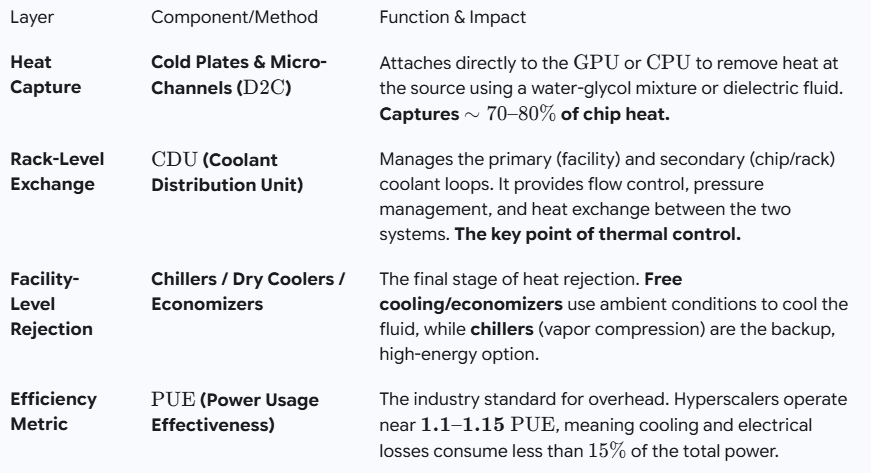
The thermal design of an AI factory is a stack of specialized technologies aimed at maximizing heat capture and minimizing PUE overhead.

The following video, Evolving Data Center Cooling for AI | Not Your Father’s Data Center Podcast, discusses the evolution of cooling technologies from air to liquid methods, which directly addresses the core theme of this blog post.

Why Liquid Cooling, Why Now (and what it means for TCO)

AI’s high-wattage silicon demands liquid cooling because of basic physics: air is a poor conductor of heat compared to liquid.

The key takeaway is TCO: while upgrading to AI-ready infrastructure is costly ($4 million to $8 million per megawatt), liquid systems allow operators to pack significantly more revenue-generating compute into the same physical footprint and reduce the single-largest variable cost, energy.

Where Software Creates Compounding Value (Observer’s Playbook)

Just as AI workloads require “Brainware” to optimize power, they require intelligent software to manage thermal performance, turning cooling from a fixed overhead into a dynamic, performance-aware variable.

1.Power-Thermal Co-Scheduling: This is the most crucial layer. Thermal-aware schedulers use real-time telemetry (fluid flow,ΔT across cold plates) to decide where to place new AI jobs. By shaping batch size and job placement against available temperature headroom, throughput can be improved by 40% in warm-setpoint data centers, preventing silent GPU throttling.

2.AI-Optimized Cooling Controls: Instead of relying on static set-points, Machine Learning (ML) algorithms dynamically adjust pump flow rates, CDU temperatures, and external dry cooler fans. These predictive models minimize cooling power while guaranteeing optimal chip temperature, achieving greater energy savings than fixed-logic control.

3.Digital Twin for Retrofits & Design: Hyperscalers use detailed digital twins to model the thermal impact of a new AI cluster before deployment. This prevents critical errors during infrastructure retrofits (e.g., ensuring new liquid circuits have adequate UPS-backed pump capacity).

4.Leak and Anomaly Detection: Specialized sensors and AI models monitor for subtle changes in pressure, flow, and fluid quality, providing an early warning system against leaks or fouling that could rapidly escalate to a critical failure, a key concern in large-scale liquid deployments.

Storytelling the Scale (so non-experts can visualize it)

A 300 MW AI campus generates enough waste heat to potentially heat an entire small city. The challenge isn’t just about survival; it’s about efficiency. The shift underway is the move from reactive, facility-level air conditioning to proactive, chip-level liquid cooling—and managing the whole system with AI-driven intelligence to ensure every watt of energy spent on cooling is the bare minimum required for maximum compute performance.

U.S. Siting Reality: The Questions We’re Asking

  • Water Risk: How will AI campuses reconcile high-efficiency, water-dependent cooling (like evaporative/adiabatic) with water scarcity, and what role will closed-loop liquid systems play in minimizing consumption?

  • Standards Catch-up: How quickly will regulatory frameworks (UL certification, OCP fluid-handling standards) evolve to reduce the perceived risk and cost of deploying immersion cooling across the enterprise market?

  • Hardware Compatibility: Will GPU manufacturers standardize chip-level cold plate interfaces to streamline multi-vendor deployment, or will proprietary cooling solutions continue to dominate the high-end AI cluster market?

What’s Next in this Series

This installment zoomed in on cooling. Next up: fabric/topology placement (optical fiber networking) and memory/storage hierarchies for low-latency inference at scale. We’ll continue to act as an independent, evidence-driven observer, distilling what’s real, what’s working, and where software can create leverage.

Explore more from RediMinds

As we track these architectures, we’re also documenting practical lessons from deploying AI in regulated industries. See our Insights and Case Studies for sector-specific applications in healthcare, legal, defense, financial, and government.

Select Sources and Further Reading:

  • Fortune Business Insights and Arizton Market Forecasts (2024–2032)

  • NVIDIA DGX H100 Server Operating Temperature Specifications

  • Uptime Institute PUE Trends and Hyperscaler Benchmarks (Google, Meta, Microsoft)

  • Vertiv and Schneider Electric Liquid-Cooling Portfolio Launches

  • Submer and LiquidStack Recent Funding Rounds

  • UL and OCP Standards Development for Immersion Cooling

Powering AI Factories: Why Baseload + Brainware Defines the Next Decade

Powering AI Factories: Why Baseload + Brainware Defines the Next Decade

Powering AI Factories: Why Baseload + Brainware Defines the Next Decade | RediMinds-Create The Future

Powering AI Factories: Why Baseload + Brainware Defines the Next Decade

Who this is for, and the question it answers

Enterprise leaders, policy analysts, and PhD talent evaluating AI inference datacenters want a ground-truth answer to one question: What power architecture reliably feeds 100–300+ MW AI campuses while meeting cost, carbon, and latency SLOs, and where can software materially move the needle?

The global context: AI’s new baseload

Independent forecasts now converge: data center electricity demand is set to surge. Goldman Sachs projects a 165% increase in data-center power demand by 2030 versus 2023; ~50% growth arrives as early as 2027. BP’s 2025 outlook frames AI data centers as a double-digit share of incremental load growth, with the U.S. disproportionately affected. Utilities are already repricing the future: capital plans explicitly cite AI as the new load driver.

What hyperscalers are actually doing (facts, not hype)

Nuclear baseload commitments. Google signed a master agreement with Kairos Power targeting up to 500 MW of 24/7 carbon-free nuclear, with the first advanced reactor aimed for 2030. Microsoft inked a 20-year PPA to restart Three Mile Island Unit 1, returning ~835 MW of carbon-free power to the PJM grid. Amazon has invested in X-energy and joined partnerships to scale advanced SMR capacity for AI infrastructure. Translation: AI factories are being paired with firm, 24/7 power, not just REC-backed averages.

High-voltage access and on-site substations. To reach 100–300+ MW per campus, operators are siting near 138/230/345 kV transmission and building or funding on-site HV substations. This is now standard for hyperscale.

Inside the rack: the 800 V DC shift

NVIDIA and partners are advancing 800 V HVDC rack power to support 1 MW-class racks and eliminate inefficient AC stages. Direct 800 V inputs feed in-rack DC/DC converters, enabling higher density and better thermals. Expect dual-feed DC bus architectures, catch/transfer protection, and close coupling with liquid cooling. For non-HVDC estates, modern OCP power shelves and in-rack BBUs continue to trim losses relative to legacy UPS-only topologies.

Why nuclear, why now (and what it means for siting)

AI campuses in the 300 MW class draw roughly the power of ~200,000 U.S. homes, a baseload profile that loves firm, dispatchable supply. SMRs (small modular reactors) match that profile: smaller footprints, modular deployment, and siting pathways that can colocate with industrial parks or existing nuclear sites. Google–Kairos (500 MW by 2030), Microsoft–Constellation (TMI restart), and Amazon–X-energy are concrete markers of the nuclear + AI pairing in the U.S.

The modern power stack for AI inference datacenters (U.S.-centric)

Transmission & Substation

  • Direct transmission interconnects at 138/230/345 kV with site-owned substations reduce upstream bottlenecks and improve power quality margins.

  • Long-lead equipment (e.g., 80–100 MVA HV transformers) must be pre-procured; GOES and copper supply constraints dominate timelines.

Medium Voltage & Distribution

  • MV switchgear (11–33 kV) with N+1 paths into modular pods (1.6–3 MW blocks) enables phased build-outs and faster energization.

  • LV distribution increasingly favors overhead busway with dual A/B feeds to maximize density and serviceability.

Conversion & Protection

  • >99%-efficient power electronics (rectifiers, inverters, DC/DC) are no longer nice to have; they’re required at AI loads to keep PUE stable. (Vendor roadmaps show standby-bypass UPS modes approaching 99%+ with sub-10 ms transfer.)

  • Fault tolerance patterns evolve beyond 2N: hyperscaler-style N+2C/4N3R with fast static transfer ensures ride-through without over-capitalizing idle iron.

On-site Firming & Storage

  • Diesel remains common for backup (2–3 MW gensets with 24–48 hr fuel), but the frontier is grid-scale batteries for black-start, peak-shave, and frequency services tied to AI job orchestration.

Clean Energy Pairing

  • SMRs + HV interconnects + battery firming form the emerging AI baseload triad, complemented by wind/solar/geothermal where interconnection queues allow.

Where software creates compounding value (observer’s playbook)

We are tracking four software layers that can lift capacity, cut $/token, and improve grid fit, without changing a single transformer:

1.Energy-aware job orchestration

Match batch windows, checkpoints, and background inference to real-time grid signals (price, CO₂ intensity, congestion). Studies and pilots show material cost and carbon gains when AI shifts work into clean/cheap intervals.
Signals to encode: locational marginal price, carbon intensity forecasts, curtailment probability, and nuclear/renewable availability windows.

2.Power-thermal co-scheduling

Thermal constraints can silently throttle GPUs and blow P99 latencies. Thermal-aware schedulers improved throughput by up to ~40% in warm-setpoint data centers by shaping batch size and job placement against temperature headroom.
Tie rack-level telemetry (flow, delta-T, inlet temp) to batchers and replica routers.

3.DC power domain observability

Expose rack→job power and conversion losses to SREs: HV/MV transformer loading, rectifier efficiency, busway losses, per-GPU rail telemetry feeding $ per successful token. This turns power anomalies into latency and cost alerts, fast enough to reroute or down-bin.

4.Nuclear-aware scheduling horizons

When SMRs come online under fixed PPAs, encode must-run baseload into the scheduler so inference saturates firm supply while peaky work flexes with grid conditions. This is where policy meets dispatch logic.

Storytelling the scale (so non-experts can visualize it)

A single 300 MW AI campus ≈ power for ~200,000 U.S. homes. Now compare that to a metro’s daily swing or a summer peak on a regional grid. The shift underway is that cities and AI cities are starting to look similar electrically, but AI campuses can be instrumented to respond in milliseconds, not hours. That’s why pairing baseload (nuclear) with software-defined demand is emerging as the pattern.

U.S. siting reality: the questions we’re asking

  • Interconnect math: Where can 138/230/345 kV tie-ins be permitted within 24–36 months? What queue position survives current FERC and ISO rules?

  • Baseload certainty: Which SMR pathways (TVA, existing nuclear sites, industrial brownfields) realistically deliver 24/7 by 2030–2035?

  • Regional case studies: How would an Armenia-sized grid or a lightly interconnected U.S. state host a 300 MW AI campus without destabilizing frequency? What market design and demand-response primitives are missing today?

What’s next in this series

This installment zoomed in on power. Next up: cooling-performance coupling, fabric/topology placement, and memory/storage hierarchies for low-latency inference at scale. We’ll continue to act as an independent, evidence-driven observer, distilling what’s real, what’s working, and where software can create leverage.

Explore more from RediMinds

As we track these architectures, we’re also documenting practical lessons from deploying AI in regulated industries. See our Insights and Case Studies for sector-specific applications in healthcare, legal, defense, financial, and government.

Select sources and further reading: Google–Kairos nuclear (500 MW by 2030), Microsoft–Constellation TMI restart (20-year PPA, ~835 MW), Amazon–X-energy SMR partnerships, NVIDIA 800 V HVDC rack architecture, and recent forecasts on data-center power growth.

The Great Attention Revolution: Why AI Engineering Will Never Be the Same

The Great Attention Revolution: Why AI Engineering Will Never Be the Same

The Great Attention Revolution: Why AI Engineering Will Never Be the Same | RediMinds-Create The Future

The Great Attention Revolution: Why AI Engineering Will Never Be the Same

From Words to Worlds: The Context Engineering Transformation

Something fundamental is shifting in the world of artificial intelligence development. After years of engineers obsessing over the perfect prompt, crafting each word, testing every phrase, a new realization is quietly revolutionizing how we build intelligent systems.

The question is no longer “what should I tell the AI?”.

It’s become something far more profound: What should the AI be thinking about?

THE HIDDEN CONSTRAINT

Here’s what researchers at Anthropic discovered that changes everything: AI systems, like human minds, have what they call an “attention budget.” Every piece of information you feed into an AI model depletes this budget. And just like a human trying to focus in a noisy room, as you add more information, something fascinating and slightly troubling happens.

The AI starts to lose focus.

THE ARCHITECTURAL REVELATION

The reason lies hidden in the mathematics of intelligence itself. When an AI processes information, every single piece of data must form relationships with every other piece. For a system processing thousands of tokens, this creates millions upon millions of pairwise connections, what engineers call n-squared complexity.

Imagine trying to have a meaningful conversation while simultaneously listening to every conversation in a crowded stadium. That’s what we’ve been asking AI systems to do.

THE PARADIGM SHIFT

This discovery sparked a complete rethinking of AI development. Engineers realized they weren’t building better prompts anymore; they were becoming curators of artificial attention. They started asking: What if, instead of cramming everything into the AI’s mind at once, we let it think more like humans do?

THE ELEGANT SOLUTIONS

The innovations emerging are breathtaking in their simplicity. Engineers are building AI systems that maintain lightweight bookmarks and references, dynamically pulling in information only when needed, like a researcher who doesn’t memorize entire libraries but knows exactly which book to consult.

Some systems now compress their own memories, distilling hours of work into essential insights while discarding the redundant details. Others maintain structured notes across conversations, building knowledge bases that persist beyond any single interaction.

The most advanced systems employ teams of specialized sub-agents, each expert in narrow domains, working together like a research lab where specialists collaborate on complex projects.

THE DEEPER IMPLICATION

But here’s what’s truly extraordinary: This isn’t just about making AI more efficient. We’re witnessing the emergence of systems that think more like biological intelligence, with working memory, selective attention, and the ability to explore their environment dynamically.

An AI playing Pokémon for thousands of game steps doesn’t memorize every action. Instead, it maintains strategic notes: “For the last 1,234 steps, I’ve been training Pikachu in Route 1. Eight levels gained toward my target of ten.” It develops maps, remembers achievements, and learns which attacks work against different opponents.

THE PROFOUND CONCLUSION

We’re not just building better AI tools; we’re discovering the architecture of sustainable intelligence itself. The constraint that seemed like a limitation ( finite attention) turns out to be the key to building systems that can think coherently across hours, days, or potentially much longer.

Every breakthrough in human cognition, from written language to filing systems to the internet, has been about extending our limited working memory through clever external organization. Now we’re teaching machines to do the same.

The question that will define the next era of AI isn’t whether we can build smarter systems; it’s whether we can build systems smart enough to manage their own intelligence wisely.