
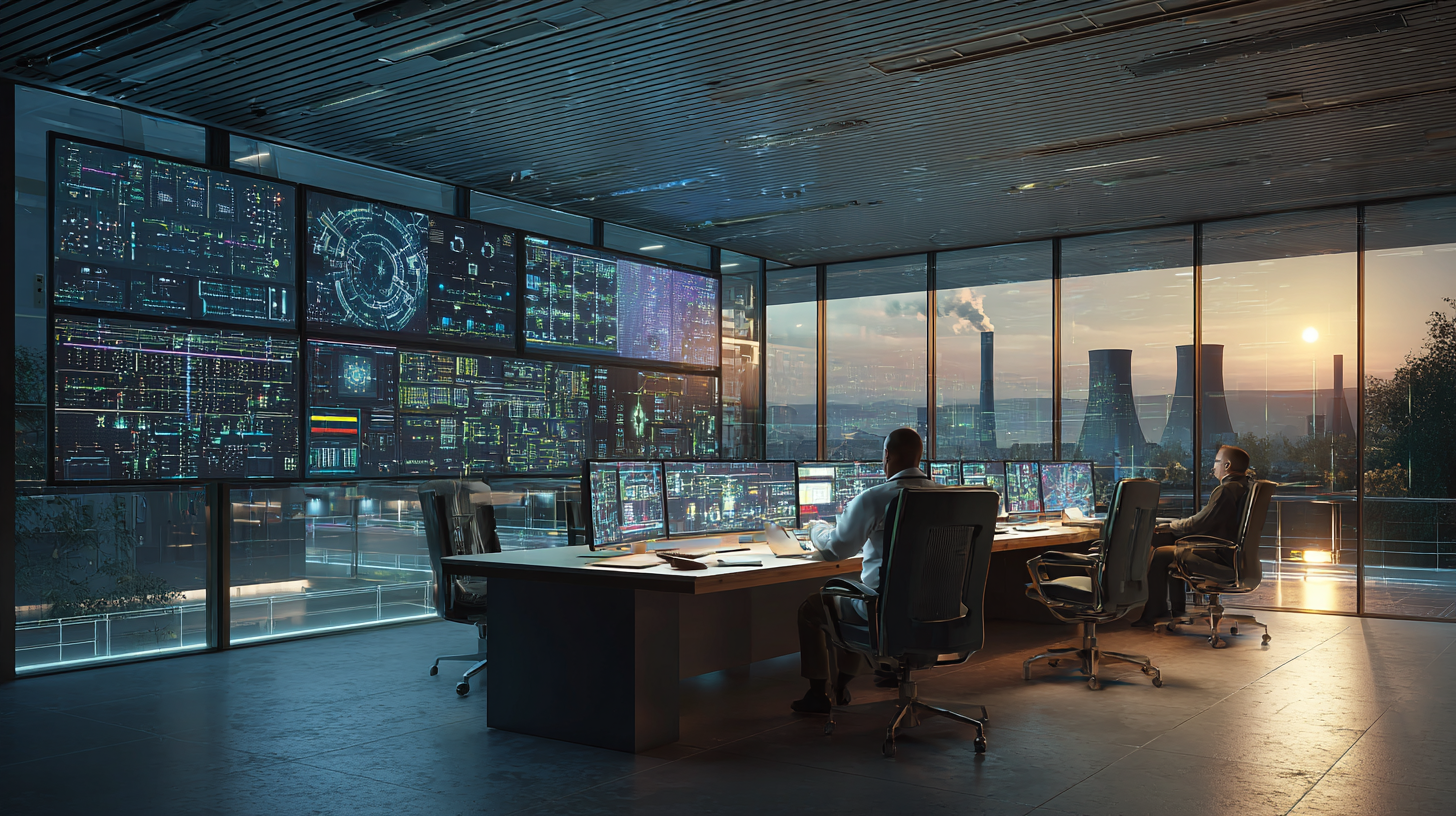
Powering AI Factories: Why Baseload + Brainware Defines the Next Decade
Who this is for, and the question it answers
Enterprise leaders, policy analysts, and PhD talent evaluating AI inference datacenters want a ground-truth answer to one question: What power architecture reliably feeds 100–300+ MW AI campuses while meeting cost, carbon, and latency SLOs, and where can software materially move the needle?
The global context: AI’s new baseload
Independent forecasts now converge: data center electricity demand is set to surge. Goldman Sachs projects a 165% increase in data-center power demand by 2030 versus 2023; ~50% growth arrives as early as 2027. BP’s 2025 outlook frames AI data centers as a double-digit share of incremental load growth, with the U.S. disproportionately affected. Utilities are already repricing the future: capital plans explicitly cite AI as the new load driver.
What hyperscalers are actually doing (facts, not hype)
Nuclear baseload commitments. Google signed a master agreement with Kairos Power targeting up to 500 MW of 24/7 carbon-free nuclear, with the first advanced reactor aimed for 2030. Microsoft inked a 20-year PPA to restart Three Mile Island Unit 1, returning ~835 MW of carbon-free power to the PJM grid. Amazon has invested in X-energy and joined partnerships to scale advanced SMR capacity for AI infrastructure. Translation: AI factories are being paired with firm, 24/7 power, not just REC-backed averages.
High-voltage access and on-site substations. To reach 100–300+ MW per campus, operators are siting near 138/230/345 kV transmission and building or funding on-site HV substations. This is now standard for hyperscale.
Inside the rack: the 800 V DC shift
NVIDIA and partners are advancing 800 V HVDC rack power to support 1 MW-class racks and eliminate inefficient AC stages. Direct 800 V inputs feed in-rack DC/DC converters, enabling higher density and better thermals. Expect dual-feed DC bus architectures, catch/transfer protection, and close coupling with liquid cooling. For non-HVDC estates, modern OCP power shelves and in-rack BBUs continue to trim losses relative to legacy UPS-only topologies.
Why nuclear, why now (and what it means for siting)
AI campuses in the 300 MW class draw roughly the power of ~200,000 U.S. homes, a baseload profile that loves firm, dispatchable supply. SMRs (small modular reactors) match that profile: smaller footprints, modular deployment, and siting pathways that can colocate with industrial parks or existing nuclear sites. Google–Kairos (500 MW by 2030), Microsoft–Constellation (TMI restart), and Amazon–X-energy are concrete markers of the nuclear + AI pairing in the U.S.
The modern power stack for AI inference datacenters (U.S.-centric)
Transmission & Substation
-
Direct transmission interconnects at 138/230/345 kV with site-owned substations reduce upstream bottlenecks and improve power quality margins.
-
Long-lead equipment (e.g., 80–100 MVA HV transformers) must be pre-procured; GOES and copper supply constraints dominate timelines.
Medium Voltage & Distribution
-
MV switchgear (11–33 kV) with N+1 paths into modular pods (1.6–3 MW blocks) enables phased build-outs and faster energization.
-
LV distribution increasingly favors overhead busway with dual A/B feeds to maximize density and serviceability.
Conversion & Protection
-
>99%-efficient power electronics (rectifiers, inverters, DC/DC) are no longer nice to have; they’re required at AI loads to keep PUE stable. (Vendor roadmaps show standby-bypass UPS modes approaching 99%+ with sub-10 ms transfer.)
-
Fault tolerance patterns evolve beyond 2N: hyperscaler-style N+2C/4N3R with fast static transfer ensures ride-through without over-capitalizing idle iron.
On-site Firming & Storage
-
Diesel remains common for backup (2–3 MW gensets with 24–48 hr fuel), but the frontier is grid-scale batteries for black-start, peak-shave, and frequency services tied to AI job orchestration.
Clean Energy Pairing
-
SMRs + HV interconnects + battery firming form the emerging AI baseload triad, complemented by wind/solar/geothermal where interconnection queues allow.
Where software creates compounding value (observer’s playbook)
We are tracking four software layers that can lift capacity, cut $/token, and improve grid fit, without changing a single transformer:
1.Energy-aware job orchestration
Match batch windows, checkpoints, and background inference to real-time grid signals (price, CO₂ intensity, congestion). Studies and pilots show material cost and carbon gains when AI shifts work into clean/cheap intervals.
Signals to encode: locational marginal price, carbon intensity forecasts, curtailment probability, and nuclear/renewable availability windows.
2.Power-thermal co-scheduling
Thermal constraints can silently throttle GPUs and blow P99 latencies. Thermal-aware schedulers improved throughput by up to ~40% in warm-setpoint data centers by shaping batch size and job placement against temperature headroom.
Tie rack-level telemetry (flow, delta-T, inlet temp) to batchers and replica routers.
3.DC power domain observability
Expose rack→job power and conversion losses to SREs: HV/MV transformer loading, rectifier efficiency, busway losses, per-GPU rail telemetry feeding $ per successful token. This turns power anomalies into latency and cost alerts, fast enough to reroute or down-bin.
4.Nuclear-aware scheduling horizons
When SMRs come online under fixed PPAs, encode must-run baseload into the scheduler so inference saturates firm supply while peaky work flexes with grid conditions. This is where policy meets dispatch logic.
Storytelling the scale (so non-experts can visualize it)
A single 300 MW AI campus ≈ power for ~200,000 U.S. homes. Now compare that to a metro’s daily swing or a summer peak on a regional grid. The shift underway is that cities and AI cities are starting to look similar electrically, but AI campuses can be instrumented to respond in milliseconds, not hours. That’s why pairing baseload (nuclear) with software-defined demand is emerging as the pattern.
U.S. siting reality: the questions we’re asking
-
Interconnect math: Where can 138/230/345 kV tie-ins be permitted within 24–36 months? What queue position survives current FERC and ISO rules?
-
Baseload certainty: Which SMR pathways (TVA, existing nuclear sites, industrial brownfields) realistically deliver 24/7 by 2030–2035?
-
Regional case studies: How would an Armenia-sized grid or a lightly interconnected U.S. state host a 300 MW AI campus without destabilizing frequency? What market design and demand-response primitives are missing today?
What’s next in this series
This installment zoomed in on power. Next up: cooling-performance coupling, fabric/topology placement, and memory/storage hierarchies for low-latency inference at scale. We’ll continue to act as an independent, evidence-driven observer, distilling what’s real, what’s working, and where software can create leverage.
Explore more from RediMinds
As we track these architectures, we’re also documenting practical lessons from deploying AI in regulated industries. See our Insights and Case Studies for sector-specific applications in healthcare, legal, defense, financial, and government.
Select sources and further reading: Google–Kairos nuclear (500 MW by 2030), Microsoft–Constellation TMI restart (20-year PPA, ~835 MW), Amazon–X-energy SMR partnerships, NVIDIA 800 V HVDC rack architecture, and recent forecasts on data-center power growth.