

Beyond the 15-Minute Visit: AI, Empathy, and the Future of the Physician’s Role
The 15-Minute Visit and the Empathy Squeeze
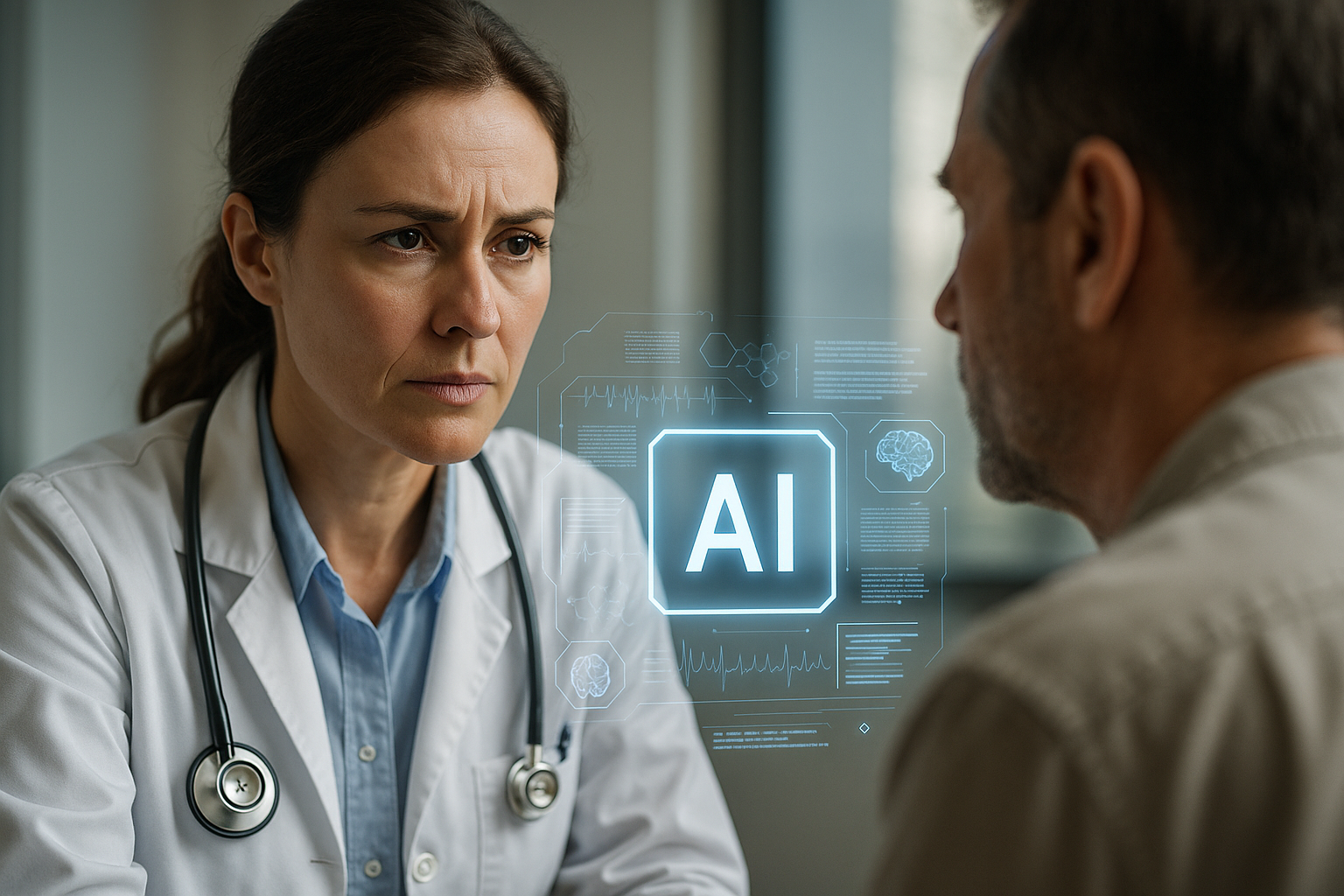
A physician faces a patient with concern, underscoring the challenge of empathy under time pressure (AI icon signifies tech’s growing presence).
Modern primary care runs on an unforgiving clock. Office visits are often limited to about 15–20 minutes, leaving precious little time for personal connection. In practice, one study found the average visit was ~16.6 minutes, but only 9 minutes of that involved face-to-face conversation – and more than 7 minutes went to after-hours electronic paperwork. Physicians today spend as much (or more) time navigating electronic health records (EHRs) and documentation as they do with patients. For example, a recent analysis showed primary care doctors logging 36 minutes on the computer per patient visit, even though appointments were scheduled for 30 minutes. These systemic pressures – rapid-fire appointments, heavy clerical loads, endless checklists – directly limit the space for empathy.
It’s no wonder many patients leave visits feeling unheard. The “assembly line” model of care, focused on throughput, can undermine the doctor-patient relationship. Clinicians, forced to multitask on screens and forms, may appear distracted or rushed. Studies link shorter visits with lower patient satisfaction and even increased malpractice risk, as patients perceive a lack of caring or adequate explanation. Meanwhile, doctors themselves report frustration and burnout when they cannot practice the listening and compassion that brought them into medicine. In short, the 15-minute visit squeezes out the human elements of care. This empathy deficit in healthcare sets the stage for an unlikely figure to step in: AI chatbots.
When Chatbots Seem More Empathetic Than Humans
Imagine a patient posts a worried question online at 2 AM. A doctor, juggling dozens of such messages, replies with a terse answer – technically correct, but blunt. An AI assistant, in contrast, crafts a lengthy reply addressing the patient’s fears with warmth and detailed explanations. Which response feels more caring? According to emerging research, the surprising answer is often the AI’s.
In a 2023 study published in JAMA Internal Medicine, a panel of healthcare professionals compared physicians’ answers with those from an AI chatbot (ChatGPT) to real patient questions. The result made headlines: 79% of the time, evaluators preferred the chatbot’s reply, rating it both higher quality and more empathetic. In fact, only 4.6% of doctors’ answers were marked “empathetic” or “very empathetic,” versus 45% of the AI’s – a nearly tenfold difference. The chatbot, unlimited by time constraints, could offer thoughtful advice with a gentle tone, whereas harried physicians often sounded brusque.
And it’s not just experts who notice. In a recent experiment with cancer patients, people consistently rated AI-generated responses as more empathetic than physicians’ replies to the same queries. The most advanced bot’s answers scored about 4.1 out of 5 for empathy, compared to a mere 2.0 for the human doctors. These findings strike at the heart of medicine: if a machine can outperform doctors in perceived compassion, what does that mean for the physician’s role?
Several factors explain why AI can excel at sounding caring. No time pressure: A chatbot can generate a 200-word comforting explanation in seconds, whereas a doctor racing through a clinic may only have time for a one-liner. Optimized tone: Developers train AI models on gracious, patient-centered communication. The chatbot doesn’t feel annoyed or tired; it’s programmed to respond with patience and courtesy every time. Customized empathy: AI can be instructed to adjust reading level, formality, or amount of emotional validation to suit the situation. In essence, the bot’s “bedside manner” is by design. As one ER doctor observed, ChatGPT is an “excellent chatter” – always ready with a creative, reassuring analogy. It never rolls its eyes or rushes the patient.
None of this is to say a bot actually cares (it doesn’t), but it can mimic the language of care exceedingly well. For overstretched clinicians, this contrast can feel almost unfair. In one notable anecdote, an emergency physician struggled to console a distraught family — until he enlisted ChatGPT to help draft a compassionate explanation. The AI’s suggested phrasing helped him connect with the family in a critical moment. Such cases hint at the potential of AI as a partner to humanize communication. Yet they also raise an urgent question: Are we mistaking simulation of empathy for the real thing?
The Perils of Pseudo-Empathy: Why AI’s “Compassion” Isn’t What It Seems
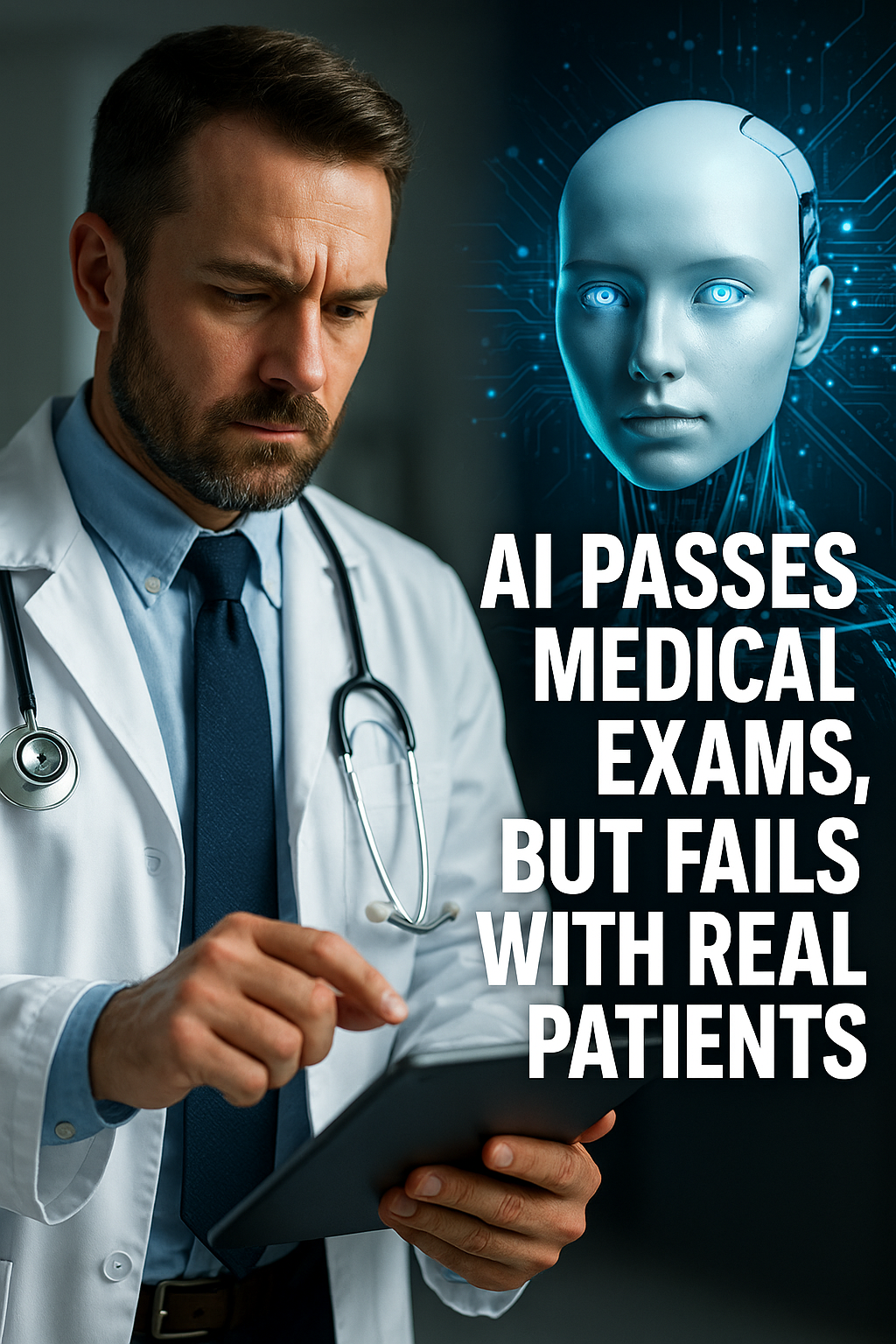
A doctor consults a tablet while an AI avatar looks on. Text on image highlights a key concern: AI aces medical tests, but falters with real patients.
It’s tempting to see an AI that speaks with kindness and think it could replace a caring clinician. This is the “empathy mirage” – and following it blindly can be dangerous. First, AI lacks any genuine real-world awareness or feeling. A chatbot might say “I’m so sorry you’re going through this,” but it does not actually understand your pain or joy. As one ethicist noted, for now “computer programs can’t experience empathy” – they only simulate it based on patterns. This means their kind words may ring hollow, or even cheapen the idea of empathy when a patient realizes the sentiment isn’t coming from a fellow human. A polite algorithm is still an algorithm. It will not check on you the next day or truly share in your relief or grief.
Another risk is misinterpretation and misplaced trust. People tend to respond differently once they know an interaction is AI-driven. A 2024 study in PNAS found that recipients rated AI-written supportive messages highly – but as soon as they learned a bot wrote it, much of that positive impact evaporated. In other words, an empathic message from an unknown source might comfort someone, but if they discover it’s from a machine, they feel less heard and valued. This “AI label” effect suggests that transparency is critical. We cannot expect patients to feel genuinely cared for if they know the compassion is coming from silicon rather than a sympathetic fellow human.
Perhaps the biggest concern is that AI’s seeming competence can mask serious errors or gaps. A chatbot may generate a reassuring, articulate answer that is flat-out wrong or dangerously incomplete. Its tone can lull patients or even physicians into overconfidence. But as medical experts warn, just because an AI can talk like a skilled doctor doesn’t mean it thinks or prioritizes like one. LLMs (large language models) have no sense of consequence; they might casually omit an urgent recommendation or misinterpret a subtle symptom. They also have a known tendency to “hallucinate” – make up facts or advice that sound plausible but are false. An empathetic-sounding lie is still a lie. Without real clinical judgment, AI might tell a patient exactly what they want to hear, and miss what they need to hear.
In short, there is a risk of overestimating AI’s empathy and wisdom. Patients might form unreciprocated emotional bonds with chatbots, or worse, follow their advice in lieu of consulting professionals. And clinicians, relieved by an AI’s polished drafts, might let their guard down on accuracy and appropriateness. We’ve already seen that LLMs can pass medical exams with flying colors, yet fail when interacting with actual patients in controlled studies. The nuance, intuition, and ethical grounding required in real patient care remain uniquely human strengths – which brings us to the promise of a balanced path forward.
Warmth + Wisdom: Marrying AI Capabilities with Human Compassion
If AI excels at knowledge recall and polite phrasing, while human doctors excel at context, intuition, and genuine care, the obvious strategy is to combine their strengths. Rather than viewing empathetic AI as a threat, leading health systems are exploring ways to harness it as a tool – one that augments clinicians and restores space for the human connection. We are entering a new hybrid era of medicine, where “Dr. AI” and Dr. Human work in tandem. The goal is to deliver both warmth and wisdom at scale.
One immediate application is freeing physicians from the clerical grind. AI “scribes” and assistants can take over documentation, data entry, and routine administrative tasks that eat up hours of a doctor’s day. Early results are promising: pilots of ambient AI listening tools (like Nuance’s DAX) report that doctors spend 50% less time on documentation and save several minutes per patient encounter. That adds up to entire hours reclaimed in a clinic session. Crucially, physicians using such tools feel less fatigued and burned out. By delegating note-taking to an algorithm, doctors can give patients their full attention in the moment – listening and observing rather than typing. In essence, AI can give doctors back the gift of time, which is the bedrock of empathy.
Beyond paperwork, AI can act as a communication coach and extender. Consider the deluge of patient messages and emails that physicians struggle to answer. What if an AI helper could draft replies with an optimal bedside manner? Researchers have floated the idea of an “empathy button” in the patient portal – a feature that, with one click, rewrites a doctor’s terse draft into a more compassionate tone. The clinician would still review and send the message, ensuring it’s accurate, but the AI would supply a touch of warmth that the busy doctor might not have time to wordsmith. Early anecdotes suggest this approach can improve patient satisfaction and even reduce follow-up queries. It’s a win-win: patients feel cared for, doctors save time and emotional energy.
Similarly, AI could help triage and address the simpler concerns so that human providers have bandwidth for the complex ones. Imagine an intelligent chatbot that answers common questions (“Is this side effect normal?”, “How do I prep for my MRI?”) with 24/7 responsiveness and empathy, but automatically flags anything nuanced or urgent to the physician. This kind of “warm handoff” between AI and doctor could ensure no patient question goes unanswered, while reserving clinicians’ time for the discussions that truly require their expertise and human touch.
Already, forward-looking physicians are experimenting with such partnerships. We saw how an ER doctor used ChatGPT to help convey bad news in a gentle way – not to replace his judgment, but to refine his messaging. On a larger scale, institutions are exploring AI-driven patient education tools, discharge instructions, and health coaching that feel personable and supportive. The key is design: workflow integration that keeps the doctor in the loop. AI can draft, but the human approves. AI can monitor, but alerts a human when compassion or complex decision-making is needed.
For healthcare executives and IT leaders, this hybrid model carries a strategic mandate: redesign care processes to leverage AI for efficiency and empathy, without sacrificing safety or authenticity. It means training clinicians to work effectively with AI assistants, and educating patients about these tools’ role. Crucially, it means maintaining trust – being transparent that AI is involved, while assuring patients that their care team is overseeing the process. When implemented thoughtfully, AI support can actually increase the humanity of care by removing the inhuman obstacles (bureaucracy, drudgery) that have crept in.
The Human Doctor’s Irreplaceable Role: Trust, Touch, and Judgment
What, then, remains the unique province of human physicians? In a word: plenty. Medicine is far more than information exchange or polite conversation. The hardest parts – building trust, navigating uncertainty, aligning decisions with a patient’s values – require a human heart and mind. As renowned cardiologist Eric Topol puts it, as machines get smarter, “it’s the job of humans to grow more humane.” Doctors may eventually be “outsmarted” by AI in raw knowledge, but empathy, compassion, and ethical judgment will only become more important. Those are the traits that truly heal, and they are inherently human.
Trust, especially, is the secret sauce of effective care. Decades of research confirm that when patients trust their physician, outcomes improve – whether it’s better diabetes control, cancer survival, or adherence to HIV treatment. High trust correlates with higher treatment adherence and fewer complications. Conversely, low trust can undermine therapies and even carry economic costs due to poor follow-through and lost confidence in the system. Trust is built through authentic relationships: listening, reliability, honesty, and advocacy. An algorithm might provide flawless guidelines, but it cannot personally reassure a patient who is frightened about surgery, or inspire the kind of confidence that makes someone say “I know my doctor cares about me.” Real trust requires accountability and empathy over time – something no AI can replicate.
Moreover, healthcare is rife with complex, nuanced decisions that go beyond any protocol. Is aggressive treatment or hospice better for a particular patient? How do we weigh risks and quality of life? Such questions demand not just data but wisdom – the kind of wisdom forged by personal experience, moral consideration, and the understanding of an individual’s life story. Doctors often act as navigators through uncertainty, helping patients choose paths aligned with their values. AI can offer options or probabilities, but choosing and caring for the person who must live with the choice are deeply human responsibilities.
Finally, the simple power of human presence should not be underestimated. A comforting touch on the shoulder, a shared tear, a doctor sitting in silence as you absorb bad news – these gestures form the language of caring that patients remember long after. Communication in medicine is as much about what is felt as what is said. While AI might supply perfect words, only a fellow human can truly share in the emotional burden of illness. In the end, patients seek not just accurate answers but partnership on their health journey. The physician’s role will increasingly center on being that compassionate partner – interpreting the avalanche of information (much of it AI-generated, perhaps) through the lens of a caring relationship.
As one medical scholar noted, we have “dehumanized healthcare” in recent years, but if done right, AI offers a chance to restore humanity by freeing up doctors to do what they do best: care. The physician of the future might spend less time memorizing minutiae (the AI will handle that) and more time connecting – practicing the art of medicine with full focus on the patient.
Embracing the Hybrid Era: Designing Workflows for AI-Enhanced Care
The trajectory is clear: we are entering a hybrid era where neither AI nor doctors alone can provide optimal care, but together they just might. For healthcare institutions and leaders, the challenge now is to thoughtfully design this new paradigm. Workflows must be reimagined so that AI supports clinicians in meaningful ways – not as a flashy gadget or a competing voice, but as a trusted aid that amplifies the clinician’s capabilities and humanity.
This starts with strategic implementation. Identify where AI can safely pick up the slack: documentation, routine inquiries, data synthesis, preliminary drafting of communications. Implement those tools in pilot programs, and gather feedback from both providers and patients. Where it’s working, physicians report they can “stay focused on the patient rather than the computer” – exactly the outcome we want. Spread those successes, but also be transparent about limitations. Develop clear protocols for when the “AI assist” should defer to human judgment (which should be often!). Clinicians need training not just in tool use, but in maintaining situational awareness so they don’t overly rely on AI outputs. For example, a doctor might use an AI-drafted reply to a patient’s message, but they must review it critically to ensure it truly addresses the patient’s concern.
Institutional culture will also need to adapt. Trust and safety are paramount: both clinicians and patients must trust that the AI is reliable where used, and trust that the human clinician is still ultimately in charge. This means vetting AI systems rigorously (for accuracy, bias, privacy compliance) and monitoring their performance continuously. It also means informing patients when AI is involved in their care in a positive, framing way: “This tool helps me take better care of you by <benefit>, and I will be reviewing everything it does.” When patients see AI as part of a seamless team working for their good – rather than a black box in the shadows – their trust can extend to the system as a whole.
Crucially, organizations should measure what really matters, not just productivity. If AI allows a clinic to increase throughput, that’s not a victory unless patient experience and outcomes improve as well. Leaders should track patient satisfaction, physician burnout rates, error rates, and quality metrics in any AI deployment. The true promise of these technologies is to give physicians the bandwidth to be the healers they want to be, which in turn boosts patient outcomes and loyalty. If instead AI is used simply to squeeze in more visits or messages without addressing root causes, we risk repeating past mistakes.
Already, we see partnerships forming to pursue this balanced vision. Forward-looking health tech companies – such as RediMinds – are developing trusted AI platforms that integrate into clinical practice with an emphasis on safety, empathy, and efficiency. These platforms aim to support clinicians in routine tasks while ensuring the physician-patient connection remains front and center. It’s not about tech for tech’s sake, but solving real problems like physician overload and patient communication gaps. By collaborating with clinicians and stakeholders, such teams are helping design AI that works for doctors and patients, not around them.
In conclusion, the role of the physician is poised to evolve, but far from diminishing, it may become more vital than ever. AI will increasingly handle the “knowledge tasks” – the diagnostic suggestions, the evidence retrieval, the drafting of instructions. This leaves physicians to embody the wisdom, moral guidance, and human connection that no machine can replace. The future of healthcare delivery will be about striking the right balance: leveraging AI’s precision and scalability alongside the irreplaceable empathy and insight of humans. Those organizations that succeed will be the ones that design workflows and cultures to get the best of both – enabling doctors to be caring healers again, with AI as their diligent assistant. In the end, medicine is about healing people, not just solving problems. The 15-minute visit may have been the norm of the past, but with a thoughtful integration of AI, we can move beyond that constraint into an era where clinicians have the time and support to truly care, and patients receive the warmth and wisdom they deserve.
Call to Action: If you’re ready to explore how AI can restore empathy and efficiency in your organization, while preserving the human heart of care, connect with us at RediMinds. We build the infrastructure for the hybrid era of medicine—where doctors have more time to care, and patients feel heard. Reach out to start the conversation or engage with us on our LinkedIn to see what the future of trusted AI in healthcare looks like.