
Agentic Neural Networks: Self-Evolving AI Teams Transforming Healthcare & Enterprise AI
Artificial Intelligence is evolving from static tools to dynamic teammates. Imagine an AI system that builds and refines its own team of specialists on the fly, much like a brain forming neural pathways – all to tackle complex problems in real time. Enter Agentic Neural Networks (ANN), a newly proposed framework that reframes multi-agent AI systems as a kind of layered neural network of collaborating AI agents. In this architecture, each AI agent is a “node” with a specific role, and agents group into layers of teams, each layer focused on a subtask of the larger problem. Crucially, these AI teams don’t remain static or hand-engineered; they dynamically assemble, coordinate, and even re-organize themselves based on feedback – a process akin to how neural networks learn by backpropagation. This concept of textual backpropagation means the AI agents receive iterative feedback in natural language and use it to self-improve their roles and strategies. The result is an AI system that self-evolves with experience, delivering notable gains in accuracy, adaptability, and trustworthiness.
From Static Orchestration to Self-Evolving AI Teams
Traditional multi-agent systems often rely on fixed architectures and painstaking manual setup – developers must pre-define each agent’s role, how agents interact, and how to combine their outputs. This static approach can limit performance, especially for dynamic, high-dimensional tasks like diagnosing a patient or managing an emergency department workflow, where new subtasks and information emerge rapidly. Agentic Neural Networks break this rigidity. Instead of a fixed blueprint, ANN treats an AI workflow like an adaptive neural network: the “wiring” between agents is not hard-coded, but formed on demand. Tasks are decomposed into subtasks on the fly, and the system spins up a layered team of AI agents to handle them. Each layer of agents addresses a specific aspect of the problem, then passes its output (as text, data, or decisions) to the next layer of agents. This is analogous to layers in a neural net extracting features step by step – but here each layer is a team of collaborating agents with potentially different skills.
Crucially, ANN introduces a feedback loop that static systems lack. After the agents attempt a task, the system evaluates the outcome against the desired goals. If the result isn’t up to par, the ANN doesn’t just fail or require human intervention – it learns from it. It uses textual backpropagation to figure out how to improve the collaboration: which agent’s prompt to adjust, whether to recruit a new specialist agent, or how to better aggregate agents’ answers. This continual improvement cycle means the multi-agent team essentially “learns how to work together” better with each attempt. In high-stakes environments (like a busy hospital or a complex enterprise operation), this could translate to AI systems that rapidly adapt to new scenarios and optimize their own workflows without needing weeks of re-engineering.
How Agentic Neural Networks Work: Forward and Backward Phases
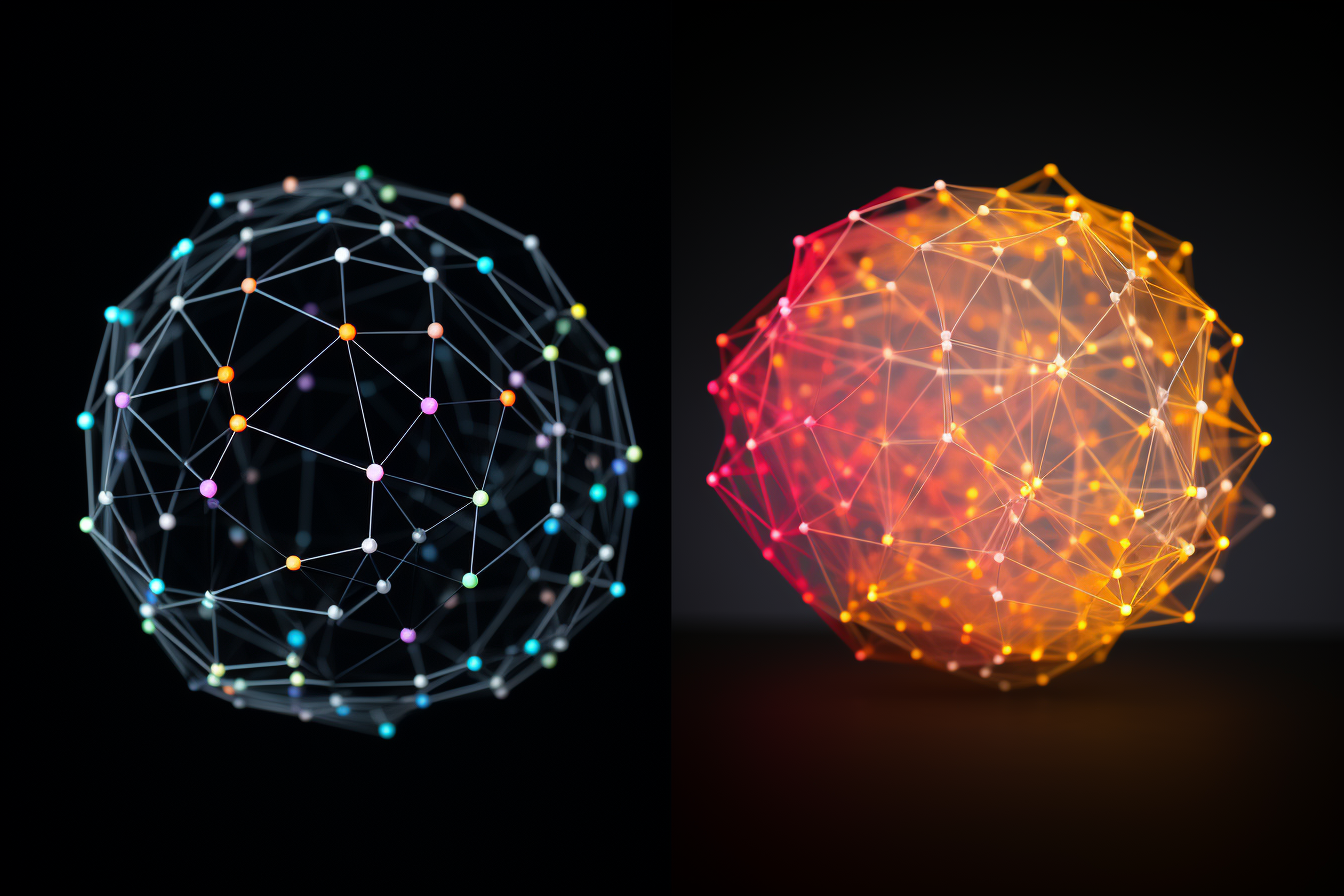
Figure: Conceptual illustration of an Agentic Neural Network. AI agents (nodes) form collaborative teams at multiple layers, each solving a subtask and passing results onward, similar to layers in a neural network. The system refines these teams and their interactions through textual feedback (akin to gradients), enabling continuous self-optimization.
To demystify the ANN architecture, let’s break down its two core phases. The ANN operates in a cycle inspired by how neural networks train, but here the “signals” are pieces of text and task outcomes instead of numeric gradients. The process unfolds in two phases:
1.Forward Phase – Dynamic Team Formation: This is analogous to a neural network’s forward pass. When a complex task arrives, the ANN dynamically decomposes the task into manageable subtasks. For each subtask, it assembles a team of agents (for example, different AI models or services each specializing in a role like data retrieval, reasoning, or verification). These teams are organized in layers, where the output of one layer becomes the input for the next. Importantly, ANN chooses an appropriate aggregation function at each layer – essentially the strategy for those agents to combine their results. It might decide that one agent should summarize the others, or that all agents’ outputs should be voted on, etc., depending on the task’s needs. The forward phase is flexible and data-driven: the system might use a different number of layers or a different mix of agents for a tough medical case than for a routine task, all decided on the fly. By the end of this phase, we have an initial result generated by the chain of agent teams.
2.Backward Phase – Textual Backpropagation & Self-Optimization: Here’s where ANN truly stands apart from static systems. If the initial result is suboptimal or can be improved, the ANN enters a feedback phase inspired by neural backpropagation. The system generates iterative textual feedback at both global and local levels – think of this as “gradient signals” but in human-readable form. Globally, it analyzes how the layers of agents interacted and identifies improvements to the overall workflow or information flow. Locally, it looks at each layer (each team of agents) and suggests refinements: maybe an agent should adjust its prompt, or a different agent should be added to the team, or a better aggregation method should be used. This feedback is given to the agents in natural language, effectively telling them how to adjust their behavior next time. The ANN then updates its “parameters” – not numeric weights, but things like agent role assignments, prompt phrasing, or team structures – analogous to a neural net updating weights. To stabilize learning, ANN even borrows the concept of momentum from machine learning: it averages feedback over iterations so that changes aren’t too sudden or erratic. This momentum-based adjustment smooths out the evolution of the agent team, preventing oscillations and overshooting changes (a crucial factor – removing the momentum mechanism caused a significant drop in performance in coding tasks, showing how it helps accumulate improvements steadily). Additionally, ANN can integrate validation checks (for example, did the answer format meet requirements? was the solution correct?) before applying changes. In essence, the backward phase is a self-coaching session for the AI team, enabling the system to learn from its mistakes and refine its strategy autonomously.
Through these two phases, an Agentic Neural Network continuously self-improves. It’s a neuro-symbolic loop: the symbolic, explainable structure of agents and their roles is optimized using techniques inspired by numeric neural learning. Over time, the ANN can even create new specialized agent “team members” after training if needed, evolving the roster of skills available to tackle tasks. This means an ANN-based AI solution in your hospital or enterprise could expand its capabilities as new challenges arise – without a developer explicitly adding new modules each time.
Real-World Impact: Smarter Healthcare, Smarter Operations
What could this self-evolving AI teamwork mean in real-world scenarios? Let’s explore a few high-stakes domains:
-
Healthcare Automation & Clinical Workflows: In a modern hospital, information flows and decisions are critical. Imagine an AI-driven clinical assistant built on ANN principles. When a patient arrives in the emergency department, the AI dynamically spawns a team of specialized agents: one agent scours the patient’s electronic health records for history, another interprets the latest lab results, another cross-checks symptoms against medical databases, and yet another verifies protocol adherence or risk factors. These agents form layers – perhaps an initial layer gathers data, the next reasons about possible diagnoses, and a final layer verifies the plan against best practices. If the outcome (e.g. a diagnostic suggestion) isn’t confident or accurate enough, the system gets feedback: maybe the suggestion didn’t match some lab data or failed a plausibility check. The ANN then adjusts on the fly: perhaps it adds an agent specializing in rare diseases to the team, or instructs the reasoning agent to put more weight on certain symptoms. All this can happen in minutes, continuously optimizing the care pathway for that patient. Such a system could improve diagnostic accuracy and speed in emergency situations by adapting to each case’s complexity. And as it encounters more cases, it learns to coordinate its “AI colleagues” more effectively – much like an experienced medical team that gels together over time, except here the team is artificial and self-organizing. The potential outcome is better patient triage, fewer diagnostic errors, and more time for human clinicians to focus on the human side of care.
-
Back-Office AI Operations: Consider the deluge of administrative tasks in healthcare or enterprise settings – from insurance claims processing and medical coding to customer support ticket resolution. Static AI solutions can handle routine cases but often break when encountering novel situations. An ANN-based back-office assistant could dynamically assemble agents for each incoming case. For a complex insurance claim, one agent extracts key details from documents, another checks policy rules, another flags anomalies or potential fraud indicators, and a supervisor agent aggregates these findings into a decision or recommendation. If a claim is denied erroneously or processing took too long, the system analyzes where the workflow could improve (maybe the rules-checking agent needed more context, or an additional verification step was missing) and learns for next time. Over days and weeks, such an AI system becomes increasingly efficient and accurate, reducing backlogs and saving costs. In enterprise customer service, similarly, an ANN could coordinate multiple bots (one fetches account data, one analyzes sentiment, one formulates a response) to handle support tickets, and refine their collaboration via feedback – leading to faster resolutions and happier customers.
-
Emergency Decision Support: In disaster response or critical industrial operations, conditions change rapidly. A static AI plan can become outdated within hours. ANN-based agent teams, however, can reconfigure themselves in real time as new data comes in. Picture an AI monitoring a power grid: initially a set of agents monitor different parts of the system, another set predicts failures. If an unusual event occurs (e.g., a sudden surge in demand or a substation fault), the AI can deploy a new specialized agent to analyze that anomaly, and re-route information flows among agents to focus on mitigating the issue. The system’s backward phase feedback might say “our prediction agent didn’t foresee this scenario – let’s adjust its model or add an agent trained on similar past events.” The self-optimizing nature of ANN means the longer it’s in operation, the more prepared it becomes for rare or unforeseen events, which is invaluable in high-stakes, safety-critical environments.

Across these examples, a common theme emerges: adaptability. By letting AI agents form ad-hoc teams and learn from outcomes, we get solutions that are not only effective in one narrow setting, but robust across evolving situations. Particularly in healthcare, where patient conditions and data can be unpredictable, this adaptability can literally become a lifesaver. The ANN’s built-in feedback loop also adds a layer of trustworthiness – the system is effectively double-checking and improving its work continually. Mistakes or suboptimal results prompt a course-correct, meaning the AI is less likely to repeat the same error twice. For decision-makers (be it a hospital chief medical officer or an enterprise CTO), this promises AI that doesn’t just deploy and decay; instead, it gets smarter and more reliable with use, while providing transparency into how it’s organizing itself to solve problems.
Performance Breakthroughs and Cost Efficiency
Agentic Neural Networks aren’t just a theoretical idea – they have shown significant performance gains in practice. Researchers tested ANN across diverse challenges, including math word problems, coding tasks (HumanEval benchmark), creative writing, and analytical reasoning. In all cases, ANN-based teams of agents outperformed traditional static multi-agent setups operating under the same conditions. This is a strong validation: by letting agents collaborate in a neural-network-like fashion and learn from feedback, the system consistently solved tasks more accurately than prior baselines. It didn’t matter if the task was generating a piece of code or answering a complex math question – the adaptive team approach yielded more robust solutions.
One particularly exciting outcome was the ability to achieve high performance with lower-cost models. In AI, we often assume that to get the best results, we need the biggest, most powerful (and often most expensive) model. ANN challenges that notion. In experiments, the ANN framework was trained using a relatively lightweight language model nicknamed “GPT-4o-mini” (a smaller, cost-efficient version of a GPT-4 level model), as well as the popular GPT-3.5-turbo model. During evaluation, the researchers had the ANN use a range of models as its agents – from GPT-3.5 up to full GPT-4 – to see how well the ANN’s learned collaboration generalized. Impressingly, the ANN achieved competitive – and sometimes even superior – performance using the cheaper GPT-4o-mini model, compared to other systems that relied on larger models. In fact, GPT-4o-mini, despite its lower cost, matched or beat existing multi-agent baselines on multiple tasks. This effectively bridges the gap between cost and performance – you can get top-tier results without always needing the priciest AI model, if you have a smart orchestration like ANN making the most of each agent’s strengths. As the authors highlight, GPT-4o-mini emerged as a high-performing yet cost-effective alternative under the ANN framework, showcasing the economic advantage of intelligent agent teaming. For businesses and healthcare systems, this is a big deal: it hints at AI solutions that deliver great outcomes while optimizing resource and budget use. Instead of paying a premium for a single super-intelligent AI, one could deploy a team of smaller, specialized AIs guided by ANN principles to achieve comparable results.

Moreover, the researchers conducted ablation studies – essentially turning off certain features of ANN to see their impact – and found that every component of the ANN design contributed to its success. Disabling the backward optimization or the momentum stabilization, for example, led to noticeable drops in accuracy. This underscores that it’s the combination of dynamic team formation, iterative feedback (backpropagation-style), and stabilization techniques that gives ANN its edge. It’s a holistic design that marries the collaborative power of multiple agents with the proven learning efficiencies of neural networks. The end result is a scalable, data-driven framework where AI agents not only work together – they learn together and improve as a unit.
Towards Trustworthy, Self-Optimizing AI
Beyond raw performance, Agentic Neural Networks signal a shift toward AI systems we can trust in critical roles. In domains like healthcare, trust is just as important as accuracy. ANN architectures inherently promote several trust-building features:
-
Transparency in Collaboration: By modeling the system as layers of agents with defined subtasks, humans can inspect and understand the workflow. It’s clearer which agent is responsible for what, as opposed to a monolithic black-box model. This layered team approach can map to real-world processes (for example, data collection, analysis, verification), making it more interpretable. If something goes wrong, we can pinpoint if the “analysis agent” or the “verification agent” made a mistake, and address it. This clarity is vital for clinicians or enterprise leaders who need to justify AI-assisted decisions.
-
Continuous Validation and Improvement: The textual backpropagation mechanism means an ANN isn’t likely to make the same mistake twice. Suppose an ANN agent team produced an incorrect patient risk assessment – the backward phase would catch the error (via a performance check) and adjust the process, perhaps tightening the verification criteria or adding a cross-checking agent. The next time a similar case appears, the system has learned from the previous error. This built-in learning from feedback is akin to having an AI QA auditor always on duty. Over time, it can greatly reduce error rates, which is essential for building trust in settings like clinical decision support or automated financial audits.
-
Dynamic Role Assignment = Flexibility: In trust terms, flexibility means the AI can handle edge cases more gracefully. A static system might outright fail or give nonsense if faced with an out-of-distribution scenario. An ANN, on the other hand, can recognize when a situation doesn’t fit its current team’s expertise and bring in new “expert” agents as needed. It’s like knowing when to call a specialist consult in medicine. This dynamic adjustment not only improves outcomes but also provides confidence that the AI knows its limits and how to compensate for them – a key aspect of operational trustworthiness.
-
Data-Driven Optimization: ANN’s neuro-symbolic learning ensures that improvements are grounded in data and outcomes, not just human guesswork. It objectively measures performance and iteratively tweaks the system to optimize that performance. For decision-makers, this is compelling: it’s an AI that can demonstrate continuous improvement on key metrics (whether that’s diagnostic accuracy, turnaround time, or customer satisfaction), making it easier to justify deployment and scaling. It also shifts the development focus to setting the right objectives and evaluation criteria, while the system figures out the best way to meet them – a more reliable path to success than hoping one’s initial design was perfect.

Looking at the broader picture, Agentic Neural Networks illustrate a future where AI is not a static product, but an adaptive service. It aligns with a vision of AI that is more like a team of colleagues – learning, growing, and optimizing itself – rather than a one-and-done software deployment. This paradigm is especially powerful for organizations that operate in complex, evolving environments (think healthcare providers, emergency services, large-scale enterprises dealing with varied data), where trust, adaptability, and continuous improvement are non-negotiable. By combining the collaborative intelligence of multiple agents with the learning dynamics of neural networks, ANN offers a path to AI systems that are both smart and self-aware of their performance, adjusting course as needed to maintain optimal results.
Conclusion: A New Era of AI Teamwork
The emergence of Agentic Neural Networks is more than just a novel research idea – it’s a rallying point for what the future of AI could be. We stand at the cusp of an era where AI teams build themselves around our hardest problems, where they communicate in natural language to refine their strategies, and where they continuously learn from each outcome to get better. For AI/ML practitioners and CTOs, ANN represents a cutting-edge architecture that can unlock higher performance without exorbitant costs, by leveraging synergy between models. For clinicians, physicians, and emergency department leaders, it paints a picture of AI assistants that are adaptive, reliable partners in care – systems that could ease workloads while safeguarding patient outcomes through constant self-improvement. For enterprise leaders, it promises AI that doesn’t just solve today’s problems, but evolves to tackle tomorrow’s challenges, all while providing the transparency and control needed to meet regulatory and ethical standards.
It’s an inspiring vision – one where AI is not just artificially intelligent, but agentically intelligent, orchestrating itself in service of our goals. The research behind ANN has demonstrated tangible gains and gives a blueprint for making this vision a reality. Now, the next step is bringing these self-evolving AI teams from the lab to real-world deployment. The potential impact is profound: imagine safer hospitals, more efficient businesses, and agile systems that can respond to crises or opportunities as fast as they arise.
Ready to harness the power of self-evolving AI in your organization? It’s time to turn this cutting-edge insight into strategy. We invite you to connect with RediMinds – our team is passionate about creating dynamic, trustworthy AI solutions that drive real results. Whether you’re looking to streamline clinical workflows or supercharge your enterprise operations, we’re here to guide you. Check out our success stories and innovative approaches in our latest case studies, and stay informed with our expert insights on emerging AI trends. Let’s create the future of AI teamwork together, today.