
Quantum Computing and the Quest for Enterprise AGI: A Hybrid Approach to Responsible AI
Introduction
Today’s large language models (LLMs) are undeniably powerful, but they are not truly “general” intelligences. These models excel at producing human-like text and recognizing patterns, yet they operate as sophisticated next-word predictors, lacking genuine understanding or reasoning. The hype around LLMs has even led some to conflate their capabilities with Artificial General Intelligence (AGI) – an AI with human-level, broad cognitive abilities – but fundamental gaps remain. Current AI systems struggle with complex reasoning: they often stumble on problems requiring multi-step logic, combinatorial search, or deep causal inference beyond surface pattern matching. In essence, today’s AI is narrow, and achieving true AGI will demand breakthroughs that address these reasoning limitations.
One intriguing path forward is emerging at the intersection of cutting-edge fields: quantum computing and AI. Quantum computing isn’t just about speed; it introduces a new computing paradigm that can explore vast solution spaces in parallel, like a massively deep “search layer” beneath classical neural networks. In this blog, we explore how quantum computing could amplify the reasoning abilities of AI, potentially helping overcome the combinatorial and multi-hop reasoning hurdles that stymie current models. We will also discuss why a quantum-classical hybrid architecture – combining quantum’s power for pattern discovery with classical computing’s strengths in control and transparency – is likely the most promising (and responsible) route to AGI in high-stakes enterprise applications.
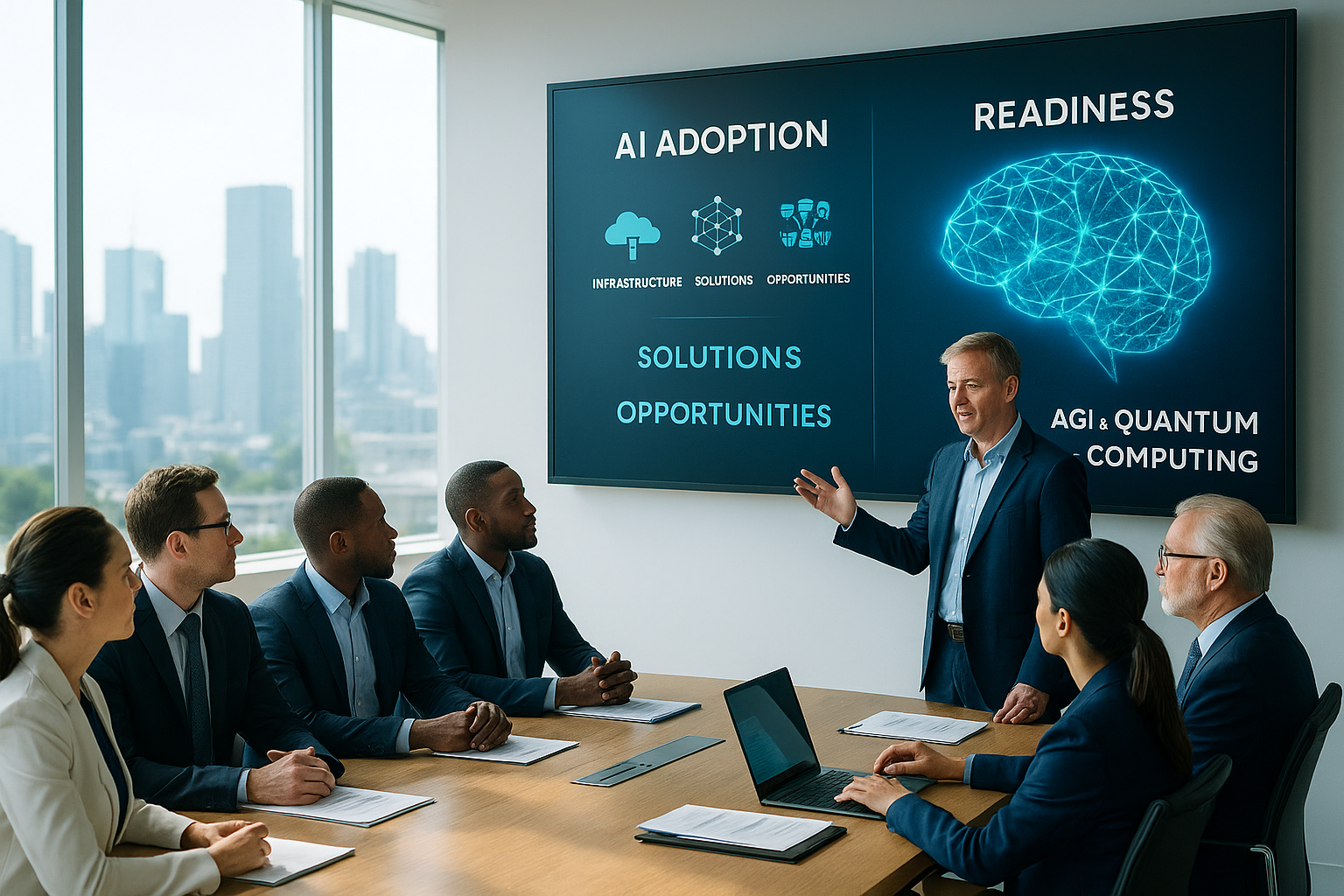
Enterprise leaders are preparing for the next wave of AI adoption. Strategic readiness means identifying high-impact AI opportunities, piloting advanced solutions, and developing the infrastructure to support them. Ensuring AGI readiness in an organization will require embracing new technologies like quantum computing while maintaining strict oversight and compliance.
LLMs vs. AGI – The Limits of Today’s AI
The recent explosion of LLM-driven applications has been impressive, but LLMs are not on their own “general intelligences.” By design, an LLM like GPT-4 or PaLM is trained to statistically predict text, not to truly understand or reason about the world. As a result, even state-of-the-art models exhibit well-documented limitations that prevent them from achieving AGI:
-
Lack of Deep Reasoning: LLMs can imitate reasoning in simple cases, but they falter on tasks requiring multiple hops of logic or combinatorial problem solving. For example, answering a question that needs drawing two or three separate facts together (multi-hop reasoning) often trips up these models. Research has found that while transformers can encode some latent reasoning steps, they “often err” on queries that require composition and multi-step logic. The ability to plan or reason through a complex chain of thought – something a human expert might do systematically – is not a strength of current LLMs.
-
Combinatorial Explosion: Many real-world challenges (from optimizing a supply chain route to proving a mathematical theorem) are combinatorial in nature, meaning the space of possible solutions is astronomically large. Classical algorithms struggle with these problems, and LLMs are not inherently designed to solve combinatorial optimization either. An LLM might help write code or suggest heuristics, but by itself it cannot brute-force search through combinatorial possibilities. This is a key limitation on the path to AGI – true general intelligence needs to handle problems that blow up in complexity, something our current AI finds infeasible.
-
No Grounded Understanding: LLMs lack grounding in real-world experience. They don’t possess true understanding of concepts; they manipulate symbols (words) based on statistical correlation. This leads to behaviors like hallucination (confidently making up facts) and brittleness when faced with inputs outside their training distribution. AGI, by definition, would require robust understanding and the ability to learn new concepts on the fly, not just regurgitate training data patterns.
Given these issues, it’s widely acknowledged that **today’s AI models, on a purely classical computing foundation, may never by themselves achieve **AGI. Simply scaling up parameters or data might yield further improvements, but diminishing returns and fundamental barriers (like lack of true reasoning or real-world grounding) remain. We seem to be approaching the edge of what purely classical, non-specialized approaches can do. As one industry analysis noted, we are “reaching the limits of generative AI in terms of model efficiency and hardware limitations”, suggesting that a significant change in computing approach may be required for the next leap.
Quantum Computing: A New Power for Reasoning and Search
How can we break through these limitations? One compelling answer is quantum computing. Quantum computers operate on completely different principles than classical machines, leveraging phenomena like superposition and entanglement to process information in ways impossible for classical bits. In practical terms, a quantum computer can explore a vast number of states simultaneously, acting as a kind of massively parallel search engine through complex solution spaces. For AI, this raises an exciting possibility: using quantum computing as a “deep search” layer to enhance an AI’s reasoning capabilities.
Richard Feynman famously pointed out that “nature isn’t classical, dammit… if we want to simulate nature, we’d better make it quantum mechanical”. The essence of that insight for AI is that many complex systems (from molecular interactions to human cognition) might be more efficiently modeled with quantum computation. In the context of AGI, quantum algorithms could enable exploration and pattern-recognition at a depth and scale that classical algorithms can’t reach. Rather than brute-forcing every possibility one by one, a quantum algorithm can consider many possibilities in parallel, drastically reducing search times for certain problems.
For example, quantum search algorithms like Grover’s algorithm can find target solutions in an unsorted space quadratically faster than any classical approach – a speedup that could be transformative when searching through combinations of reasoning steps or large knowledge graphs. And beyond speed, certain quantum algorithms natively handle the kind of probabilistic inference and linear algebra that underpin machine learning. A well-known case is quantum annealing: it naturally finds low-energy (optimal or near-optimal) solutions to optimization problems by exploiting quantum tunneling. This could directly tackle combinatorial optimization challenges that are intractable for classical solvers.
Crucially, quantum computing’s advantages align with the very areas where current AI struggles. Need to evaluate an exponentially large number of possibilities? A quantum routine might prune that search space drastically. Need to explore multiple potential reasoning paths in parallel? A quantum system, by its superposition principle, can do exactly that – in Quantum Reinforcement Learning experiments, for instance, quantum agents can explore many possible future states simultaneously, accelerating learning. It’s easy to imagine a future AGI system where a classical neural network proposes a question or partial solution, and a quantum module searches through myriad connections or simulations to advise on the best next step (much like a chess AI evaluating millions of moves in parallel, but at a far larger scale).

To be clear, today’s quantum computers are still in early stages – limited in qubit count and error-prone. But the progress is steady, and quantum capabilities are improving yearly. We’ve already seen demonstrations of “quantum advantage” where quantum hardware solved specific tasks faster than classical supercomputers. As these machines become more powerful, their relevance to AI will grow. The convergence of AI and quantum computing is now a major research frontier, with the promise that quantum-enhanced AI could handle complexity and reasoning in ways that classical AI alone cannot.
Pioneers of Quantum-Classical Hybrid Architecture
This vision of quantum-enhanced AI isn’t just theoretical. Around the world, leading companies and labs are actively developing hybrid quantum-classical architectures to merge the strengths of both paradigms. The idea is not to replace classical neural networks, but to augment them – embedding quantum computations as specialized subroutines within classical AI workflows. Let’s look at some notable players driving this innovation:
-
IBM – As a pioneer in both AI and quantum, IBM is investing heavily in hybrid approaches. IBM Research has demonstrated quantum algorithms that work alongside classical ML to improve performance on certain tasks. For example, IBM’s Quantum Open Science projects have used quantum circuits to classify data and even to enhance feature selection for AI models. IBM’s toolkits like Qiskit Machine Learning allow developers to integrate quantum nodes into classical deep learning pipelines. IBM recently highlighted how quantum-hybrid algorithms could accelerate medical diagnostics, noting that adding quantum routines to an AI workflow improved a cancer diagnostic’s accuracy at identifying cancer sub-types dramatically. IBM’s vision is that quantum and AI will converge in enterprise computing, and it is building the ecosystem (hardware and software) to enable that.
-
Google Quantum AI – Google’s Quantum AI division (in concert with Google Research/DeepMind) is likewise at the forefront. Google has built some of the most advanced superconducting quantum processors (achieving a milestone in quantum supremacy in 2019), and they’ve also released TensorFlow Quantum, an open-source library integrating quantum circuits into the popular TensorFlow AI framework. With TensorFlow Quantum, developers can construct “quantum neural network” models where a quantum circuit is treated as a layer in a neural network, trained with classical backpropagation. Google’s researchers have explored quantum advantages in combinatorial optimization and even quantum-inspired neural nets. The company’s goal is explicitly stated as “building quantum processors and algorithms to dramatically accelerate computational tasks for machine intelligence”.
-
Xanadu – A startup based in Toronto, Xanadu is notable for its focus on photonic quantum computing and its development of PennyLane, a popular open-source framework for quantum machine learning. PennyLane enables quantum differentiable programming, meaning researchers can seamlessly combine quantum circuit simulations with classical deep learning libraries. Xanadu’s team and collaborators have demonstrated hybrid models, like quantum-classical neural networks for image classification and variational quantum algorithms for chemistry. They are even exploring quantum-enhanced generative models. Xanadu’s hardware approach (using light rather than electronic qubits) and its cross-platform software have made it a key player in pushing hybrid quantum-AI research forward.
-
Rigetti Computing – Rigetti is a pioneer of the quantum-classical cloud service model. In 2018, Rigetti launched the first commercial Quantum Cloud Services (QCS) platform, which tightly integrates quantum processors with classical co-processors in one data center. This eliminates latency between the two and allows algorithms to offload parts of the computation to quantum hardware on the fly. Rigetti’s approach was shown to potentially yield 20×–50× speedups on certain algorithms by uniting the systems. The company actively works on quantum algorithms for finance, optimization, and machine learning, and has collaborated with partners like Zapata Computing on compilers for hybrid algorithms. Rigetti’s vision of a tightly coupled quantum-classical infrastructure has influenced larger companies to offer similar integrated cloud access (e.g., Amazon Braket and Azure Quantum now host Rigetti chips for hybrid experimentation).
-
D-Wave Systems – D-Wave took a different route with its quantum technology, specializing in quantum annealing machines that are particularly suited for optimization problems. D-Wave’s systems are already being used in hybrid solutions for real-world use cases. The company offers a Hybrid Solver Service that lets developers formulate problems (like scheduling or routing optimizations) and have it solved by a mix of classical and quantum annealing techniques. For example, D-Wave has worked with automotive and logistics companies on route optimization and traffic flow problems – domains where their quantum solver can evaluate many possible routes to find efficient ones. Enterprise clients have used D-Wave’s hybrid approach to optimize portfolio selections in finance and supply chain logistics, areas where classical algorithms struggle to find near-optimal solutions quickly. D-Wave’s continual hardware improvements (its latest Advantage system has 5000+ qubits, albeit noisy ones) are enabling larger problem instances to be tackled with this quantum-accelerated optimization.
-
Academic Labs (MIT, Caltech, Oxford, and more) – Academia is playing a huge role in inventing the algorithms and theoretical groundwork for quantum-enhanced AI. At MIT, the MIT-IBM Watson AI Lab has a research program on Quantum Computing in machine learning, and MIT’s quantum information researchers have explored everything from quantum boosts to classical neural nets to quantum algorithms for natural language processing. Caltech is home to pioneering quantum theorists and even houses the AWS Quantum Computing Center, where academic and industry researchers jointly explore quantum machine learning algorithms. Caltech’s expertise in both AI (through initiatives like Caltech’s AI4Science program) and quantum (through the IQIM – Institute for Quantum Information and Matter) makes it a hotbed for hybrid ideas. Meanwhile, the University of Oxford has one of the world’s leading quantum computing groups and has produced notable work on quantum algorithms that could impact AI (for instance, algorithms for quantum analogues of neural networks and efforts to use quantum computers for complex graph inference problems). Oxford is also known for quantum natural language processing research, aiming to represent linguistic meaning on quantum computers – a fascinating crossover of AI and quantum theory. These are just a few examples; universities from Stanford to Tsinghua to the University of Toronto are all contributing to the fast-growing body of research on quantum-classical hybrid AI.

What all these efforts share is a recognition that the future of AI may not be purely classical. Instead, a hybrid architecture – where certain heavy-lift reasoning or search tasks are offloaded to quantum subroutines – could dramatically expand AI’s capabilities. Importantly, each of these pioneers also acknowledges that classical computing remains essential: quantum components will augment, not replace, the classical layers of neural networks and logic that we already know work well for perception and pattern recognition.
Quantum Advantage in Action: Enterprise Use Cases
The excitement around hybrid quantum AI isn’t just academic – it stems from very practical needs in industry. Many enterprise use cases push the limits of classical computing, especially in regulated, high-stakes fields where optimal decisions and predictions can save lives or millions of dollars. Here we explore a few domains where quantum-enhanced AI could unlock new levels of performance, and discuss why these gains matter:
Healthcare and Life Sciences
Perhaps nowhere is the impact of advanced AI felt more profoundly than in healthcare. From diagnostics to drug discovery, AI systems are already assisting clinicians and researchers – but they also face extreme requirements for accuracy and accountability. Quantum computing has enormous potential in healthcare AI, where the problems often involve vast combinatorial searches and pattern recognition at the very edge of current capability.
One area gaining attention is diagnostic AI for medical imaging and genomics. Identifying a complex disease from imaging scans, or finding a needle-in-a-haystack mutation in a genome, can be like looking for a very tiny pattern in an ocean of data. Classical AI (like deep convolutional networks) has made great strides in image recognition, but still struggles with subtle, multi-factorial cases – and training such models requires huge computational resources. Quantum-enhanced algorithms could change the game. In fact, IBM researchers reported that by injecting a quantum algorithm into a cancer diagnosis model, the hybrid system could not only detect the presence of cancer but even predict the specific subtype of cancer with 70% accuracy, a significant improvement over previous results. That kind of multi-dimensional pattern recognition hints at why quantum could add value: a quantum model might consider complex interactions in data (like how multiple genes and biomarkers collectively indicate a disease) more naturally than a flattened classical model.
Another healthcare frontier is drug discovery and genomics, which involves navigating astronomically large chemical and genetic search spaces. Pharmaceutical companies have billions of compounds to virtually screen for a potential new drug; combinatorial chemistry and protein folding are famously hard problems. Quantum computers, even today’s prototypes, have shown the ability to simulate small molecular systems more efficiently than classical exact methods. As they scale, we expect quantum subroutines to significantly accelerate drug discovery AI – for example, rapidly suggesting molecular candidates that fit a desired profile or optimizing the design of a compound for efficacy and safety. Companies like Biogen and Roche are already partnering with quantum computing firms to explore these possibilities. In genomics, a quantum-assisted AI might sift through huge genomic databases to find complex patterns (e.g. combinations of genetic variants that together raise disease risk) far faster than classical stats can.
It’s important to note that in healthcare, accuracy isn’t enough – transparency and validation are paramount. So, any quantum-powered diagnosis or discovery would still go through rigorous clinical trials and approvals. But by integrating quantum algorithms into the discovery pipeline, enterprises in biotech and healthcare could gain a competitive edge: faster time-to-insight, the ability to consider more variables and hypotheses, and potentially breakthroughs that a classical-only approach might miss.
Finance and Portfolio Optimization
The finance industry has always been a heavy user of advanced computing, from algorithmic trading to risk modeling. Yet many financial optimization problems remain so complex that even supercomputers struggle – which is why banks and hedge funds are eagerly watching quantum computing’s rise. Quantum AI could fundamentally change how we approach financial optimization and risk analysis.
Consider portfolio optimization: determining the ideal mix of assets (stocks, bonds, etc.) to maximize return for a given risk appetite. This is a classic combinatorial optimization problem that becomes exponentially harder as you increase the number of assets and constraints. Sophisticated investors want to factor in a multitude of data – market scenarios, correlations, macroeconomic indicators – and rebalance in real-time as conditions change. Classical algorithms use heuristics or simplified assumptions because the full problem is intractable beyond a certain size. But a quantum-enhanced optimizer can explore portfolio configurations in a high-dimensional space far more efficiently. Rigetti, for instance, has pointed out that quantum computers can “optimize returns and risks for large financial portfolios”, potentially identifying investment strategies that elude classical methods. Similarly, experiments using D-Wave’s quantum annealer have tackled portfolio selection with promising results, finding optimal or near-optimal portfolios among dozens of assets. The impact for financial firms could be significant – better performing portfolios and faster adaptation to market changes translate directly into competitive advantage and higher profits.
Beyond portfolios, fraud detection and algorithmic trading are also ripe for quantum enhancement. Fraud detection often involves analyzing huge graphs of transactions to spot illicit patterns (a task related to the “subgraph isomorphism” problem which has known quantum speedups). A quantum-infused AI could potentially flag suspicious activity by examining connections and sequences that a classical system might consider impractically complex to evaluate in realtime. For algorithmic trading, which might involve optimizing execution of thousands of trades across global markets, quantum algorithms could help compute optimal strategies under constraints in split seconds, something that could be the difference between a profitable trade and a missed opportunity.
It’s worth noting that finance is a highly regulated domain. Gains from quantum AI will only be realized if they come with robustness and auditability (no black boxes picking trades that can’t be explained to regulators or risk officers). We’ll discuss later how hybrid approaches can ensure this. But it’s clear that the financial services sector stands to benefit enormously from quantum computing – which is why major banks (JPMorgan, Goldman Sachs, etc.) have active quantum research teams and are already testing quantum algorithms on real problems.
Logistics and Supply Chain
Modern global supply chains are incredibly complex, comprising many variables: routing of ships, trucks and planes; inventory levels at warehouses; timing and pricing decisions; and so on. The goal in logistics is usually to optimize efficiency and cost – for example, minimize the total distance traveled or ensure demand is met with minimal delay. This becomes an NP-hard problem (like the infamous traveling salesman problem, but on steroids) and is often too complex to solve optimally. Companies resort to approximate methods and lots of computing power to get “good enough” solutions.
Quantum optimization has a natural fit here. D-Wave’s annealing quantum computers have already been used in pilot projects for things like optimizing delivery routes and traffic light timing in cities. In one example, a partnership with a traffic management system showed that a quantum solver could optimize the routes of municipal buses in near-real-time, reducing congestion and travel time. In supply chain management, quantum algorithms can take into account a vast number of factors (weather, fuel costs, delivery windows, etc.) and churn out routing plans or distribution schedules that are better than those from classical heuristics. D-Wave reports that using their quantum annealer in a hybrid mode has enabled optimizing vehicle routing and reducing fuel costs for transportation companies – a direct boost to the bottom line and sustainability.
Similarly, consider predictive forecasting and inventory management. Retailers must decide how much stock to keep where, and manufacturers must schedule production to meet uncertain future demand. These are probabilistic problems with enormous state spaces (especially in the era of global e-commerce). A quantum-enhanced AI could potentially evaluate many demand scenarios in parallel and find strategies that minimize stockouts and overstocks, something classical Monte Carlo simulations struggle with at scale. By integrating quantum sampling or optimization into forecasting models, enterprises could achieve more resilient, cost-effective supply chains. For instance, a quantum algorithm might quickly solve a complex supply chain routing problem that involves multiple depots and hundreds of stores – a task that classical solvers either simplify (with loss of optimality) or take too long to run.

In logistics, even a small percentage improvement in efficiency can save millions. So the promise of quantum – even a modest quantum speedup or better solution quality – is generating significant interest. Companies like UPS and FedEx, as well as aviation and energy logistics firms, are already engaged in quantum computing trials. As one industry article put it, the real-time optimization of routes and supply flows is poised to be one of the earliest valuable applications of quantum computing, complementing AI-driven predictive analytics in those businesses.
Why AGI Needs Guardrails: Explainability, Compliance, and Trust
We’ve painted an exciting picture of quantum-boosted AI breaking through technical barriers. However, when it comes to deploying any AI – let alone a potential AGI – in high-stakes industries like healthcare, finance, or law, raw capability is not enough. **Enterprise leaders know that AI systems must also be auditable, explainable, and aligned with regulations and ethical norms. In fact, the higher the stakes, the stronger the demand for AI “guardrails” that ensure the technology’s outputs can be trusted and verified.
Classical rule-based systems (and even traditional software algorithms) have historically excelled in these traits. They behave deterministically, their decision logic can often be inspected, and they can be validated against compliance checklists. By contrast, modern AI – especially deep learning – is often a black box. A neural network might provide a diagnosis or approve a loan, but explaining why it did so can be challenging. When we add quantum computing into the mix, the complexity grows further; quantum algorithms are probabilistic and non-intuitive, which could make the overall system even harder to interpret. Therefore, the consensus is that **the future of AGI in enterprise must be a hybrid not just in technology but in governance: pairing quantum-enhanced pattern discovery with classical, rule-based guardrails and oversight.
Consider the earlier healthcare scenario: an AI identifies a cancer in a scan with 99% confidence. That’s great – but a doctor (and patient) will rightly ask, how did it reach that conclusion? Was it a specific shadow on the MRI, a combination of biomarkers? Clinicians are unlikely to accept “the quantum neural network thought so” as an answer. They need interpretable evidence or at least a clear chain of reasoning. This is why researchers are developing explainable AI techniques that can be applied on top of neural networks – and similar work will be needed for quantum algorithms. One promising approach is to have classical logic modules that can audit the suggestions made by an AI (quantum or not). For example, if an AI recommends a treatment plan, a separate classical system might cross-check that recommendation against medical guidelines and the patient’s history, flagging anything that doesn’t align with established knowledge or policy. This kind of “second layer” oversight is something classical computing is well-suited for, ensuring nothing crazy slips through even if the AI’s internal reasoning is opaque.

In high-stakes settings, AI must operate under human oversight. Above, a physician and patient use an AI-driven medical chatbot together. The doctor monitors the chatbot’s suggestions (displayed on the laptop) as the patient asks about her symptoms. This scenario illustrates a key point: AI can assist with preliminary analysis or Q&A, but professionals need to validate its outputs. The doctor’s presence provides assurance, context, and the final judgment – an example of classical “guardrails” in action even as we tap AI for efficiency.
Another example is in the legal domain. Imagine an AI system that helps judges or lawyers by researching case law and even suggesting verdicts or sentences based on precedent – essentially an AGI legal assistant. The risks of bias or error here are profound; a mistake could unjustly alter someone’s life. Legal systems have stringent standards for evidence and explanation. Any AI in this space would need to provide a clear rationale for its suggestion (e.g., citing prior cases and statutes) and operate within the bounds of law and rights. Achieving that requires more than just a powerful AI engine: it needs an architecture designed for accountability. We might see AI that drafts a legal argument (drawing on a quantum-accelerated search through millions of documents), but a suite of classical checks will verify that the citations are valid, the logic follows, and no unethical bias crept in. Essentially, the AI can do the heavy lifting of knowledge retrieval and pattern-finding, while classical systems (and humans) ensure the results are legally sound and fair.
In finance, regulations demand explainability for automated decisions, like credit scoring or trade approvals. An AGI that recommends approving a large loan because “it predicts the business will succeed” would not satisfy an auditor – it would need to show the financial analysis backing that prediction. Here again, classical rule-based frameworks can wrap around the AI’s core, forcing it to justify predictions with reference to understandable factors (cash flow, credit history, etc.) even if a complex model initially made the prediction.
All these considerations point to a clear conclusion: Robust, responsible AGI will blend the best of both worlds. The quantum and AI side will give us unprecedented prediction and optimization capabilities. The classical side will provide stability, interpretability, and adherence to human rules and values. It’s a symbiotic relationship. In fact, we already see the seeds of this today: many “AI in healthcare” products are actually hybrid systems where a machine learning model flags cases and a human doctor or a rule-based expert system double-checks them before action is taken. The future AGI will likely formalize and enhance this pattern at scale.
It’s instructive to note a recent finding in the medical AI field: an AI (GPT-4 based) was able to pass medical licensing exams with high scores, yet still failed at certain real-life clinical decision-making tasks. Researchers from Harvard and Stanford dubbed it a “striking paradox” – the AI could regurgitate medical knowledge for a test, but faltered when dealing with nuanced patient scenarios where questions and answers aren’t straightforward. This underlines our point: test-taking is one thing, but real-world practice needs understanding, context, and judgment. An AGI in medicine (or law, or finance) will face the same challenge. By combining raw AI intelligence (augmented by quantum computing) with classical interpretability and constraints, we give such a system the best chance to perform safely and effectively in the complexities of the real world.
The Hybrid Path to Responsible, Enterprise-Grade AGI
Bringing it all together, a picture emerges of how we can achieve AGI that is both powerful and safe: through a hybrid architecture that leverages quantum-enhanced AI for deep pattern discovery, alongside classical systems for control and transparency. Rather than chasing pure superintelligence in a black box, the most pragmatic and enterprise-friendly vision of AGI is one of balance.
Such a hybrid AGI might work like this in practice: The quantum-enhanced modules (perhaps quantum neural networks or quantum optimizers) tackle the hardest parts of a problem – they churn through the combinatorial possibilities, they generate creative solutions, they see patterns we’d otherwise miss. Surrounding those modules, the classical AI components handle interfacing with humans and existing systems – they apply business rules, legal constraints, ethical guidelines, and they provide explanations in human terms. This way, whenever the “alien intelligence” of a deep quantum algorithm produces an insight, it is immediately contextualized and vetted by more familiar, interpretable processes. The end result is an AI you can trust with critical decisions because it’s both supercharged in capability and inherently audited by design.
For enterprises, this hybrid approach is not just idealistic – it’s likely the only acceptable path. Highly regulated industries (healthcare, finance, defense, etc.) will simply not deploy a monolithic AGI that they cannot explain or control. We’ve already seen regulatory movements (such as the EU’s proposed AI Act) that would require transparency and risk controls for AI systems. A black-box AGI, no matter how intelligent, would face severe adoption hurdles. In contrast, a hybrid AGI can be pitched as “quantum-powered but with classical guardrails.” This is an AI that checks all the boxes: it can solve previously unsolvable problems, drive innovation and efficiency in the enterprise, and at the same time produce audit logs, reason codes, and fail-safes that management and regulators can be comfortable with.
There’s also a practical reason to keep the classical parts around: human talent and institutional knowledge are built on classical computing and decades of business processes. By having the classical layer in our AGI, we ensure that the new system can integrate with existing IT infrastructure and decision-making processes. Think of it as an evolutionary approach to AGI deployment – rather than throwing out all our old systems, we embed a quantum brain within the legacy nervous system of the enterprise. This makes change management feasible. You don’t have to trust a wild new technology blindly; you introduce its benefits gradually, under the watch of tried-and-true systems.
Finally, a hybrid quantum-classical AGI aligns with how humans themselves solve problems. We often have flashes of intuition (which are inscrutable, subconscious, parallel – almost our “quantum” side, if you will) but we validate those intuitions with logic, reason, and social norms (our “classical” reasoning). The best human experts toggle between creative insight and methodical analysis. Our proposed AGI does the same: the quantum part provides the leap, the classical part provides the ladder to climb that leap safely.
Navigating the Quantum AI Frontier with the Right Partner
Achieving this vision of hybrid AGI is no small feat. It requires orchestrating advanced technologies and aligning them with business strategy, regulatory requirements, and industry-specific needs. This is where having a future-ready AI partner becomes invaluable. Organizations will need guidance to navigate the rapidly advancing ecosystem of enterprise-grade AI, quantum computing, and new governance frameworks.
RediMinds positions itself as exactly such a partner. With deep expertise in AI enablement, RediMinds stays at the forefront of emerging trends – from the latest in quantum AI research to best practices in AI ethics and compliance. We understand that enterprise leaders are asking not just “How do we get to AGI?” but “How do we do it responsibly, in a way that’s auditable and aligned with our business goals?” RediMinds helps clients craft a tailored roadmap for AGI readiness, beginning with today’s capabilities and strategically integrating tomorrow’s breakthroughs.
For example, we might start by identifying high-impact AI opportunities in a client’s operations (such as optimizing a supply chain or enhancing diagnostic decision support). From there, our team can pilot hybrid AI architectures that incorporate early quantum computing access (via cloud platforms like AWS Braket or IBM Quantum) alongside classical ML models – essentially implementing pilot projects of quantum-classical solutions on a small scale. As results and insights are gathered, we help develop those into full-fledged systems, enhancing infrastructure as needed to support specialized hardware and ensuring that robust guardrails (explainability modules, audit logs, etc.) are built in from day one. Throughout this journey, RediMinds emphasizes medical AI compliance, data privacy, model validation, and all the other governance aspects required in regulated industry AI deployment. Our goal is that by the time AGI technologies mature, our clients will have the infrastructure and confidence to deploy them responsibly, having already evolved their AI practices in parallel with the tech.
In summary, the path to AGI for the enterprise is not a single giant leap into the unknown; it’s a series of measured steps that combine innovation with prudence. Quantum computing will likely be a catalyst, empowering AI systems to reach new heights of intelligence. But the real winners of the AI revolution will be those who harness this power thoughtfully – blending it with classical strengths to create solutions that are not only super-intelligent, but also trustworthy, transparent, and compliant.
As we stand at this crossroads of technology, enterprise leaders should be planning for a hybrid future. The writing is on the wall: what’s next in AI is not purely generative or purely quantum, but a convergence of both. By embracing a hybrid quantum-classical architecture for AI, and by partnering with experts who understand both cutting-edge tech and industry realities, organizations can ensure they are ready for the era of responsible AGI. That future – where we achieve transformative AI capabilities without sacrificing control and trust – is one we at RediMinds are excited to help build, together with forward-thinking enterprises.