

Mastering the Modern AI Ecosystem: A Strategic Guide for Leaders, Innovators, and Institutions
Artificial intelligence has transitioned from a niche tech experiment to a core driver of transformation across industries. Nearly all enterprises are now exploring AI in some form, yet many struggle to translate pilots into tangible value. In fact, one study found that **74% of companies have yet to see **meaningful ROI from their AI investments. Bridging this gap requires more than enthusiasm—it demands a strategic understanding of the complete AI ecosystem. This guide provides high-impact decision-makers with a panoramic view of that ecosystem, from fundamental concepts to real-world applications, ethical responsibilities, and the organizational preparation needed to succeed.
Today’s healthcare executives, finance leaders, legal and regulatory stakeholders, and public sector strategists face a dual imperative. They must grasp what AI can do—the cutting-edge use cases and innovations unlocking new value—and what AI demands in return. Adopting AI at scale isn’t a plug-and-play endeavor; it calls for robust data systems, updated workflows, skilled talent, and unwavering governance. The sections below break down the core elements of AI every leader should know, illustrated with sector-specific examples and actionable insights. By mastering this modern AI ecosystem, leaders can steer their organizations to innovate confidently and responsibly, turning AI from a buzzword into a wellspring of strategic advantage.
Core Fundamentals of AI
Successful AI adoption starts with a solid grasp of core fundamentals. High-level leaders don’t need to become data scientists, but understanding the building blocks of AI is crucial for informed decision-making. At its heart, Artificial Intelligence is a field of computer science aimed at creating systems that exhibit traits of human intelligence. This encompasses several key domains and concepts:
-
Machine Learning (ML): Algorithms that enable machines to learn patterns from data and improve over time. ML powers predictive models in everything from customer behavior forecasts to fraud detection. It often relies on statistical techniques and large datasets rather than explicit programming, allowing systems to learn and adapt.
-
Deep Learning (DL): A subset of ML that uses multi-layered neural networks to achieve powerful pattern recognition. Deep learning has fueled recent breakthroughs in image recognition, speech understanding, and complex decision-making by mimicking the layers of neurons in the human brain.
-
Natural Language Processing (NLP): Techniques for machines to understand and generate human language. NLP underpins chatbots, language translation, and text analysis tools—enabling AI to parse documents, converse with users, and derive insights from unstructured text.
-
Computer Vision: Methods that allow AI to interpret and process visual information like images or video. From medical image analysis to self-driving car navigation, computer vision systems can detect objects, classify images, and even recognize faces or anomalies by “seeing” the world as humans do.
-
Reinforcement Learning: An approach where AI agents learn by trial and error via feedback from their environment. By receiving rewards or penalties for their actions, these agents can autonomously learn optimal strategies—useful in robotics control, game-playing AIs, and any scenario requiring sequential decision-making.
-
Generative AI: Algorithms (often based on deep learning) that can create entirely new content—text, images, audio, even video—from scratch. Recent generative AI models like large language models (LLMs) have demonstrated the ability to draft articles, write code, compose music, or produce realistic art based on user prompts. This subfield burst into the mainstream with applications like ChatGPT and DALL-E, showcasing AI’s creative potential.
Underpinning all these domains is a foundation of mathematics and data science. Linear algebra, calculus, probability, and statistics provide the language in which AI models are formulated. Leaders should appreciate that data is the lifeblood of AI—quality data and sound algorithms go hand in hand. In practice, this means organizations must ensure they have the right data inputs (relevant, accurate, and sufficiently large datasets) and clarity on which AI technique is the best fit for a given problem. By familiarizing themselves with these fundamentals, executives and policymakers can better evaluate proposals, ask the right questions, and set realistic expectations for AI initiatives.

Real-World Applications & Sector-Specific Use Cases
AI in Healthcare
In healthcare, AI is revolutionizing how we diagnose, treat, and manage illness. Advanced machine learning models can analyze medical images (like X-rays, MRIs, CT scans) with expert-level accuracy, aiding radiologists in detecting diseases earlier and more reliably. For example, AI-powered image analysis has shown success in spotting tumors or fractures that might be missed by the human eye. Beyond imaging, AI algorithms comb through electronic health records to identify patterns—flagging at-risk patients for early intervention or optimizing hospital workflows to reduce wait times. Predictive analytics help forecast patient deterioration or hospital readmission risks, enabling preventive care. Meanwhile, natural language processing is automating administrative burdens: transcribing doctors’ notes, processing insurance claims, and triaging patient inquiries via chatbot. Perhaps most exciting is AI’s role in drug discovery and personalized medicine. Generative models (like DeepMind’s AlphaFold) can predict protein structures and suggest new drug molecules, dramatically accelerating research. Healthcare leaders, however, must pair these opportunities with caution—ensuring patient data privacy, validating AI tools for bias and accuracy, and securing regulatory approvals. When applied thoughtfully, AI in healthcare promises improved outcomes, lower costs, and a shift from one-size-fits-all medicine toward truly personalized care.
AI in Finance
Finance was an early adopter of AI and continues to push the frontier in both customer-facing and back-office applications. Banks and fintech firms leverage AI-driven fraud detection systems that scan millions of transactions in real time, spotting anomalies or suspicious patterns far faster than manual review. Investment firms employ algorithmic trading and portfolio optimization models that use machine learning to analyze market data and execute trades at lightning speed, often finding arbitrage opportunities invisible to human traders. Customer service in banking is also augmented by AI: intelligent chatbots and virtual assistants handle routine customer inquiries, assist with account management, and provide 24/7 support, improving client experience. In areas like lending and insurance, AI models assess creditworthiness or risk by analyzing a wide array of data (beyond traditional credit scores), potentially expanding access to services—though this raises fairness questions if not monitored. Robo-advisors are utilizing AI to provide personalized investment advice at scale, adjusting allocations based on individual goals and risk appetite. Additionally, natural language processing systems scour financial news, earnings call transcripts, and social media sentiment to inform trading decisions or risk assessments. Financial leaders must grapple with regulatory compliance and transparency for these AI systems: ensuring algorithms meet regulations, preventing unintended bias (e.g. in loan approvals), and maintaining robust human oversight. When well-managed, AI can boost efficiency, cut fraud losses, enhance decision-making, and create more personalized financial products for consumers.
AI in Government and Public Sector
Public sector organizations and government agencies are increasingly leveraging AI to improve services, optimize operations, and inform policy decisions. One prominent use case is in smart cities: municipalities deploy AI algorithms to analyze traffic patterns and adjust light timings, reducing congestion; computer vision sensors monitor infrastructure for maintenance needs; and predictive models help manage energy consumption across city grids. Governments are also using AI-driven analytics on large datasets (such as census data, economic indicators, or public health data) to identify trends and shape proactive policies. For example, AI can help predict disease outbreaks by analyzing epidemiological data and even social media signals, giving public health officials a head start. In citizen services, AI-powered virtual assistants or chatbots handle common queries about government programs (like permit applications or benefits enrollment), improving responsiveness and freeing up staff for complex cases. Law enforcement and defense have begun experimenting with AI for tasks like analyzing surveillance footage, forecasting crime hotspots (predictive policing), and enhancing cybersecurity—though these applications are rightly subjected to intense ethical scrutiny. Perhaps the most transformative potential is in administrative efficiency: automating paperwork processing, using natural language processing to streamline legal document review or legislative drafting, and applying machine learning to flag waste or fraud in government spending. Public sector leaders must ensure that these AI systems operate transparently and equitably, given the high stakes of public trust. The government AI ecosystem also demands robust data governance (to protect citizen data) and careful alignment with laws and regulations. When done right, AI in government can mean more effective programs, data-driven policymaking, and improved quality of life for citizens.
AI in Legal Services
The legal industry, traditionally known for mountains of documents and intensive research, is ripe for AI-driven disruption. Law firms and in-house legal teams are using natural language processing to rapidly review contracts and legal documents. Instead of paralegals spending dozens of hours on tedious contract analysis or discovery, AI tools can scan and identify relevant clauses, anomalies, or precedents in a fraction of the time. This not only speeds up due diligence in mergers or court discovery in litigation, but it can also reduce human error. Predictive analytics are being used to inform legal strategy—for instance, by analyzing past court decisions and judges’ records to predict the likely outcome of a case or identify which arguments might resonate. Some jurisdictions are even exploring AI to assist with sentencing recommendations or bail decisions, though these applications are controversial due to concerns about bias and transparency. Another emerging use is legal chatbots that help the public navigate legal processes (filing small claims, understanding rights) by providing basic guidance based on vast legal databases. Importantly, AI in legal settings must be handled with care: explainability is critical (lawyers need to justify decisions in court, so they must understand how an AI arrived at a recommendation), and ethical guidelines must ensure AI augments rather than replaces human judgment, particularly where justice and rights are on the line. For legal executives and regulators, embracing AI means balancing efficiency gains with rigorous oversight to maintain fairness and accountability in the justice system.
Beyond these sectors, AI innovations are permeating virtually every field. In marketing and sales, for example, AI is automating customer segmentation, content generation, and campaign optimization to reach the right audience with the right message at the right time. In manufacturing and robotics, AI-driven robots and quality control systems learn to improve production efficiency and reduce defects. Startups across industries are finding niche problems to solve with AI at their core, from agriculture (using AI to monitor crop health) to education (personalizing learning for students). What’s common across all domains is the rapid pace of AI advancement. Techniques like generative AI are creating new possibilities (and challenges) universally—for instance, synthetic data generation to aid training or AI-generated content raising questions of authenticity. Staying updated is therefore a critical part of the AI journey. Leaders should cultivate a habit of following AI research trends, market developments, and success stories. Subscribing to reputable AI newsletters, reading industry-specific AI case studies, and encouraging their teams to share learnings can help decision-makers remain informed. In a landscape where a breakthrough can render old best practices obsolete, an organization’s agility and knowledge are key assets. By understanding the real-world applications of AI in and beyond their sector, leaders can better envision high-impact use cases and anticipate the next waves of innovation.

Ethics, Safety, and Responsible AI
As organizations race to adopt AI, they must give equally urgent attention to AI ethics and safety. For leaders, this isn’t just a matter of compliance or public relations—it’s about trust, risk management, and long-term viability. AI systems, if unchecked, can amplify biases, operate opaquely, or even behave in unintended ways. A strategic AI leader will prioritize responsible AI development and deployment through several lenses:
-
Bias and Fairness: AI models learn from data, and if that data reflects historical biases or inequalities, the AI can inadvertently perpetuate or even magnify those biases. Examples abound: hiring algorithms that discriminate against certain demographics based on past hiring data, or lending models that unfairly score minority borrowers. Leaders should insist on processes to identify and mitigate bias in AI systems. This may include diversifying training data, applying algorithmic fairness techniques, and continuously auditing outcomes for disparate impacts. Establishing an AI ethics committee or equivalent oversight group can help evaluate sensitive use cases and set fairness standards aligned with the organization’s values and legal obligations.
-
Explainability and Transparency: Unlike traditional software with straightforward logic, many AI systems—particularly deep learning models—are “black boxes,” meaning their decision-making processes are not easily interpretable. However, in domains like finance, healthcare, or criminal justice, being able to explain an AI’s recommendation is crucial. Stakeholders (be it a doctor explaining a diagnosis or a bank explaining a loan denial) need clarity into how the AI arrived at its output. Techniques for explainable AI (XAI) are evolving to address this, providing insights into which factors influenced a model’s decision. Leaders should demand a level of transparency from AI vendors and internal projects, ensuring that systems include features or documentation that make their workings understandable to humans. This transparency builds trust and makes it easier to debug and improve AI behavior over time.
-
Regulations and Compliance: The regulatory environment for AI is quickly taking shape. Around the world, governments are introducing rules to govern AI use—such as the EU’s AI Act, which is the first comprehensive legal framework for AI and imposes strict requirements on “high-risk” AI systems. Regulators are concerned with issues like data privacy (e.g. GDPR and similar laws), algorithmic accountability, and consumer protection. In the United States, agencies and bodies have released guidelines (for example, the NIST AI Risk Management Framework in 2023 and the White House’s AI Bill of Rights blueprint) to steer the development of safe AI. Leaders must stay abreast of relevant regulations in their industry and region—whether it’s healthcare AI needing FDA approvals or finance AI complying with audit requirements—and proactively incorporate compliance into AI project plans. Embracing regulatory frameworks not only avoids penalties but can enhance an organization’s reputation as a trustworthy adopter of AI.
-
AI Alignment and Safety: A more recent concern, especially with the advent of very advanced AI like LLMs, is AI alignment—ensuring AI systems act in accordance with human goals, ethical principles, and intended outcomes. An aligned AI is one that reliably does what it is meant to do (and only that). Misaligned AI could range from a customer service chatbot that gives out incorrect or harmful advice to, in far-future scenarios, autonomous systems that could cause harm if their objectives deviate from human intent. While today’s enterprise AI projects aren’t about to turn into science-fiction villains, the principle of alignment underscores the need for rigorous testing and monitoring of AI behavior. Leaders should promote a culture of safety where developers are encouraged to consider worst-case scenarios and implement safeguards (like kill-switches or human-in-the-loop checkpoints for critical decisions). Additionally, scenario planning for AI failures or misbehavior is a wise exercise—much like disaster recovery planning in IT. It prepares the organization to respond quickly and responsibly if an AI system produces an unexpected or dangerous output.
Implementing responsible AI isn’t just an ethical choice; it’s strategically smart. Biased or non-compliant AI can lead to legal repercussions, financial penalties, and irreparable damage to brand reputation. Lack of transparency can erode user and employee trust, making it harder to integrate AI into operations. Conversely, organizations that champion ethics can differentiate themselves. By being candid about how their AI systems work and the steps taken to ensure fairness and privacy, they build confidence among customers, regulators, and partners. Many forward-looking institutions are now creating AI governance frameworks internally—formal policies and committees that review AI initiatives much like financial controls or cybersecurity practices. This ensures a consistent approach to risk across all AI projects. Ultimately, leaders must remember that responsible AI is sustainable AI. The goal is not to fear AI’s risks, but to manage them in a way that unlocks AI’s enormous benefits while upholding the organization’s duty of care to stakeholders and society.
Supporting Technologies and Infrastructure
A common reason AI initiatives falter is not the algorithms themselves, but the lack of supporting technology and infrastructure to deploy and scale those algorithms. To truly master the AI ecosystem, leaders must invest in the complementary tools, platforms, and practices that allow AI to thrive in production environments. These “supporting concepts” ensure that brilliant prototypes in the lab become reliable, high-performing solutions in the real world:
-
Data Science and Big Data: At the core of any AI project is data. Data Science combines statistics, domain expertise, and programming to extract actionable insights from data. It’s the discipline that turns raw data into understanding—using methods from exploratory analysis to predictive modeling. Big Data refers to the massive volume, velocity, and variety of data that modern organizations deal with. AI excels with large, diverse datasets, but handling big data requires robust pipelines and tools (like distributed processing frameworks such as Hadoop or Spark). Leaders should ensure their organizations have strong data engineering capabilities to gather, clean, and organize data for AI use. This might mean breaking down data silos within the company or investing in data integration platforms. The payoff is significant: better data leads to better models and more insightful AI-driven decisions.
-
Cloud Computing for AI: The computational demands of AI, especially deep learning, are immense. Training a single deep learning model can require processing billions of calculations, something not feasible on a typical local server. Cloud computing platforms like Amazon Web Services (AWS), Google Cloud Platform, and Microsoft Azure provide on-demand access to powerful hardware (including GPUs and TPUs specialized for AI workloads) and scalable storage. They also offer managed services for machine learning (for instance, AWS SageMaker or Google’s Vertex AI) that simplify building and deploying models. Cloud infrastructure allows organizations to experiment quickly without massive upfront hardware investment and to scale successful AI solutions to users globally. A strategic leader will weigh the cloud options and possibly adopt a hybrid approach (combining on-premises systems for sensitive data with cloud for heavy computation). Embracing cloud-based AI not only provides agility but can also speed up deployment cycles—from sandbox experimentation to live service—in a secure, cost-efficient manner.
-
MLOps (Machine Learning Operations): Deploying an AI model is not a one-and-done task; models require continuous monitoring, maintenance, and updates to remain effective. MLOps is a set of practices and tools designed to streamline the machine learning lifecycle, analogous to DevOps in software development. It covers version control for datasets and models, automated testing of model performance, CI/CD pipelines for pushing models into production, and monitoring systems to track model predictions and data drift over time. Without MLOps, even a promising AI pilot can stagnate—studies have shown that a large majority of data science projects never make it to production due to deployment and integration challenges. By implementing MLOps, organizations ensure that models can be reliably updated as new data comes in or as conditions change, and that any issues (like a model’s accuracy degrading) are promptly detected and addressed. Leaders should champion the development of an MLOps capability or use of MLOps platforms, as it directly impacts AI ROI: it’s the difference between one-off insights and sustained, scalable AI value.
-
Model Fine-Tuning and Transfer Learning: Not every organization has the resources to train giant AI models from scratch—fortunately, they often don’t need to. Transfer learning is a technique where a model developed for one task (usually trained on a huge dataset by big AI labs) is repurposed for a new, related task by retaining its learned knowledge. For example, a deep learning model trained on millions of general images (such as ImageNet data) can be fine-tuned with a much smaller set of medical images to create a high-accuracy model for detecting a specific condition. Model fine-tuning involves taking a pre-trained model and training it a bit more on your specific data so it learns the nuances of your task. This approach dramatically lowers the data and compute needed for high performance, allowing smaller teams to leverage world-class AI through open source models or API providers. Leaders should make sure their teams are evaluating build vs. buy vs. fine-tune options for AI solutions. Often, the fastest route to value is adapting an existing model (from sources like Hugging Face or model zoos) rather than reinventing the wheel. This approach also encourages the use of AI ecosystems—public pre-trained models, libraries, and frameworks—accelerating development while cutting costs.
-
Integration and Data Infrastructure: In addition to the above concepts, organizations need sound data infrastructure to feed AI and integrate its outputs. This means investing in data warehouses or lakes where data is easily accessible for analysis, implementing APIs or middleware that allow AI services to plug into existing IT systems, and ensuring real-time data pipelines when up-to-the-minute AI decisions are needed (like in fintech or online services). It also includes attention to data security and privacy – using techniques like encryption or federated learning when sensitive data is involved, so that AI can be performed on data without compromising compliance. A well-integrated AI system will seamlessly weave into business workflows: for instance, a sales prediction model should connect to the CRM system so that reps see AI insights in their daily tools, or an AI quality control camera on a factory line should trigger alerts in the operations dashboard when it flags an issue. Leaders should view AI as a component of a larger digital transformation puzzle; it needs the right data plumbing and connections to truly make an impact.
In summary, the hidden heroes of AI success are often these supporting technologies and practices. A brilliant AI algorithm without the right data is impotent; a promising pilot without cloud scalability and MLOps might never reach the customer; a proprietary model built from scratch might lag behind a competitor who smartly fine-tuned an open model with half the effort. By ensuring their organization’s AI infrastructure is as robust as its AI ideas, leaders create an environment where innovation can translate into deployable, dependable solutions. This holistic investment—data, cloud, MLOps, integration—pays off in agility and resilience. It means when a new opportunity arises or a model needs a tweak, the team can respond in weeks, not years, and do so in a governed, secure way. In the fast-moving AI landscape, such preparedness is a strategic advantage.
AI Tools and LLM Skills Mastery
The explosion of user-friendly AI tools and powerful large language models (LLMs) in recent years has put AI capabilities directly into the hands of non-engineers. For leaders, this democratization of AI is a tremendous opportunity: it enables teams across business functions to boost productivity and creativity by leveraging AI in everyday tasks. However, unlocking this potential requires mastery of new skills—particularly knowing how to effectively use AI tools and craft interactions with LLMs. A forward-looking executive will not only invest in enterprise AI platforms, but also foster AI literacy so that employees can make the most of these technologies in a responsible way.

Mastering LLMs (large language models) involves learning how to prompt effectively, understanding the models’ capabilities and limitations, and exploring diverse use cases where these models can augment work or decision-making. Modern LLMs like GPT-4, Google’s PaLM, or open-source alternatives are incredibly versatile—they can draft emails, summarize reports, generate code, brainstorm ideas, and answer domain-specific questions. But their output quality depends heavily on how they are asked. Prompting is the art of crafting the right input or question for an AI model to get a useful result. For example, asking an LLM “Summarize this legal contract in plain English focusing on liabilities and obligations” will yield a more targeted summary than just “Summarize this.” Training staff on prompt engineering techniques can dramatically improve outcomes. Leaders might organize workshops or share best-practice cheat sheets on writing good prompts (clear instructions, providing context or examples, specifying format of answer, etc.). It’s also important to understand capabilities and limits: LLMs can produce fluent, confident answers, but they do not truly reason or guarantee correctness—they sometimes generate incorrect information (so-called “AI hallucinations”). Therefore, teams must learn to use LLMs as assistive tools, double-checking critical outputs and not relying on them for final decisions without verification. By systematically experimenting with use cases of LLMs, organizations can identify where these models add value—be it drafting marketing copy, coding small scripts, answering HR questions, or aiding research—and where human expertise must remain primary. The goal is to integrate LLMs as a kind of cognitive assistant across the workforce: freeing people from drudge work and enabling higher-level focus, all while maintaining appropriate oversight.
Beyond models themselves, a new ecosystem of AI-powered tools is emerging—ranging from productivity and design assistants to code-generation aides and no-code AI app builders. Evaluating and adopting the right tools can significantly accelerate workflows. Today, there are AI tools tailored for almost every professional niche. AI productivity tools (like Notion’s AI assistant or Microsoft 365 Copilot) can help with brainstorming, summarizing lengthy documents, generating first drafts of presentations, or even managing schedules by interpreting natural language requests. These tools act like on-demand research assistants or content creators, allowing employees to accomplish tasks faster. AI design tools have matured to generate graphics, layouts, and even entire website designs based on simple prompts—tools like Canva’s AI features or Adobe’s generative suite can produce banners, social media visuals, or marketing materials in minutes. This lowers the barrier for non-designers to create decent graphics and enables designers to iterate more quickly. In software development, AI coding assistants are game-changers: systems like GitHub Copilot or Amazon CodeWhisperer can auto-complete code, suggest solutions, and help debug, drastically reducing development time for routine programming tasks. These AI pair programmers have been shown to improve productivity and even act as training for junior developers by providing instant suggestions and explanations. Meanwhile, for those who aren’t developers, AI no-code builders allow the creation of simple apps or workflows without writing a single line of code—platforms can translate natural language instructions into working apps or automate data processing tasks visually. And in the creative media space, AI video and audio tools like Descript (for editing podcasts and videos via text transcript) or Rask AI (for automatically translating and dubbing videos into multiple languages) are enabling new levels of content localization and editing efficiency.
For organizational leaders, the challenge is twofold: selection and skills. There’s a flood of AI tools on the market; choosing the right ones means focusing on those that are reputable, secure, and genuinely add value to your workflows (often via trial projects to evaluate them). It’s wise to pilot new tools in a controlled setting—e.g. have a team test an AI sales email generator and measure engagement uplift, or let the design team experiment with an AI image generator for a campaign. Engage your IT and security teams as well, since tools may require data safeguards or compliance checks, especially if they tap into sensitive data or connect to internal systems. On the skills front, simply providing tools isn’t enough; employees need to be trained to use them effectively. This might involve creating internal “AI toolkits” or training sessions so staff can see concrete examples of how to apply these tools in their day-to-day jobs. Encouraging a culture of experimentation is key—employees should feel empowered to try these AI aids, share successes and tips, and also voice concerns or limitations they observe. By building LLM and AI tool mastery across the organization, leaders create a multiplier effect: the collective intelligence and efficiency of the workforce increases. People can focus more on strategy, creativity, and complex problem-solving, while routine or time-consuming parts of their work are handled by AI. In essence, savvy use of AI tools can augment human talent, and companies that embrace this augmentation stand to gain a competitive edge in productivity and innovation.
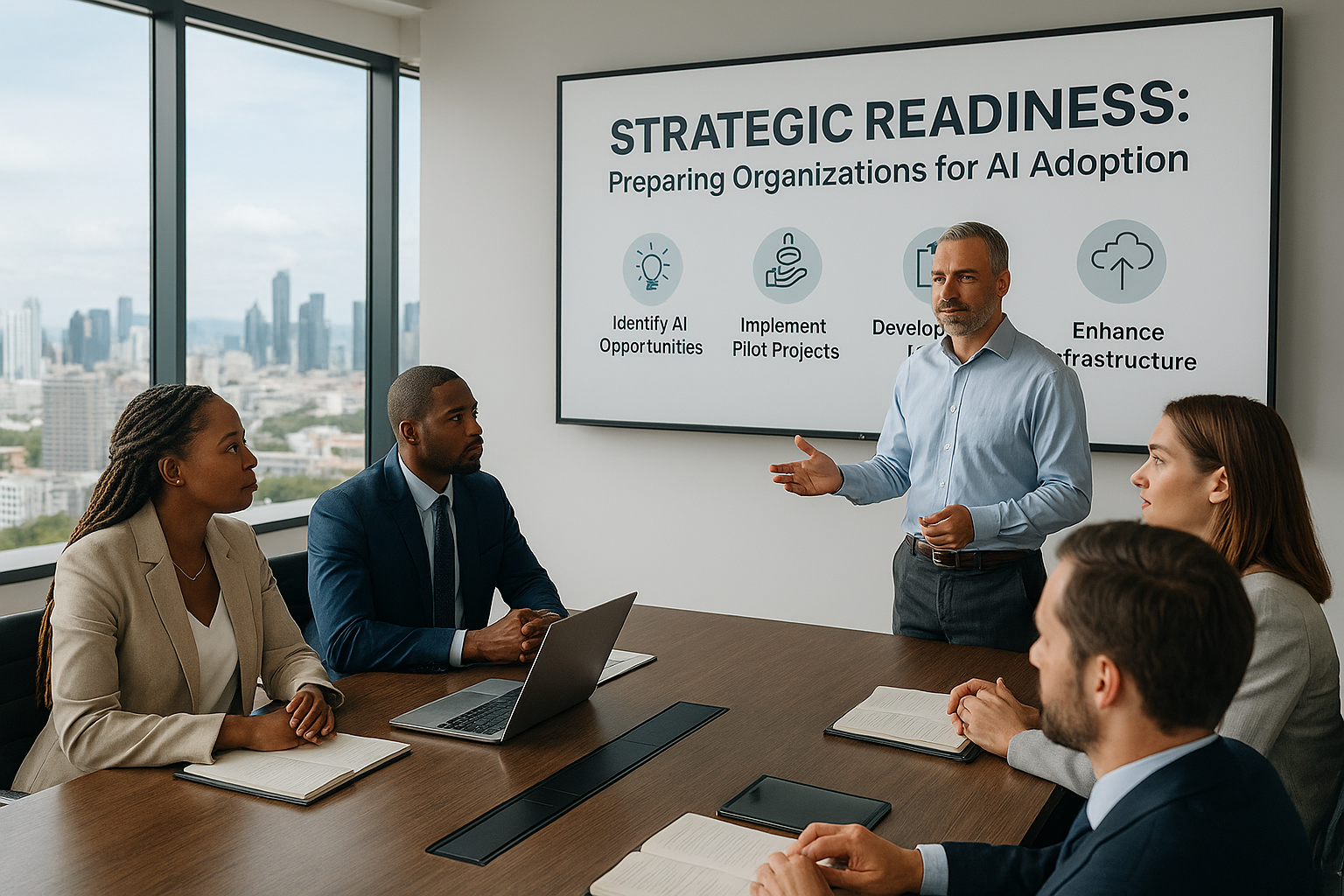
Strategic Readiness: Preparing Organizations for AI Adoption
No AI initiative will thrive without the organization itself being ready. “Readiness” spans technology, people, processes, and leadership mindsets. As numerous studies have shown, it’s often organizational factors—not the AI tech—that determine success. In fact, companies that successfully generate value from AI tend to rewire their operations and culture in the process. For leaders plotting an AI strategy, the following considerations are crucial to prepare your institution for sustainable AI adoption:
1.Align AI with Business Strategy: AI for AI’s sake can lead to pilot projects that go nowhere. Instead, start by identifying key business challenges or opportunities where AI could move the needle—be it improving customer acquisition, reducing operational downtime, personalizing services, or informing policy decisions. Define clear objectives for AI initiatives that tie into the broader strategic goals of the organization. This ensures executive buy-in and resource commitment. When AI efforts are linked to revenue growth, cost savings, or mission outcomes, they’re more likely to get sustained support. Leaders should ask: “How will this AI project create value or advantage, and how will we measure success?” A well-articulated AI roadmap will prioritize projects by impact and feasibility, often starting with some quick wins to build momentum and organizational confidence.
2.Champion Executive and Stakeholder Engagement: Top-down support is a common thread in AI-leading organizations. Senior leadership (C-suite and board) must be visibly and actively involved in AI governance and advocacy. This might mean appointing a Chief AI Officer or forming a steering committee that includes executives from key departments (IT, data, business units). When CEOs and other top leaders evangelize AI’s importance and participate in oversight, it signals to the entire organization that AI is a strategic priority, not just an IT experiment. Furthermore, engagement shouldn’t stop at the corner office—stakeholders across departments should be involved early. Frontline employees can provide practical insights on workflow integration; legal and compliance teams can flag issues early, ensuring solutions are workable within regulatory constraints; and external partners or customers might even be included in co-creating AI solutions (for example, a healthcare provider collaborating with a tech company to develop an AI diagnostic tool). Building a cross-functional AI task force can break down silos and align efforts, integrating diverse perspectives for a more robust implementation.
3.Invest in Skills and Culture: AI adoption will reshape job roles and required skills. It’s essential to upskill and reskill the workforce so employees feel empowered—rather than threatened—by AI. This can range from basic AI literacy programs (helping non-technical staff understand AI concepts and potential in their field) to advanced training for data scientists, machine learning engineers, and AI product managers. Encourage teams to experiment with AI tools (as discussed in the previous section) and share success stories. Some companies create internal AI communities of practice or “AI champions” programs, where enthusiasts help train and support others. Cultivating a data-driven, innovation-friendly culture is equally important. Leaders should promote a mindset where decisions are informed by data and insights (with AI as a key enabler), and where failing fast with pilots is acceptable in pursuit of learning. Recognize and reward employees who find creative ways to improve processes with AI assistance. The objective is to make AI adoption not a top-down imposition, but a grassroots improvement movement within the organization. When people at all levels understand the why and how of the AI changes, they are more likely to embrace them and ensure success.
4.Strengthen Data and Technology Foundations: As highlighted earlier, data readiness and infrastructure are the bedrock of AI. Organizations should conduct an audit of their data assets and data quality. Are critical datasets complete, accurate, and accessible to the teams that need them? Do you have the means to collect new kinds of data (for example, sensor data from operations or customer interaction data from digital channels) that AI models might require? Data governance policies need to be in place so that data is handled ethically and in compliance with privacy laws. On the technology side, ensure you have the required platforms in place for development and deployment—this could mean investing in cloud accounts, MLOps tools, or upgrading hardware for on-premise needs when necessary. Cybersecurity is another aspect of readiness: AI systems can create new attack surfaces (such as adversarial attacks on ML models, or simply more automated processes that hackers might target), so involving your security team to preempt threats is wise. By solidifying data pipelines, storage, compute, and security, you create a stable launchpad for AI projects. This also involves deciding on build vs. buy for AI components: there are many third-party AI services (for vision, speech, etc.) available—part of readiness is knowing when to leverage external solutions versus developing in-house, based on your team’s strengths and strategic control considerations.
5.Embed AI into Workflows and Change Management: Deploying an AI model is only half the battle; the other half is getting people to use it and adjust their workflows accordingly. Change management practices are crucial. When introducing an AI tool (say, an AI sales lead scoring system or an automated report generator), involve the end-users early to co-design the workflow. Address the “What does this mean for my job?” question head-on—be transparent about whether the AI is meant to assist (augmenting the employee’s capabilities) or automate a task, and how roles might shift as a result. Provide training sessions specifically on the new workflow, and create feedback channels for users to express concerns or suggestions. Perhaps assign a human “owner” or liaison for each AI system in production, someone who monitors performance and user feedback and can make adjustments (or retrain the model) as needed. The goal is to avoid scenarios where an AI system is deployed but largely ignored or worked around by staff because it wasn’t well integrated or introduced. By embedding AI into standard operating procedures and making sure there’s accountability and continuous improvement post-launch, you ensure the technology actually delivers the expected benefits. Often this might mean redesigning business processes: for instance, if AI handles the first draft of a financial report, maybe analysts now spend more time on interpretation and validation, and the process document needs updating to reflect that new allocation of tasks.
6.Ensure Ongoing Governance and Evolution: Adopting AI is not a one-time transformation—it’s an ongoing journey. Establishing governance mechanisms (as noted in the ethics section) will provide continuous oversight. This includes setting up key performance indicators (KPIs) to track AI impact (Are error rates decreasing? Is customer satisfaction improving? What’s the ROI on that AI recommendation engine?) and reviewing them at leadership meetings. It also involves regularly revisiting the AI strategy as technology and business needs evolve. Perhaps two years ago your focus was on predictive analytics, but now generative AI opens new possibilities for content creation or code generation—does your strategy adjust to include that? Forward-looking leaders keep an eye on the AI research and competitive landscape: if rivals are using AI in novel ways, it may be time to accelerate your own adoption in that area. Scenario planning for future developments (like regulations getting stricter, or a breakthrough in AI capabilities) can help the organization stay prepared. Moreover, consider ethical governance as part of this evolution—continuously refine your responsible AI guidelines as you learn from each deployment. On the talent side, maintain a pipeline of AI talent by hiring selectively and rotating internal talent into AI projects to build experience. Some firms partner with universities or join industry consortiums to stay at the cutting edge. In short, treat AI capability as a living strategic asset that must be nurtured, evaluated, and renewed over time.
Finally, leaders should consider partnerships as part of strategic readiness. Few organizations can do everything alone. Partnering with experienced AI vendors, consultants, or research institutions (for example, tapping into an AI startup’s innovation via collaboration, or working with a firm like RediMinds that specializes in AI enablement) can accelerate learning and implementation. These partners bring cross-domain experience, technical expertise, and an external perspective that can help avoid pitfalls. The key is to approach partnerships strategically: identify gaps in your AI roadmap that an external partner could fill more efficiently and ensure knowledge transfer so your internal team grows stronger through the collaboration.
Conclusion: Building the Future with Strategic AI
The modern AI ecosystem is vast and fast-moving—encompassing everything from algorithms and data pipelines to ethics and workforce enablement. For leaders, mastering this ecosystem isn’t a luxury; it’s quickly becoming a prerequisite for driving meaningful innovation and staying ahead of the curve. By understanding core AI principles, keeping a pulse on real-world applications, enforcing ethical guardrails, strengthening your technology foundations, and upskilling your people to wield new AI tools, you prepare your organization not just to adopt AI, but to thrive with AI.
The journey may seem complex, but the reward is transformative. Companies and institutions that integrate AI strategically are already reaping benefits: streamlined operations, more personalized services, smarter decision-making, and new avenues for growth. Meanwhile, those that take a passive or haphazard approach risk falling behind in efficiency, customer experience, and even talent attraction (as next-generation workers gravitate towards AI-forward environments). The guidance laid out in this post is a blueprint to approach AI with confidence—treating it not as a magic solution, but as a multifaceted capability that, when built and guided correctly, can yield extraordinary outcomes.
As you look to the future, remember that successful AI adoption is a team effort that blends business savvy, technical insight, and responsible leadership. It’s about crafting a vision for how AI will create value in your context and then executing that vision with discipline and care. Whether you are in a hospital network, a financial conglomerate, a government agency, or a law firm, the path to “mastering” AI involves continuous learning and adaptation. And you don’t have to navigate it alone.
If you’re ready to turn ambition into reality, consider tapping into specialized expertise to accelerate and de-risk your AI initiatives. RediMinds stands ready as a trusted partner in this journey—bringing deep experience in AI enablement to help leaders like you build the future, strategically, securely, and intelligently. From initial strategy and infrastructure set-up to model development and ethical governance, we help organizations weave AI into the fabric of their business in a sustainable way. Reach out to explore how we can support your vision, and let’s create that future together.