

From Chips to Civilizations: How NVIDIA’s AI Factories and Physical Intelligence Will Reshape Industries
From Words to Actions: The Rise of Physical AI
Physical AI shifts artificial intelligence from generating words and images to taking action in the real world. It enables autonomous machines – from humanoid robots to self-driving cars – to perceive, understand, and perform complex tasks in physical environments. NVIDIA’s Jensen Huang calls this the next frontier: “Physical AI and robotics will bring about the next industrial revolution”. Recent NVIDIA announcements back this bold claim, introducing a new class of foundation models for robots alongside simulation tools to train them safely and swiftly.
One highlight is NVIDIA Isaac GR00T N1.5, an open, generalized foundation AI model for humanoid robot reasoning and skills. Described as the “GPT of humanoid robots,” GR00T N1.5 can be customized to imbue robots with general-purpose abilities. Its training leveraged NVIDIA’s simulation platforms: using the new Isaac GR00T-Dreams blueprint, NVIDIA generated vast synthetic “neural trajectory” data in virtual worlds to teach robots new behaviors. In Huang’s COMPUTEX 2025 demo, a single image of a task (like a robot grasping an object) could be turned into a realistic video of the robot performing it in varied scenarios. From those simulations, the system extracts action tokens – bite-sized skills – to load into real robots. The result is dramatic: NVIDIA’s research team updated the GR00T model to version N1.5 in just 36 hours using AI-generated motion data, a process that would have taken nearly three months with manual human demos. The new GR00T N1.5 model is far more adaptable – it generalizes to new environments and understands user instructions for object manipulation, significantly boosting success rates in tasks like sorting and assembly. In short, robots can now learn in simulation at super-human speed and then transfer those skills to the real world.
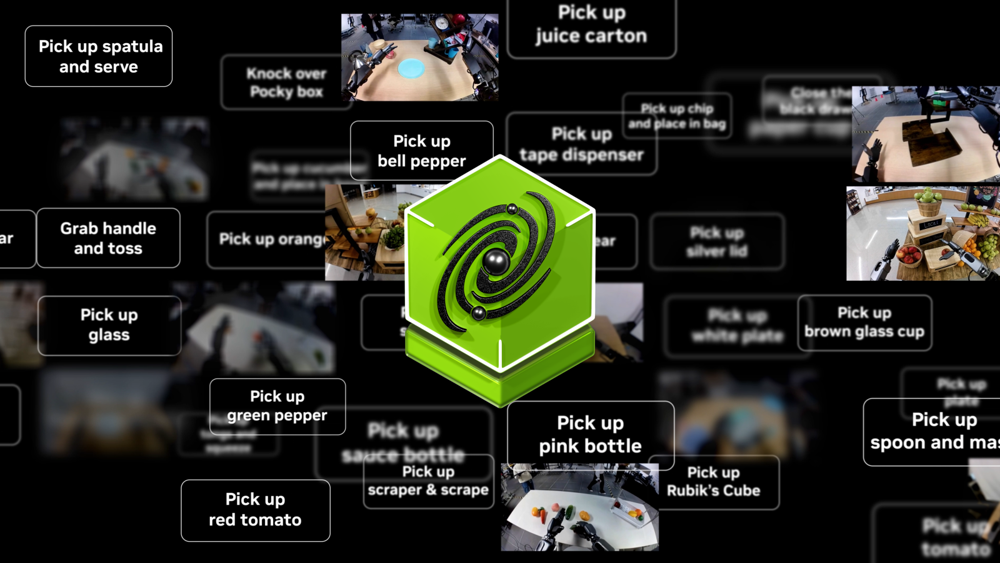
NVIDIA’s Isaac platform uses simulation to generate massive “neural trajectory” datasets for training robots. Foundation models like Isaac GR00T enable humanoid robots to learn tasks (e.g. picking various objects) with unprecedented speed, closing the gap between AI’s understanding and real-world action.
To support this leap from virtual training to physical execution, NVIDIA is also building the ecosystem around physical intelligence. At GTC 2025, NVIDIA, Google DeepMind, and Disney Research announced Newton, a new open-source physics engine optimized for robot learning. Built on NVIDIA’s Warp framework and compatible with DeepMind’s MuJoCo simulator, Newton will let robots practice complex tasks with high-fidelity physics – essentially a sandbox to refine physical skills with precision. It’s slated to launch later this year (with a target around July 2025) and promises a huge speedup (DeepMind reports 70× faster robotics simulations with the upcoming MuJoCo-Warp integration). Even Disney is on board: Disney Imagineering will use Newton to train the next generation of expressive animatronic characters. These tools underscore a key point: to build physical AI, teams need powerful simulation environments to safely train machines on countless scenarios. NVIDIA’s Omniverse and Isaac Sim provide exactly that – a virtual playground where robots can fail, learn, and repeat at scale before touching real-world equipment. Early adopters like Agility Robotics, Boston Dynamics, and others are already embracing NVIDIA’s Isaac platform to accelerate development of humanoid assistants and warehouse robots. By combining foundation models (the “AI brains”), high-fidelity simulators (the training grounds), and powerful robot-compute (the RTX PRO 6000 Blackwell GPU workstations for simulation), NVIDIA is erecting the scaffolding for AI that acts. Physical AI moves beyond content generation; it is about skills generation – teaching machines to manipulate the physical world as reliably as ChatGPT generates text. This transition from words to deeds will redefine work in industries from manufacturing and logistics to healthcare and beyond. “The age of generalist robotics is here,” Huang declared, pointing to a coming era where intelligent machines tackle labor shortages and dangerous tasks by learning from simulation and executing in reality.
AI Factories as the New National Infrastructure
If physical AI is the brains and brawn on the ground, AI factories are the giant “brain farms” powering AI at the national and enterprise level. Jensen Huang often describes AI factories as the next-generation data centers where “data comes in and intelligence comes out” – much like factories turning raw materials into useful goods. These AI factories consist of racks of accelerated computing (usually NVIDIA GPU supercomputers) that train and deploy AI models at scale, from LLMs to genomics and climate models. Critically, they are becoming strategic assets for countries and companies alike – the bedrock of modern economies, as Huang puts it.
In the race for AI leadership, nations are investing heavily in domestic AI factories to secure their digital sovereignty. NVIDIA’s AI Nations initiative has helped over 60 countries craft national AI strategies, often anchored by sovereign AI supercomputers. The logic is simple: AI prowess depends on unique local data (language, culture, industry specifics), and no country wants to export its data only to “buy back” insights from foreign models. “There’s no reason to let somebody else come and scrape your internet, take your history and data… People realize they have to use their own data to create their own AI,” Huang explained. We now see a wave of national AI cloud projects – from Europe’s JLuminor and France’s 1,016-GPU DGX SuperPOD to new initiatives across Asia, the Middle East, and the Americas – all aiming to turn local data into homegrown AI solutions. As VentureBeat noted, Huang views these as “AI generation factories” that transform raw data via supercomputers into “incredibly valuable tokens” – the outputs of generative AI models that drive business and societal applications. In other words, AI factories are becoming as essential as power plants: every nation will build one to fuel its economy in the AI era.
A prime example is Taiwan’s national AI factory, announced at COMPUTEX 2025. NVIDIA and manufacturing giant Foxconn (Hon Hai) are partnering with Taiwan’s government to build a colossal AI supercomputer featuring 10,000 NVIDIA Blackwell GPUs. This “AI cloud for Taiwan” will be run by Foxconn’s Big Innovation subsidiary and provide AI computing as a utility to local researchers, startups, and industries. Backed by Taiwan’s National Science and Technology Council, the AI factory will vastly expand access to AI horsepower for everything from semiconductor R&D at TSMC to smart manufacturing and healthcare across the island. “AI has ignited a new industrial revolution — science and industry will be transformed,” Huang said at the launch, framing the project as critical infrastructure for the country’s future. Foxconn’s chairman described it as “laying the groundwork to connect people… and empower industries” across Taiwan. In essence, Taiwan is ensuring it has its own advanced AI backbone, rather than relying solely on U.S. or Chinese cloud providers. Similar moves are afoot globally. In Canada, telecom leader TELUS is launching a sovereign AI cloud to bolster domestic innovation. In Europe, initiatives like Italy’s Leonardo and France’s Mistral aim to foster AI models attuned to European languages and norms. Even telecom and cloud companies are partnering with NVIDIA to offer regional AI clouds – e.g. Swisscom’s AI factory in Switzerland for privacy-sensitive enterprises.
For enterprises too, AI factories are the new strategic asset. Banks, hospitals, and even automotive firms are deploying on-premises GPU clusters (or renting dedicated DGX Cloud pods) to train models on proprietary data while meeting compliance needs. The appeal is control: a secure AI factory lets an organization refine its own models (say, a finance LLM tuned to internal datasets or a medical imaging model trained on hospital records) without sending data off-site. It’s also about customization – as NVIDIA notes, sovereign AI includes building foundation models with local dialects, domain jargon, and cultural context that big generic models might overlook. We saw this with the rise of large language models for non-English markets and industry-specific models (for example, France’s Bloom or India’s open-source AI models, which aim to reflect local language and values). In short, competitive advantage and national interest now intersect in the data center. Owning an AI factory means faster innovation cycles and protection against being overtaken by those who do. It’s why Huang emphasizes that AI factories will be “the bedrock of modern economies across the world.” Global competitiveness may soon be measured by a nation’s (or company’s) capacity to produce advanced AI in-house – much as industrial might was once measured in steel mills or energy output.
Blackwell and CUDA-X: The New Infrastructure Primitives
Underpinning both physical AI and AI factories is a powerful foundation: accelerated computing platforms like NVIDIA’s Blackwell architecture and the expansive CUDA-X software ecosystem. These are the 21st-century equivalent of electrification or the internet – fundamental infrastructure primitives that enable everything else. NVIDIA’s Blackwell-generation GPUs and Grace CPU superchips are explicitly billed as “the engine of the new industrial revolution”. Why? Because they deliver unprecedented compute horsepower and efficiency, unlocking AI and HPC workloads that were previously impractical. Each Blackwell GPU packs 208 billion transistors, with cutting-edge design features (like twin dies linked at 10 TB/s) to push throughput to new heights. In practical terms, a single Blackwell-based server can train and infer AI models that would have required racks of hardware a few years ago. Blackwell’s Transformer Engine introduces 4-bit floating point (FP4) precision and other optimizations that double the effective performance and model size capacity without sacrificing accuracy. This means next-generation models up to 10 trillion parameters can be trained or served in real-time on Blackwell systems – an astronomical scale edging into what one might call “civilization-scale” AI models.
The impact is evident in benchmarks. At GTC 2025, NVIDIA demonstrated that eight Blackwell GPUs (in a DGX B200 node) can sustain over 30,000 tokens per second throughput on the massive 671B-parameter DeepSeek-R1 model. This is a world record and represents a 36× increase in throughput since January 2025, slashing the cost per inference by 32×. In plain English: Blackwell can serve or “reason” with gigantic models far more efficiently than previous-gen hardware, bringing latency down to practical levels. In fact, using Blackwell with new software optimizations (like NVIDIA’s TensorRT-LLM and 4-bit quantization), NVIDIA achieved 3× higher inference throughput on models like DeepSeek-R1 and Llama-3 than on the prior Hopper-based systems. OpenAI CEO Sam Altman remarked that Blackwell offers massive performance leaps that will accelerate delivery of leading-edge models – a sentiment echoed by industry leaders from Google to Meta. This raw power is what makes national AI factories and enterprise AI clouds feasible; it’s the “workhorse engine” turning all that data into intelligence.
Equally important is CUDA-X, NVIDIA’s collection of GPU-accelerated libraries and frameworks spanning every domain. Over the past decade, NVIDIA didn’t just build chips – they built a full-stack software ecosystem to make those chips useful across disciplines. Jensen Huang highlighted at GTC that CUDA acceleration now powers a multitude of HPC and scientific applications: computer-aided design (CAD), engineering simulations (CAE), physics and chemistry calculations, genomics and drug discovery, weather forecasting, quantum circuit simulation – even basic data analytics. This breadth means Blackwell GPUs are not specialized for AI alone; they have become general-purpose engines for any computation-heavy task. For instance, NVIDIA’s cuQuantum library speeds up quantum computing research by simulating qubit systems on GPUs, aiding the design of future quantum algorithms. In climate science, GPU-accelerated climate models can project weather patterns or climate change scenarios with higher resolution and more speed, improving disaster predictions. In genomics, tools like NVIDIA Clara and Parabricks use GPUs to accelerate genome sequencing and medical imaging for faster diagnoses. These domain-specific accelerations (collectively termed CUDA-X extensions) effectively turn the GPU platform into a utility – much like electricity – that can be applied to countless problems. As Huang put it, CUDA made “the extremely time-consuming or unfeasible possible” by speeding up computation dramatically. It’s now hard to find a cutting-edge industry or scientific field not touched by this accelerated computing revolution. Just as the internet became the underlying network for communication and commerce, GPU-accelerated infrastructure is becoming the underlying engine for intelligence and discovery across domains.
One striking example of how accessible this power is becoming: NVIDIA’s introduction of DGX Spark, dubbed the world’s smallest AI supercomputer. DGX Spark (formerly Project “Digits”) is a Grace-Blackwell desktop system that delivers a petaflop of AI performance on your desk. About the size of a shoebox, this mini supercomputer features the new GB10 Superchip – pairing a Blackwell GPU and 20-core Grace CPU on one chip – and 128 GB of unified memory, enough to train or fine-tune large models up to 200 billion parameters locally. Jensen Huang described it as “placing an AI supercomputer on the desks of every researcher and student”, enabling developers to experiment with advanced models at home and then seamlessly scale up to cloud or data center clusters. With products like this (and its bigger sibling DGX Station, which boasts nearly 800 GB of memory for larger workloads), AI compute is scaling out as well as up. It’s reminiscent of the PC revolution – bringing computing power to every individual – but now it’s AI power. The Grace–Blackwell architecture ensures that whether it’s a national AI facility or a personal workstation, the same stack of technology can run consistently. This ubiquity cements Blackwell and CUDA-X as core infrastructure: much as you assume electricity or broadband in any modern building, tomorrow’s labs and offices will assume the presence of accelerated AI compute.
The net effect is that compute is no longer the bottleneck to grand AI ambitions. With trillion-parameter model capability, secure enclaves for sensitive data (Blackwell introduces confidential computing that protects models and data with near-zero performance penalty), and an ever-expanding suite of optimized libraries, NVIDIA’s platform is akin to a global AI utility provider. It furnishes the raw power and tools needed to transform industries – if leaders know how to harness it. The responsibility now falls on enterprises and policymakers to put this infrastructure to good use in solving real problems.
High-Stakes Domains: Transforming Healthcare, Finance, Law, and Security
The implications of NVIDIA’s AI roadmap for regulated and high-stakes industries are profound. Sectors like healthcare, law, finance, and national security face strict standards for accuracy, fairness, and reliability – yet they stand to gain enormously from AI-accelerated innovation. The challenge and opportunity is to integrate these AI advances in a trustworthy, mission-aligned way.
Take healthcare: Foundation models and generative AI are viewed as a “major revolution in AI’s capabilities, offering tremendous potential to improve care.” Advanced language models could act as medical copilots, aiding clinicians in summarizing patient histories or suggesting diagnoses; computer vision models can analyze radiology scans faster than human eyes; generative models might design new drug molecules or treatment plans. Importantly, these models can be tuned to local medical data and practices – for example, an LLM could be trained on a hospital system’s own electronic health records to answer clinician queries with knowledge of that hospital’s formulary and protocols. Already, NVIDIA’s Clara platform and partnerships with healthcare institutions are enabling AI in medical imaging and genomics. However, the introduction of such powerful AI requires rigorous validation. Medical journals and regulators emphasize thorough testing of AI tools on clinical outcomes, and caution that new risks like hallucinations or biased recommendations must be managed. The encouraging news is that techniques like federated learning (training on sensitive data without that data leaving the hospital) and Blackwell’s confidential computing features can help preserve patient privacy while leveraging collective insights. The expansion of CUDA-X into life sciences – e.g., GPU-accelerated genomic sequencing that can analyze a genome in under an hour – will likely make certain medical processes both faster and safer. In short, healthcare leaders should view AI factories and models as critical tools for tasks like drug discovery, personalized medicine, and operational efficiency, but they must also invest in validation, bias mitigation, and clinician training to safely deploy these tools.
In finance, accelerated AI promises real-time risk modeling, fraud detection, and even natural language interfaces for banking customers. Wall Street has long used GPUs for high-frequency trading simulations; now, with Blackwell and FP4 precision, they can run far more complex stress tests and AI-driven forecasts on economic data. Major banks are exploring large language models fine-tuned on their own research reports and customer data – essentially AI analysts that can parse market trends or regulatory changes instantly. However, issues of model governance and transparency loom large. Financial regulators will demand explainability for AI decisions (e.g. why a loan was denied by an AI model). Fortunately, there is progress here: NVIDIA’s focus on safety (such as the NVIDIA Halos safety platform for autonomous vehicles, built with explainability in mind) is an example that accountability can be designed into AI systems. Finance firms are beginning to adopt similar ideas, like “AI audit trails” and adversarial testing, to ensure compliance. For instance, some compliance teams use red-teaming exercises – borrowed from cybersecurity – to probe their AI for weaknesses. (One law firm, DLA Piper, even enlisted its lawyers to red-team AI systems and check if outputs adhere to legal frameworks, a practice financial institutions could emulate for regulatory compliance.) With the right safeguards, AI factories can empower finance with superior analytic insight while keeping human oversight in the loop.
Law and government sectors likewise must balance innovation and risk. Generative AI can rapidly sift legal documents, draft contracts, or support intelligence analysis – tasks that consume thousands of hours today. Yet, a hallucinated legal citation or a biased algorithm in policing could have serious consequences. This places a premium on domain-specific fine-tuning and evaluation. We’re likely to see “LLMs with law degrees” – models trained on national laws and case precedents – deployed to help judges and lawyers, but always with a human in charge to verify outputs. National security agencies are investing in AI factories to develop secure models for intelligence (ensuring that no sensitive data or methods leak out). At the same time, governments are drafting policies (e.g. the U.S. National Security Memorandum on AI, the EU AI Act) to set boundaries on acceptable AI use. NVIDIA’s platform supports these needs by enabling on-premises, auditable AI deployments – one can fine-tune models behind an organization’s firewall and even lock weights or apply watermarks to model outputs for traceability. Additionally, the immense compute efficiency gains (like Blackwell’s ability to run giant models cheaply) mean that even public sector agencies with limited budgets can contemplate their own AI solutions rather than depending entirely on Big Tech providers.
In all these regulated arenas, one common theme emerges: human oversight and alignment are as important as raw compute power. The technology is reaching a point where it can be applied to critical tasks; the focus now is on aligning it with societal values, ethical norms, and legal requirements. Enterprises and governments will need interdisciplinary teams – AI engineers working with doctors, lawyers, economists, policymakers – to ensure the models and simulations are validated and robust. The good news is that the same technologies powering this revolution can also assist in managing it. For example, AI simulation can generate rare scenarios (edge cases) to test an autonomous vehicle or a medical diagnosis model exhaustively before deployment. And as noted, red-teaming and stress-testing AI is becoming a best practice to uncover vulnerabilities. With proper guardrails, high-stakes industries can reap the rewards of AI (better outcomes, lower costs, enhanced capabilities) while minimizing unintended harm.
Preparing for an AI-Native Future: A Leadership Roadmap
For enterprise CTOs, policymakers, and developers, the writing on the wall is clear: an AI-native paradigm is fast emerging, and preparing for it is now a strategic imperative. NVIDIA’s advances – AI factories, physical AI, Blackwell superchips – provide the tools, but how those tools are used will determine winners and losers in the next decade. Here’s how leaders can get ready:
-
Invest in AI-Fluent Talent: Ensure your workforce includes people who understand both advanced AI technology and your sector’s unique context. This might mean training existing domain experts (e.g. radiologists, lawyers, engineers) in data science and AI, as well as hiring new talent familiar with NVIDIA’s AI stack and modern ML Ops. The goal is to build “translators” – individuals or teams who can bridge cutting-edge compute innovation with industry-specific problems. For example, a robotics developer in manufacturing should grasp NVIDIA Isaac simulation workflows and the nuances of factory operations. Building this talent now will position your organization to fully leverage AI factories and avoid the adoption pitfalls that come from misunderstanding AI outputs.
-
Forge Compute and Data Partnerships: The scale of AI compute and data needed is enormous, and not every organization will own a 10,000-GPU supercomputer. But partnerships can grant access to these resources. Leaders should explore collaborations with cloud providers, national supercomputing centers, or initiatives like NVIDIA’s DGX Cloud and AI Nations program to tap into large-scale compute on demand. Likewise, data partnerships – across agencies in a country or between companies in a supply chain – can create richer datasets to train better models (while respecting privacy via federated learning or secure enclaves). A hospital network, for instance, might partner with a government research cloud to train healthcare models on combined anonymized datasets from multiple hospitals, all using an AI factory as the centralized training ground. Such alliances will be key to keeping up with the rapid progress in model capabilities.
-
Adopt AI-Native Workflows and Governance: Preparing for this shift means embedding AI into the core of your workflows, not as an afterthought. Encourage teams to pilot AI-driven processes – whether it’s a copilot for software developers to write code, an AI assistant triaging customer service tickets, or simulation-generated synthetic data augmenting real data in model training. Equally, update your governance: implement AI oversight committees or review boards (with technical, ethical, and domain experts) to vet new AI deployments. Establish clear policies for issues like model bias, data usage rights, and fail-safes when AI is wrong. Organizations that treat AI governance with the same rigor as financial auditing or cybersecurity will build trust and be able to deploy innovations faster than those who move fast and break things without oversight.
-
Focus on High-Impact, Regulated Use Cases First: Counterintuitive as it sounds, some of the biggest wins (and challenges) will come in regulated sectors that have high stakes. Leaders in healthcare, finance, energy, and government should proactively engage with regulators to shape sensible guidelines for AI. By participating in standards development and sharing best practices (for example, how you validated your AI model for FDA approval or how you ensured an AI trading algorithm complied with market rules), you not only gain credibility but also help set the rules in your favor. Proactive compliance – showing that you can deploy AI responsibly and transparently – will be a competitive advantage. It can open the door for faster approvals (e.g. expedited processes for AI-powered medical devices) and public acceptance. Moreover, solving hard problems in regulated domains often yields innovations that transfer to the broader market (similar to how NASA or defense research spins off commercial tech). Prioritize projects where AI can demonstrably enhance safety, efficiency, or accessibility in your field, and document the outcomes rigorously.
-
Cultivate an Innovation Ecosystem: Finally, no single organization can master all facets of this AI revolution. Smart leaders will cultivate an ecosystem of domain-aligned AI experts and partners. This could mean partnering with AI startups specializing in your industry, joining consortiums (like automotive companies banding together on autonomous driving safety standards), or engaging academia on research (e.g. sponsoring a university lab to work on open problems relevant to your business). An ecosystem approach ensures you stay at the cutting edge: you’ll hear about breakthroughs sooner, and you can pilot new NVIDIA releases (like the latest CUDA-X library for quantum chemistry or a new robotics API) in collaboration with those experts. Crucially, it also helps with the cultural shift – integrating external AI expertise can infuse a more experimental, learning-oriented mindset in traditionally risk-averse sectors.
In summary, the next industrial paradigm will be defined by those who merge computational prowess with domain expertise. NVIDIA’s CEO aptly observed that AI has transformed every layer of computing, prompting the rise of “AI-native” computers and applications. Leaders must therefore cultivate AI-native organizations – ready to leverage chips as intelligent as Blackwell, data as vast as national corpora, and simulations as rich as Omniverse to drive their mission.
Conclusion: Bridging Compute Innovation and Industry Transformation
We stand at an inflection point where the boundaries between silicon, software, and society are blurring. NVIDIA’s vision of AI factories and physical intelligence paints a future in which entire industries are refounded on AI-driven capabilities. National competitiveness will be measured by access to accelerated infrastructure and the savvy to use it. Robots endowed with simulation-trained smarts will tackle labor and knowledge gaps, while AI models will co-author discoveries in labs and decisions in boardrooms. From chips enabling trillion-parameter reasoning to AI factories churning out solutions to grand challenges, this new ecosystem holds the promise of unprecedented productivity and innovation – essentially a new civilizational leap powered by AI.
Yet, realizing that promise requires more than technology; it demands leadership. Enterprise CTOs and policymakers must act now to align this technological tsunami with their strategic goals and ethical compass. The call to action is clear: invest, partner, and pilot aggressively but responsibly. Those who build the right talent and partnerships today will be the ones steering industries tomorrow. The era of AI as a mere tool is ending – we are entering the era of AI as infrastructure, as integral to progress as electricity or the internet.
For decision-makers across sectors, the question is no longer if AI will reshape your industry, but how and with whom. It’s time to explore partnerships with domain-specialized AI providers and experts who can bridge NVIDIA’s cutting-edge compute innovations with the nuances of your field. By collaborating with the right AI ecosystem, organizations can ensure that their adoption of AI is not only technically robust but also aligned with sector-specific regulations, risks, and opportunities. From chips to civilizations, the journey will be transformative – and those who engage early with these AI advancements will help shape industries in their image. Now is the moment to step forward and harness this fusion of computing power and human ingenuity, turning today’s AI factories and physical AI breakthroughs into tomorrow’s sustainable, inclusive growth.
Ready to take the next step? Embrace this AI-driven paradigm by partnering with experts who understand both the technology and your domain. Together, you can leverage AI factories, simulation-trained intelligence, and bespoke accelerated solutions to drive innovation that is secure, ethical, and groundbreaking. The new industrial revolution is here – and with the right alliances, your organization can lead it.