

The Future of Digital Creation: How AI and Imagination Are Redefining Innovation
Introduction
Mark Zuckerberg recently shared a bold vision for the future of digital creation: a world where 99% of innovation stems from imagination and only 1% from code. He predicts that AI tools will empower content creators—not just software engineers—to craft the next wave of innovation, such as holograms that blur the line between digital and physical worlds. Imagine a TV on your wall that’s not a device but a hologram, displaying anything you dream up, all powered by AI and a creator’s vision. At RediMinds, we’re thrilled to be part of this AI era, where creativity meets technology to redefine how we live and connect. In this blog post, we’ll dive into Zuckerberg’s vision, explore how AI is enabling creators, examine the implications for innovation and traditional tech skills, and show how RediMinds can help government, healthcare, legal, and financial sectors harness this transformative potential to enhance back-office operations.
Zuckerberg’s Vision: Imagination Over Code
Mark Zuckerberg’s vision for digital creation centers on the idea that AI will shift the focus from coding to creativity, allowing content creators to drive innovation. At Meta Connect 2024, he introduced Orion, Meta’s prototype holographic smart glasses with a neural interface, enabling users to see digital objects overlaid on the real world and control them with brain waves – Mark Zuckerberg unveils new Orion holographic smart glasses. Zuckerberg predicts that holograms will become as commonplace as physical objects, transforming everyday experiences (Mark Zuckerberg says ‘holograms of digital things’ will be commonplace). For example, a holographic TV on your wall could display anything you imagine, powered by AI and a creator’s vision, without requiring extensive coding knowledge. This shift aims to make technology more accessible, enabling a broader range of individuals to innovate and create immersive digital experiences.
AI as a Catalyst for Creators
AI is already making this vision a reality by enabling tools that simplify complex digital creation processes. Researchers at MIT have developed deep learning methods to generate 3D holograms in real-time, which can run on smartphones with minimal computational requirements—using a compact tensor network that requires less than 1 MB of memory Using artificial intelligence to generate 3D holograms. This technology allows creators to produce holographic displays without deep technical expertise, focusing instead on their creative ideas. AI tools can now generate code, design interfaces, or render 3D models based on natural language prompts, lowering barriers to entry and enabling creators to bring their visions to life quickly. This aligns with Zuckerberg’s prediction that the future of digital creation will be driven by imagination, with AI handling the technical heavy lifting, making innovation more accessible across industries.
Democratizing Innovation: Opportunities and Challenges
Zuckerberg’s vision has the potential to democratize innovation by making advanced technology accessible to non-technical creators, leading to a surge in creativity and new applications across sectors:
-
Healthcare: Medical professionals could use AI to create holographic models for patient education or surgical planning, enhancing understanding and training without needing coding skills.
-
Government: Public servants could develop holographic citizen engagement platforms, such as virtual town halls, improving accessibility and participation in public services.
-
Legal: Lawyers could create holographic presentations to visualize legal arguments or timelines, improving client communication and case preparation.
-
Financial: Financial advisors could use holographic interfaces to present data interactively, enhancing customer engagement and decision-making.
This democratization could accelerate innovation, allowing more people to contribute ideas and solutions. However, it also raises challenges, such as ensuring equitable access to AI tools and addressing potential skill gaps. While AI lowers barriers, it might reduce the demand for traditional coding skills, prompting debate about whether this shift sidelines the deep tech expertise that has driven technological progress.
The Role of Traditional Tech Skills in an AI-Driven Future
While AI tools empower creators, traditional tech skills remain essential. Software engineers are crucial for developing and maintaining the AI systems that enable these innovations, ensuring their security, performance, and scalability. For instance, creating holographic displays requires engineers to build the underlying frameworks, such as neural interfaces for Meta’s Orion glasses, and to address technical challenges like latency and data privacy. Moreover, deep technical knowledge is vital for validating AI outputs, optimizing systems, and handling edge cases that AI might not address effectively.
Zuckerberg’s vision doesn’t eliminate the need for tech expertise; it redefines its role. Engineers will focus on building the infrastructure that empowers creators, while creators drive the application layer. This collaboration between creativity and technical expertise could lead to groundbreaking innovations, but there’s a concern that over-reliance on AI might diminish the importance of coding skills. The balance lies in ensuring that AI augments, rather than replaces, technical expertise, fostering a symbiotic relationship between creators and engineers.
RediMinds’ Role in This AI Era
At RediMinds, we’re excited to be part of this AI-driven era, helping government, healthcare, legal, and financial sectors leverage AI to enhance back-office operations and explore innovative applications like holographic technologies. Our expertise in AI enablement allows us to support organizations in integrating these tools effectively:
-
Government: We can help agencies implement AI for holographic citizen engagement platforms, improving public service delivery while streamlining back-office processes like data management.
-
Healthcare: We enable healthcare providers to use AI for holographic training models, reducing administrative burdens and enhancing patient care through efficient back-office automation.
-
Legal: We support legal firms in adopting AI for holographic presentations, while optimizing back-office tasks like contract analysis and compliance monitoring.
-
Financial: We assist financial institutions in creating holographic customer interfaces, while enhancing back-office operations like fraud detection and reporting.
Our custom AI solutions ensure that you can focus on innovation while we handle the technical integration, ensuring ethical and effective implementation tailored to your sector’s needs.
Ethical Considerations in AI-Driven Digital Creation
The adoption of AI for digital creation raises important ethical considerations:
-
Data Privacy: AI tools often require access to sensitive data, raising concerns about privacy, especially in healthcare and government. Compliance with regulations like HIPAA and GDPR is essential.
-
Bias and Fairness: AI models can inherit biases from training data, potentially leading to unfair outcomes in digital creations, such as biased holographic representations. Continuous monitoring is necessary.
-
Accessibility: Ensuring equitable access to AI tools is vital to avoid widening tech divides, particularly in government and education sectors.
RediMinds prioritizes ethical AI practices, ensuring your implementations are secure, fair, and accessible, aligning with public sector standards.
Table of Potential Applications and Benefits
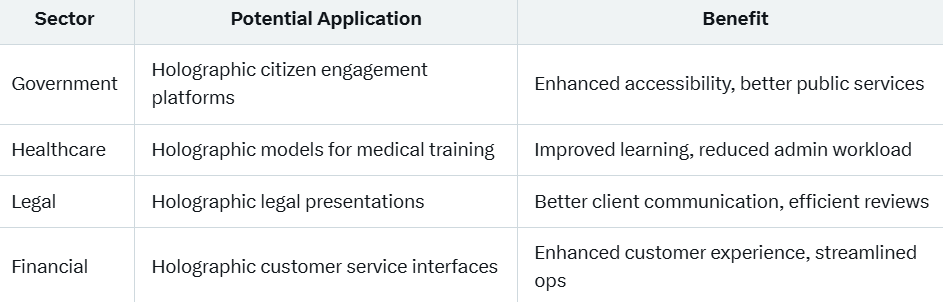
This table highlights practical applications of AI-driven holographic innovations, offering a clear view of their potential impact.
Conclusion
Mark Zuckerberg’s vision of a future where AI empowers creators to innovate with minimal code is a game-changer, promising to democratize innovation and redefine how we interact with technology. From holographic TVs to immersive citizen engagement platforms, the possibilities are endless, and the blend of creativity and AI is set to transform industries. At RediMinds, we’re committed to helping government, healthcare, legal, and financial sectors harness this potential, ensuring back-office operations are efficient and innovative as we step into this new era of digital creation.
What’s your wildest digital idea? We’re excited to hear all about it and help you bring it to life with AI! Get in touch with us today to start your journey. Or, explore our existing AI products, already loved in the market, and share the exhilarating feeling with the world—experience innovation through RediMinds!