

Bridging the Gap with MCP: How AI Integration is Transforming Back-Office Operations
Introduction
Imagine a world where AI doesn’t just process data but seamlessly connects with every tool, system, and database it needs to deliver transformative results—turning complexity into simplicity. This isn’t a distant dream; it’s the reality being ushered in by the Model Context Protocol (MCP). MCP, an open-source protocol developed by Anthropic, is revolutionizing AI integration by enabling systems to communicate effortlessly with external tools and data sources, eliminating the need for custom coding chaos. With over 300 server implementations already live and whispers of adoption by tech giants like Google, MCP is poised to redefine how we build smarter, more connected AI solutions. At RediMinds, we’re passionate about pioneering technologies that empower our clients to lead, particularly in back-office operations across healthcare, legal, financial, and government sectors. In this blog post, we’ll explore what MCP is, how it works, its transformative potential for back-office operations, and how RediMinds can help you harness this technology to unlock new efficiencies and innovations.
Understanding the Model Context Protocol (MCP)
The Model Context Protocol (MCP) is a standardized, open-source protocol introduced by Anthropic in November 2024, designed to simplify how AI systems, particularly large language models (LLMs), interact with external tools and data sources. Often likened to a “universal connector” for AI, MCP eliminates the need for custom integrations by providing a common language for AI applications to access diverse data sources like databases, APIs, and local files.
MCP operates on a client-server architecture:
-
MCP Hosts: Applications like AI chatbots or IDEs that initiate requests to access data, such as Claude Desktop.
-
MCP Servers: Lightweight programs that expose specific capabilities, connecting to local or remote data sources.
-
MCP Clients: Manage 1:1 connections between hosts and servers, ensuring secure and efficient communication.
This structure transforms the integration challenge from an M×N problem (where M AI applications need to connect to N tools, requiring M×N integrations) to an M+N problem, where tool creators build N MCP servers and developers build M MCP clients (Model Context Protocol Overview). With over 300 server implementations already live, as noted in community discussions (MCP 101 Introduction), and potential interest from tech giants like Google, MCP is gaining significant traction (Introducing the Model Context Protocol Anthropic).
The Impact of MCP on Back-Office Operations
Back-office operations in healthcare, legal, financial, and government sectors often grapple with complex data ecosystems, legacy systems, and stringent compliance requirements. MCP’s ability to standardize AI integrations offers a game-changing solution, enabling seamless connectivity that drives efficiency and innovation.
-
Healthcare: MCP can connect AI systems to electronic health records (EHRs), diagnostic databases, and telemedicine platforms. For instance, an AI assistant could pull patient history from an EHR, access real-time lab results, and integrate with telemedicine tools to assist doctors in making evidence-based decisions, reducing administrative burdens and enhancing patient care (The Model Context Protocol MCP Ultimate Guide).
-
Legal: In the legal sector, MCP enables AI to integrate with legal research databases, document management systems, and compliance frameworks. An AI system could analyze contracts by pulling clauses from regulatory databases, ensuring compliance and reducing manual review time, which is critical for back-office efficiency.
-
Financial: For financial institutions, MCP facilitates connections between AI and transaction systems, risk management tools, and reporting platforms. An AI could use MCP to monitor transactions in real-time, integrate with fraud detection APIs, and generate financial reports, improving accuracy and speed in back-office operations.
-
Government: Government agencies can leverage MCP to connect AI with public records, citizen service platforms, and internal systems. For example, an AI could streamline public service delivery by accessing citizen data, integrating with service portals, and pulling internal budget data for better oversight, enhancing transparency and efficiency.
By simplifying integrations, MCP reduces costs, accelerates deployment, and enhances AI performance, making it a transformative tool for back-office operations in these sectors.
Why MCP Matters for Your Business
MCP’s standardized approach to AI integration offers several benefits that can directly impact your business:
-
Efficiency Gains: By eliminating custom coding, MCP reduces the time and cost of integrating AI with your systems, allowing faster deployment of solutions.
-
Scalability: Its modular design makes it easy to add new tools or data sources as your needs grow, crucial for sectors like government and finance with expanding datasets.
-
Enhanced AI Capabilities: Seamless access to diverse data sources provides AI with richer context, leading to more accurate and actionable insights, such as improved fraud detection in finance or faster diagnostics in healthcare.
-
Cost Savings: Reduced development and maintenance costs make AI more accessible, benefiting smaller organizations or budget-constrained government agencies.
-
Innovation Opportunities: Simplified integrations encourage experimentation, potentially leading to new AI-driven solutions, like automated compliance checks in legal or citizen service chatbots in government.
As MCP adoption grows, with whispers of tech giants like Google exploring its use, the ecosystem will expand, offering even more opportunities for businesses to innovate and stay competitive.
How RediMinds Leverages MCP for Your Success
At RediMinds, we’re at the forefront of AI enablement, helping clients in healthcare, legal, financial, and government sectors harness cutting-edge technologies like MCP to drive innovation. Our expertise ensures that you can integrate MCP into your operations seamlessly, unlocking its full potential:
-
Tailored Solutions: We design AI solutions that leverage MCP to connect with your specific tools and data sources, whether it’s EHRs in healthcare or public records in government.
-
Seamless Integration: Our team ensures MCP integrates smoothly with your existing systems, minimizing disruption, especially for legacy systems common in government and finance.
-
Training and Support: We provide comprehensive training to ensure your team can maximize MCP’s benefits, along with ongoing support to address any challenges.
-
Ethical AI Practices: We prioritize data privacy, security, and fairness, ensuring compliance with regulations like HIPAA and GDPR, which is critical for sensitive sectors.
Ethical Considerations in MCP Implementation
Implementing MCP raises important ethical considerations:
-
Data Privacy: Connecting AI to external data sources requires robust security measures to protect sensitive information, adhering to regulations like HIPAA and GDPR (Model Context Protocol Specification).
-
Bias Mitigation: AI systems using MCP must be monitored for biases introduced through connected data, ensuring fair outcomes in applications like fraud detection or legal analysis.
-
Transparency: MCP integrations should be explainable, building trust with stakeholders, particularly in government where public accountability is essential.
RediMinds addresses these concerns by embedding ethical practices into every MCP implementation, ensuring responsible and effective use of AI.
Table of MCP Benefits Across Sectors
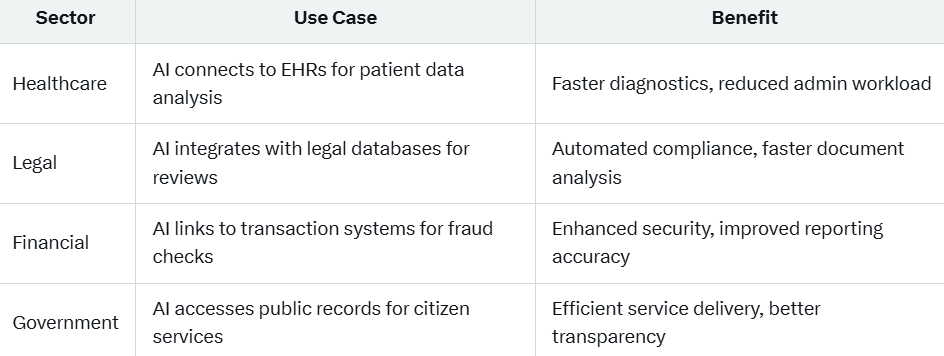
This table highlights MCP’s practical applications, offering a clear view of its potential impact.
Conclusion
The Model Context Protocol (MCP) is set to transform how AI integrates with the tools and systems that power back-office operations. By providing a standardized, open-source solution, MCP eliminates the complexity of custom integrations, unlocking new levels of efficiency and innovation in healthcare, legal, financial, and government sectors. At RediMinds, we’re excited to help our clients leverage MCP to build smarter, more connected AI solutions, driving a future where complexity becomes simplicity.
Ready to explore how MCP can transform your back-office operations? Dive deeper into our AI enablement services and see how RediMinds can help you integrate this groundbreaking technology into your workflows. Contact our team today to start your journey toward a more efficient, innovative future!